AQA · A-Level · Physics
Course version: 7408 · Version from Sept 2016
Students will be expected to know the direction of displacement of…
Full specification wording
Longitudinal and transverse waves: Students will be expected to know the direction of displacement of particles/fields relative to the direction of energy propagation and that all electromagnetic waves travel at the same speed in a vacuum.
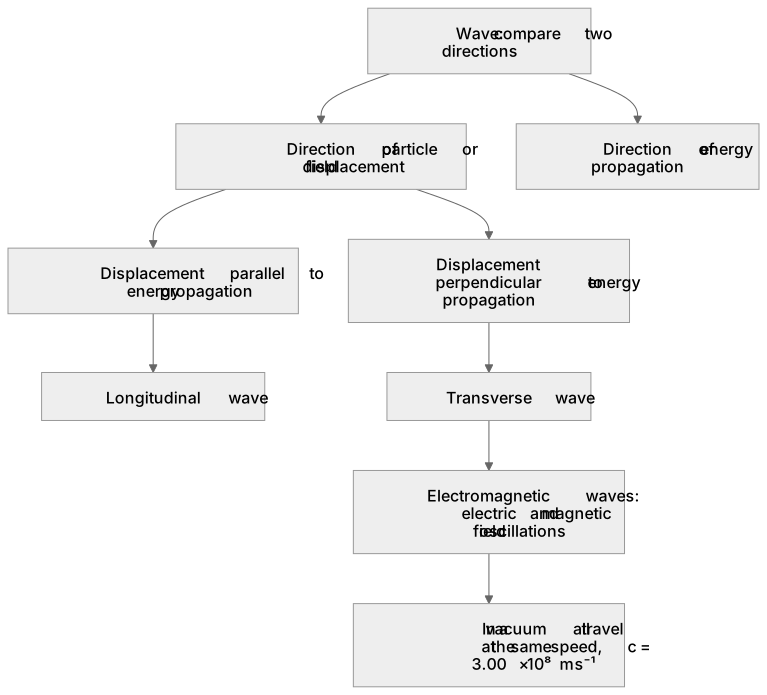
A wave is classified by comparing two directions: the displacement of the oscillating particles or fields, and the direction in which the wave carries energy.
Checked against the AQA 7408 specification (opens in a new tab) on .
- Point 3 of 5
- 4 key terms
Study notes
From the checked teaching notes for this specification point.
The idea
A wave is classified by comparing two directions: the displacement of the oscillating particles or fields, and the direction in which the wave carries energy. In a longitudinal wave the displacement is parallel to energy propagation, as with compressions and rarefactions in sound. In a transverse wave the displacement is perpendicular to energy propagation, as with the electric and magnetic field oscillations of an electromagnetic wave or the vertical motion of a point on a string. Electromagnetic waves form a family from radio to gamma, and in a vacuum every member travels at the same speed, c = 3.00 × 10⁸ m s⁻¹, regardless of frequency or wavelength. In a material medium the speed is lower and depends on the medium.
What earns the marks
- Longitudinal waves have particle or field displacement parallel to the direction of energy propagation.
- Transverse waves have particle or field displacement perpendicular to the direction of energy propagation.
- Classification requires both directions to be stated and compared, not just one of them.
- All electromagnetic waves travel at the same speed in a vacuum, c = 3.00 × 10⁸ m s⁻¹.
- The vacuum speed is independent of frequency and wavelength, so it is a shared property of the whole electromagnetic spectrum.
Common mistakes and how to put them right
Treating the direction of energy propagation as the same as the direction of particle displacement for every wave.
Put it right: Compare the two directions and classify as parallel or perpendicular.
Believing that higher-frequency electromagnetic waves travel faster in a vacuum.
Put it right: All electromagnetic waves have the same vacuum speed, and frequency changes only the wavelength.
Assuming electromagnetic waves slow down in a vacuum as they do in glass or water.
Put it right: The reduced speed occurs in a material medium, not in a vacuum.
Exam tips
- Write the comparison as a full sentence naming both directions, for example displacement is perpendicular to energy propagation.
- Quote the vacuum speed with its value and unit, and state that it applies to all electromagnetic waves.
- If a question gives frequency and wavelength, check whether their product equals the vacuum speed before using the data.
Try the lesson
The start of the Longitudinal and transverse waves: Students will be expected to know the direction of displacement of particles/fields relative to the direction of energy propagation and that all electromagnetic waves travel at the same speed in a vacuum. lesson, made from checked teaching notes for this specification point.
Have a go first
In a transverse wave, what is the direction of the displacement of the particles relative to the direction in which the wave transfers energy?
Listen
A wave is classified by comparing two directions: the displacement of the oscillating particles or fields, and the direction in which the wave carries energy. In a longitudinal wave the displacement is parallel to energy propagation, as with compressions and rarefactions in sound. In a transverse wave the displacement is perpendicular to energy propagation, as with the electric and magnetic field oscillations of an electromagnetic wave or the vertical motion of a point on a string. Electromagnetic waves form a family from radio to gamma, and in a vacuum every member travels at the same speed, c = 3.00 × 10⁸ m s⁻¹, regardless of frequency or wavelength. In a material medium the speed is lower and depends on the medium. A strong answer earns marks for these points. Longitudinal waves have particle or field displacement parallel to the direction of energy propagation. Transverse waves have particle or field displacement perpendicular to the direction of energy propagation. Classification requires both directions to be stated and compared, not just one of them. All electromagnetic waves travel at the same speed in a vacuum, c = 3.00 × 10⁸ m s⁻¹. A common slip: Treating the direction of energy propagation as the same as the direction of particle displacement for every wave. Instead, compare the two directions and classify as parallel or perpendicular. Exam tip: Write the comparison as a full sentence naming both directions, for example displacement is perpendicular to energy propagation.
See it
Key words
Say what each word means before you turn the card.
Longitudinal wave
Try answering aloud or in your head before turning the card.
Transverse wave
Try answering aloud or in your head before turning the card.
Classification of waves
Try answering aloud or in your head before turning the card.
Vacuum speed of electromagnetic waves
Try answering aloud or in your head before turning the card.
See every definition
- Longitudinal wave
- A wave in which the displacement of the oscillating particles or fields is parallel to the direction of energy propagation.
- Transverse wave
- A wave in which the displacement of the oscillating particles or fields is perpendicular to the direction of energy propagation.
- Classification of waves
- Requires both the direction of displacement and the direction of energy propagation to be stated and compared, not just one of them.
- Vacuum speed of electromagnetic waves
- All electromagnetic waves travel at the same speed in a vacuum, c = 3.00 × 10⁸ m s⁻¹, regardless of frequency or wavelength.
Label the diagram
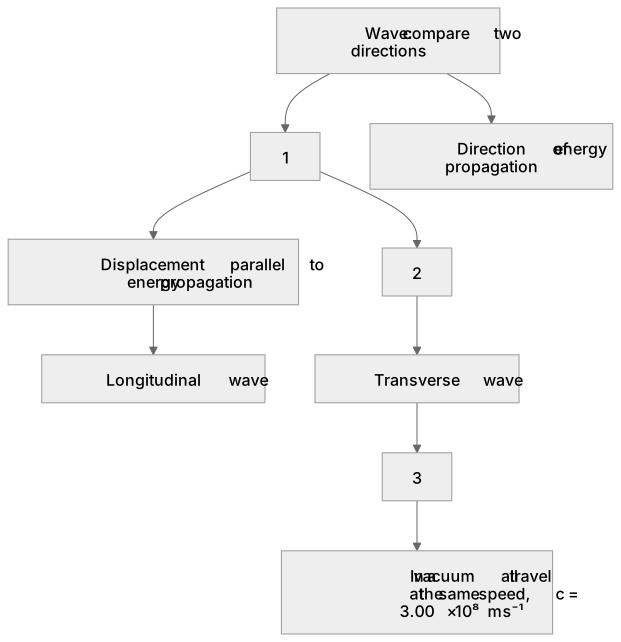
Some boxes have lost their names. Pick the right name for each number.
1Box 1
2Box 2
3Box 3
There is more to this lesson
The full lesson goes on to check your understanding and help you earn the marks. Create a free account to carry on, with your progress saved.
A week of Premium from your first lesson · Then the free plan continues · No card, no charge
Test your understanding of Longitudinal and transverse waves: Students will be expected to know the direction of displacement of particles/fields relative to the direction of energy propagation and that all electromagnetic waves travel at the same speed in a vacuum.
Active recall beats re-reading. Take an instant quiz now to test what you’ve learned and lock it into long-term memory.
A week of Premium from your first lesson · Then the free plan continues · No card, no charge