AQA · A-Level · Physics
Course version: 7408 · Version from Sept 2016
Magnetic flux defined by Φ = BA where B is normal to A.
Full specification wording
Magnetic flux and flux linkage (A-level only): Magnetic flux defined by Φ = BA where B is normal to A.
Magnetic flux Φ quantifies the magnetic field passing through a surface.
Checked against the AQA 7408 specification (opens in a new tab) on .
- Point 1 of 3
- 4 key terms
Study notes
From the checked teaching notes for this specification point.
The idea
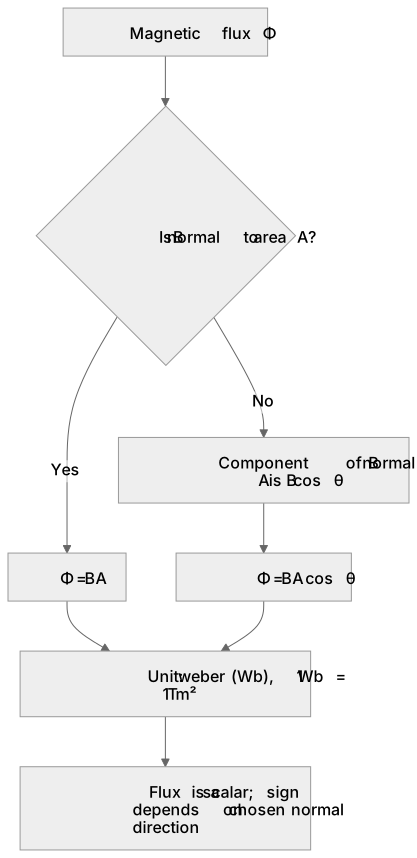
Magnetic flux Φ quantifies the magnetic field passing through a surface. It is defined as Φ = BA only when the magnetic field B is perpendicular (normal) to the area A. If B is at an angle θ to the normal, the component of B perpendicular to the area is B cos θ, so Φ = BA cos θ. The SI unit of flux is the weber (Wb), where 1 Wb = 1 T m². For example, a uniform field of 0.50 T through a rectangular coil of area 0.020 m² gives Φ = 0.50 × 0.020 = 0.010 Wb. If the coil is tilted so its normal makes 60° with B, then Φ = 0.50 × 0.020 × cos 60° = 0.0050 Wb. Flux is a scalar and can be positive or negative depending on the chosen direction for the normal. Understanding this definition is essential for later work on flux linkage and electromagnetic induction.
What earns the marks
- States that magnetic flux Φ is the product of magnetic flux density B and the area A when B is perpendicular to A.
- Uses the correct SI units: tesla (T) for B, square metre (m²) for A, and weber (Wb) for Φ.
- Applies Φ = BA cos θ when the field is not normal to the area, identifying θ as the angle between B and the normal to the area.
- Calculates flux correctly for a given uniform field and area, including appropriate significant figures and units.
- Explains that flux is a scalar quantity and that its sign depends on the direction chosen for the area normal.
Common mistakes and how to put them right
Using the angle between B and the plane of the area instead of the angle between B and the normal to the area.
Put it right: Use θ measured from the normal, so Φ = BA cos θ.
Forgetting to convert area to square metres when dimensions are given in centimetres or millimetres.
Put it right: Convert all lengths to metres before calculating area.
Treating flux as a vector and attempting to add fluxes vectorially.
Put it right: Recognise that flux is a scalar and is added algebraically, taking account of sign conventions.
Exam tips
- Always check that the field is perpendicular to the area before using Φ = BA; if not, resolve the field using cos θ.
- Write the unit of flux as Wb and show that it is equivalent to T m² to avoid unit errors.
- Sketch the area and mark the normal clearly, especially when the field is at an angle, to avoid using the wrong angle.
Try the lesson
The start of the Magnetic flux and flux linkage (A-level only): Magnetic flux defined by Φ = BA where B is normal to A. lesson, made from checked teaching notes for this specification point.
Have a go first
A uniform magnetic field of flux density 0.40 T acts at right angles to a flat rectangular coil of area 0.025 m². Calculate the magnetic flux through the coil.
Listen
Magnetic flux Φ quantifies the magnetic field passing through a surface. It is defined as Φ = BA only when the magnetic field B is perpendicular (normal) to the area A. If B is at an angle θ to the normal, the component of B perpendicular to the area is B cos θ, so Φ = BA cos θ. The SI unit of flux is the weber (Wb), where 1 Wb = 1 T m². For example, a uniform field of 0.50 T through a rectangular coil of area 0.020 m² gives Φ = 0.50 × 0.020 = 0.010 Wb. If the coil is tilted so its normal makes 60° with B, then Φ = 0.50 × 0.020 × cos 60° = 0.0050 Wb. Flux is a scalar and can be positive or negative depending on the chosen direction for the normal. Understanding this definition is essential for later work on flux linkage and electromagnetic induction. A strong answer earns marks for these points. States that magnetic flux Φ is the product of magnetic flux density B and the area A when B is perpendicular to A. Uses the correct SI units: tesla (T) for B, square metre (m²) for A, and weber (Wb) for Φ. Applies Φ = BA cos θ when the field is not normal to the area, identifying θ as the angle between B and the normal to the area. Calculates flux correctly for a given uniform field and area, including appropriate significant figures and units. A common slip: Using the angle between B and the plane of the area instead of the angle between B and the normal to the area. Instead, use θ measured from the normal, so Φ = BA cos θ. Exam tip: Always check that the field is perpendicular to the area before using Φ = BA; if not, resolve the field using cos θ.
See it
Key words
Say what each word means before you turn the card.
Magnetic flux
Try answering aloud or in your head before turning the card.
Φ = BA
Try answering aloud or in your head before turning the card.
Φ = BA cos θ
Try answering aloud or in your head before turning the card.
Weber (Wb)
Try answering aloud or in your head before turning the card.
See every definition
- Magnetic flux
- Quantifies the magnetic field passing through a surface, defined by Φ = BA where B is normal to A.
- Φ = BA
- The definition used only when the magnetic field B is perpendicular (normal) to the area A.
- Φ = BA cos θ
- The expression used when B is at an angle θ to the normal, taking the component of B perpendicular to the area as B cos θ.
- Weber (Wb)
- The SI unit of flux, where 1 Wb = 1 T m².
There is more to this lesson
The full lesson goes on to check your understanding and help you earn the marks. Create a free account to carry on, with your progress saved.
A week of Premium from your first lesson · Then the free plan continues · No card, no charge
Test your understanding of Magnetic flux and flux linkage (A-level only): Magnetic flux defined by Φ = BA where B is normal to A.
Active recall beats re-reading. Take an instant quiz now to test what you’ve learned and lock it into long-term memory.
A week of Premium from your first lesson · Then the free plan continues · No card, no charge