AQA · A-Level · Physics
Course version: 7408 · Version from Sept 2016
Brownian motion as evidence for existence of atoms.
Full specification wording
Molecular kinetic theory model (A-level only): Brownian motion as evidence for existence of atoms.
Brownian motion is the random, jerky movement of small particles such as smoke particles or pollen grains suspended in a fluid.
Checked against the AQA 7408 specification (opens in a new tab) on .
- Point 1 of 5
- 4 key terms
Study notes
From the checked teaching notes for this specification point.
The idea
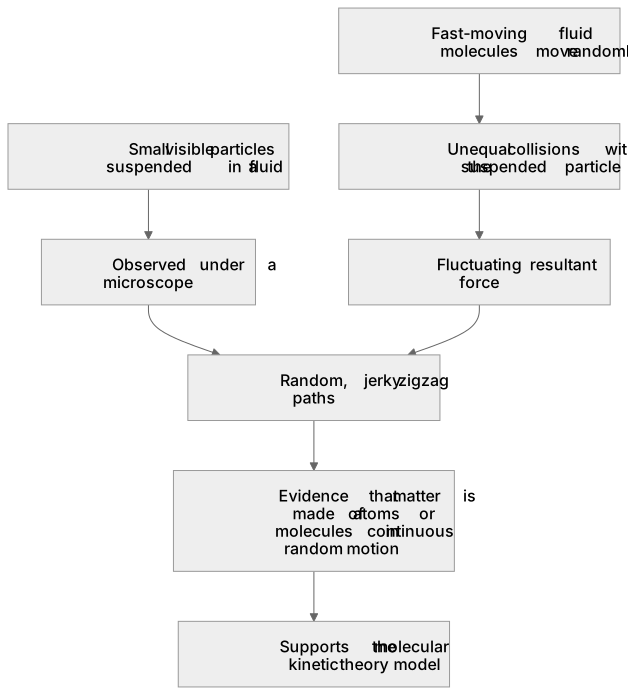
Brownian motion is the random, jerky movement of small particles such as smoke particles or pollen grains suspended in a fluid. Under a microscope, the particles move in unpredictable zigzag paths. This motion is explained by collisions with much smaller, fast-moving fluid molecules. Because the molecules move randomly and collide unevenly from different directions, the suspended particle experiences a fluctuating resultant force. The effect is stronger for smaller particles and higher temperatures. Brownian motion provides direct evidence that matter is made of atoms or molecules in continuous random motion, supporting the molecular kinetic theory model. It does not prove the exact size of atoms, but it is strong evidence for their existence and movement.
What earns the marks
- Brownian motion is the random, irregular movement of small visible particles suspended in a fluid, observed as a jerky zigzag path under a microscope.
- The motion is caused by unequal collisions between the suspended particle and fast-moving fluid molecules, producing a fluctuating resultant force.
- The random nature of the motion reflects the random motion of the fluid molecules, so it provides evidence that molecules are in constant random motion.
- Brownian motion supports the existence of atoms and molecules because the visible particle moves only if it is bombarded by smaller unseen particles.
- The effect is more noticeable with smaller suspended particles and at higher temperatures, because collisions are more frequent and energetic.
- Brownian motion is consistent with the molecular kinetic theory model, in which gas or liquid particles move randomly and collide with each other and with surfaces.
Common mistakes and how to put them right
Saying that Brownian motion is the movement of atoms themselves.
Put it right: It is the movement of larger suspended particles caused by collisions with atoms or molecules.
Claiming that Brownian motion proves the size or shape of atoms.
Put it right: It provides evidence for their existence and random motion, not their exact dimensions.
Describing the motion as smooth or predictable.
Put it right: It is random and jerky, with changes in direction caused by uneven molecular collisions.
Exam tips
- Link the observation to the explanation: random jerky motion of a visible particle is caused by uneven collisions with invisible molecules.
- Use the phrase 'evidence for the existence of atoms' rather than 'proof', because scientific evidence supports a model.
- Mention one factor that affects the motion, such as particle size or temperature, and explain its effect in terms of collisions.
Try the lesson
The start of the Molecular kinetic theory model (A-level only): Brownian motion as evidence for existence of atoms. lesson, made from checked teaching notes for this specification point.
Have a go first
What causes the random, jerky movement of smoke particles observed in Brownian motion?
Listen
Brownian motion is the random, jerky movement of small particles such as smoke particles or pollen grains suspended in a fluid. Under a microscope, the particles move in unpredictable zigzag paths. This motion is explained by collisions with much smaller, fast-moving fluid molecules. Because the molecules move randomly and collide unevenly from different directions, the suspended particle experiences a fluctuating resultant force. The effect is stronger for smaller particles and higher temperatures. Brownian motion provides direct evidence that matter is made of atoms or molecules in continuous random motion, supporting the molecular kinetic theory model. It does not prove the exact size of atoms, but it is strong evidence for their existence and movement. A strong answer earns marks for these points. Brownian motion is the random, irregular movement of small visible particles suspended in a fluid, observed as a jerky zigzag path under a microscope. The motion is caused by unequal collisions between the suspended particle and fast-moving fluid molecules, producing a fluctuating resultant force. The random nature of the motion reflects the random motion of the fluid molecules, so it provides evidence that molecules are in constant random motion. Brownian motion supports the existence of atoms and molecules because the visible particle moves only if it is bombarded by smaller unseen particles. A common slip: Saying that Brownian motion is the movement of atoms themselves. Instead, it is the movement of larger suspended particles caused by collisions with atoms or molecules. Exam tip: Link the observation to the explanation: random jerky motion of a visible particle is caused by uneven collisions with invisible molecules.
See it
Key words
Say what each word means before you turn the card.
Brownian motion
Try answering aloud or in your head before turning the card.
Random molecular motion
Try answering aloud or in your head before turning the card.
Collisions and resultant forces
Try answering aloud or in your head before turning the card.
Kinetic theory and observation
Try answering aloud or in your head before turning the card.
See every definition
- Brownian motion
- The random, jerky movement of small particles such as smoke particles or pollen grains suspended in a fluid, seen as unpredictable zigzag paths under a microscope.
- Random molecular motion
- Fluid molecules move randomly and collide unevenly from different directions, so a suspended particle experiences a fluctuating resultant force.
- Collisions and resultant forces
- Unequal collisions between the suspended particle and fast-moving fluid molecules produce a fluctuating resultant force on the particle.
- Kinetic theory and observation
- Brownian motion provides direct evidence that matter is made of atoms or molecules in continuous random motion, supporting the molecular kinetic theory model.
Label the diagram
Some boxes have lost their names. Pick the right name for each number.
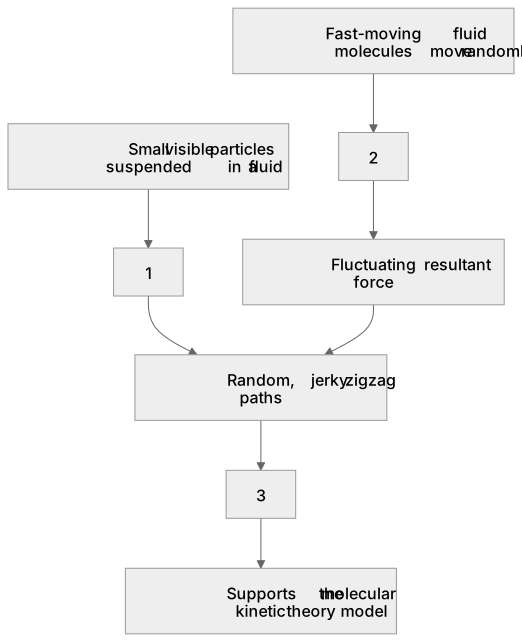
1Box 1
2Box 2
3Box 3
There is more to this lesson
The full lesson goes on to check your understanding and help you earn the marks. Create a free account to carry on, with your progress saved.
A week of Premium from your first lesson · Then the free plan continues · No card, no charge
Test your understanding of Molecular kinetic theory model (A-level only): Brownian motion as evidence for existence of atoms.
Active recall beats re-reading. Take an instant quiz now to test what you’ve learned and lock it into long-term memory.
A week of Premium from your first lesson · Then the free plan continues · No card, no charge