AQA · A-Level · Physics
Course version: 7408 · Version from Sept 2016
Momentum: momentum = mass × velocity Conservation of linear momentum.
Momentum is a vector quantity defined by p = mv, where p is momentum in kg m s⁻¹, m is mass in kg and v is velocity in m s⁻¹.
Checked against the AQA 7408 specification (opens in a new tab) on .
- Point 1 of 6
- 4 key terms
Study notes
From the checked teaching notes for this specification point.
The idea
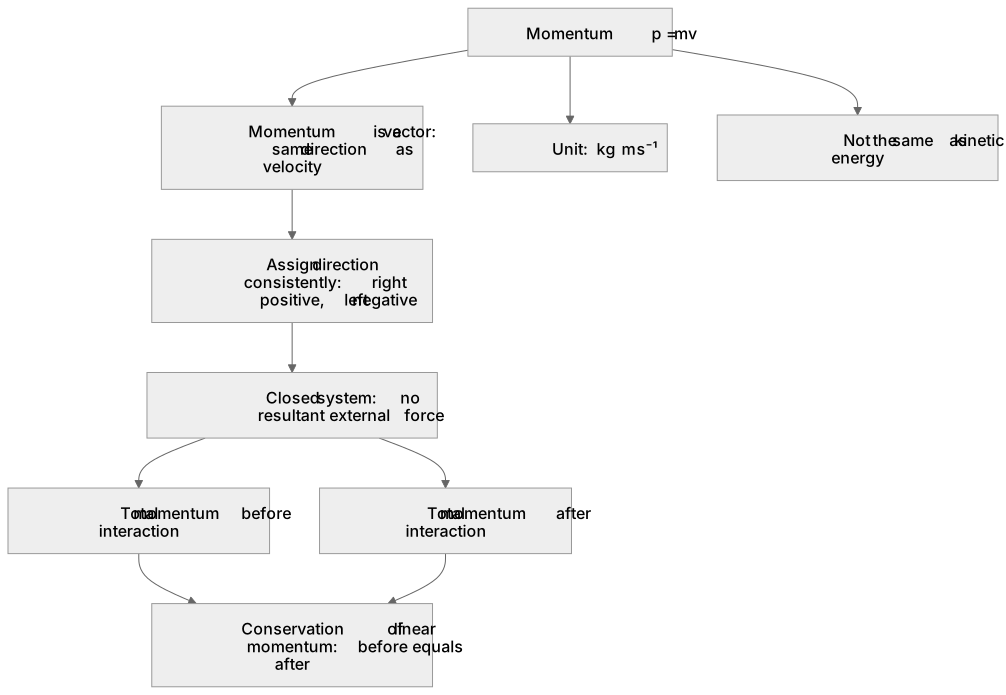
Momentum is a vector quantity defined by p = mv, where p is momentum in kg m s⁻¹, m is mass in kg and v is velocity in m s⁻¹. Because velocity carries direction, momentum has the same direction as the velocity. In a closed system with no resultant external force, total momentum before an interaction equals total momentum after it: this is conservation of linear momentum. For example, two trolleys collide on a frictionless track; the vector sum of their momenta is unchanged. Momentum is not the same as kinetic energy: a heavy slow object can have large momentum but small kinetic energy. Conservation follows from Newton's third law and the equal contact times of the forces.
What earns the marks
- State that momentum is the product of mass and velocity, p = mv, and give the unit kg m s⁻¹.
- Recognise momentum as a vector and assign direction consistently, for example taking right as positive and left as negative.
- Define a closed system as one on which no resultant external force acts, so total momentum is conserved.
- Apply conservation by equating total momentum before an interaction to total momentum after it, including signs.
- Distinguish momentum from kinetic energy, noting that momentum depends on velocity while kinetic energy depends on speed squared.
Common mistakes and how to put them right
Treating momentum as a scalar and adding magnitudes regardless of direction.
Put it right: Assign a positive or negative sign to each velocity before summing.
Confusing momentum with kinetic energy and using ½mv² in a momentum calculation.
Put it right: Use p = mv and reserve ½mv² for energy.
Assuming momentum is conserved when a significant external force acts, such as friction or a thrust.
Put it right: Check that the system is closed before applying conservation.
Exam tips
- Write the vector direction convention explicitly before substituting values, for example 'taking right as positive'.
- Show the momentum of each object separately before and after the interaction, then form the conservation equation.
- Check units and significant figures at the end, and state the direction of any final velocity.
Try the lesson
The start of the Momentum: momentum = mass × velocity Conservation of linear momentum. lesson, made from checked teaching notes for this specification point.
Have a go first
A trolley of mass 5.0 kg moves in a straight line at a velocity of 2.0 m/s. Calculate the momentum of the trolley.
Listen
Momentum is a vector quantity defined by p = mv, where p is momentum in kg m s⁻¹, m is mass in kg and v is velocity in m s⁻¹. Because velocity carries direction, momentum has the same direction as the velocity. In a closed system with no resultant external force, total momentum before an interaction equals total momentum after it: this is conservation of linear momentum. For example, two trolleys collide on a frictionless track; the vector sum of their momenta is unchanged. Momentum is not the same as kinetic energy: a heavy slow object can have large momentum but small kinetic energy. Conservation follows from Newton's third law and the equal contact times of the forces. A strong answer earns marks for these points. State that momentum is the product of mass and velocity, p = mv, and give the unit kg m s⁻¹. Recognise momentum as a vector and assign direction consistently, for example taking right as positive and left as negative. Define a closed system as one on which no resultant external force acts, so total momentum is conserved. Apply conservation by equating total momentum before an interaction to total momentum after it, including signs. A common slip: Treating momentum as a scalar and adding magnitudes regardless of direction. Instead, assign a positive or negative sign to each velocity before summing. Exam tip: Write the vector direction convention explicitly before substituting values, for example 'taking right as positive'.
See it
Key words
Say what each word means before you turn the card.
Momentum
Try answering aloud or in your head before turning the card.
Conservation of linear momentum
Try answering aloud or in your head before turning the card.
Closed system
Try answering aloud or in your head before turning the card.
Vector
Try answering aloud or in your head before turning the card.
See every definition
- Momentum
- The product of mass and velocity, p = mv, measured in kg m s⁻¹.
- Conservation of linear momentum
- In a closed system with no resultant external force, total momentum before an interaction equals total momentum after it.
- Closed system
- A system on which no resultant external force acts, so total momentum is conserved.
- Vector
- A quantity that carries direction, so momentum has the same direction as the velocity.
Label the diagram
Some boxes have lost their names. Pick the right name for each number.
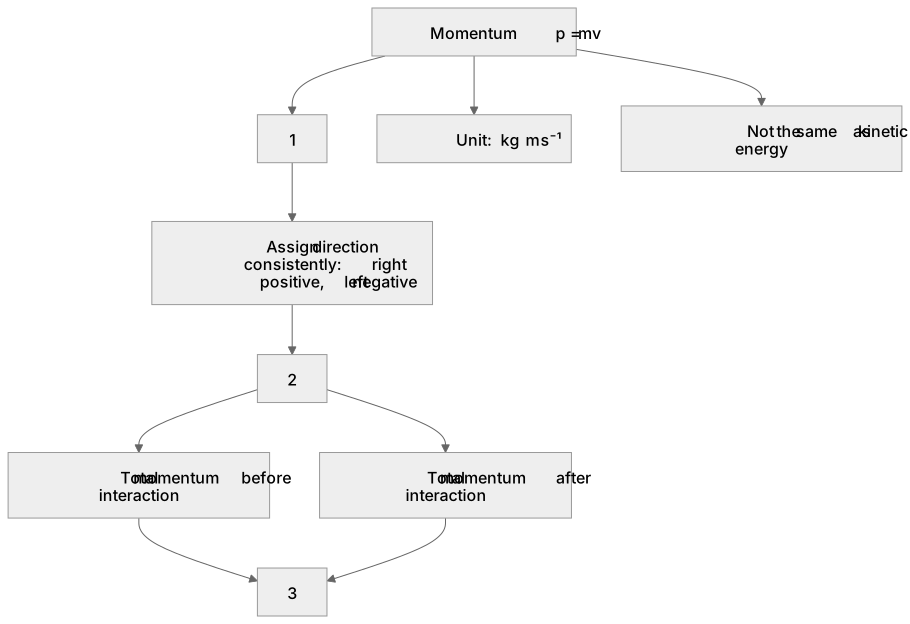
1Box 1
2Box 2
3Box 3
There is more to this lesson
The full lesson goes on to check your understanding and help you earn the marks. Create a free account to carry on, with your progress saved.
A week of Premium from your first lesson · Then the free plan continues · No card, no charge
Test your understanding of Momentum: momentum = mass × velocity Conservation of linear momentum.
Active recall beats re-reading. Take an instant quiz now to test what you’ve learned and lock it into long-term memory.
A week of Premium from your first lesson · Then the free plan continues · No card, no charge