AQA · A-Level · Physics
Course version: 7408 · Version from Sept 2016
Simplified structure, behaviour and characteristics.
Full specification wording
MOSFET (metal-oxide semiconducting field-effect transistor) (A-level only): Simplified structure, behaviour and characteristics.
A MOSFET is a voltage-controlled device built on a semiconductor substrate.
Checked against the AQA 7408 specification (opens in a new tab) on .
- Point 1 of 3
- 4 key terms
Study notes
From the checked teaching notes for this specification point.
The idea
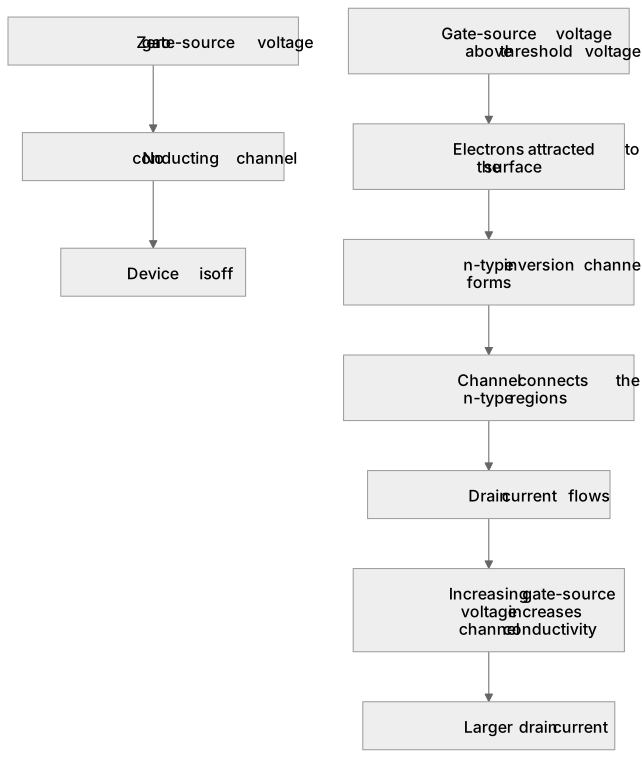
A MOSFET is a voltage-controlled device built on a semiconductor substrate. In the simplified enhancement n-channel picture, two n-type regions are separated by a p-type channel gap, with a thin insulating oxide layer and a metal gate above. With zero gate-source voltage no conducting channel exists, so the device is off. Raising the gate-source voltage above the threshold voltage attracts electrons to the surface, forming an n-type inversion channel that connects the two regions and allows current to flow. The gate draws almost no steady current because the oxide insulates it, giving very high input resistance. Increasing the gate-source voltage increases channel conductivity, so a small input voltage controls a larger drain current. This makes the MOSFET useful as a voltage amplifier and as a fast electronic switch.
What earns the marks
- Identifies the three terminals and the role of each: gate controls conduction, source and drain are the main current-carrying terminals.
- Describes the insulating oxide layer between gate and channel, explaining the very high input resistance and negligible steady gate current.
- Explains enhancement behaviour: no channel at zero gate-source voltage, and channel formation once the gate-source voltage exceeds the threshold voltage.
- Relates gate-source voltage to channel width and conductivity, so drain current increases as gate-source voltage increases.
- Distinguishes voltage-controlled operation from current-controlled operation in a bipolar transistor.
- Applies the device as a switch (off below threshold, on above it) or as an amplifier (small gate signal controlling a larger drain current).
Common mistakes and how to put them right
Treating the gate as a terminal that passes a large steady current.
Put it right by stressing that the oxide insulator makes gate current negligible.
Assuming a conducting channel exists at zero gate-source voltage.
Put it right by stating that an enhancement MOSFET needs a gate-source voltage above threshold.
Confusing the source and drain roles or reversing the polarity needed for an n-channel device.
Put it right by linking terminal names to the direction of conventional current and carrier type.
Exam tips
- Sketch a labelled cross-section showing substrate, oxide, gate, source and drain before writing any explanation.
- Use the phrase voltage-controlled in answers and contrast it explicitly with current-controlled bipolar operation.
- When describing switching, state the threshold condition and what happens to drain current on each side of it.
Try the lesson
The start of the MOSFET (metal-oxide semiconducting field-effect transistor) (A-level only): Simplified structure, behaviour and characteristics. lesson, made from checked teaching notes for this specification point.
Have a go first
In a simplified n-channel enhancement MOSFET, which layer separates the metal gate contact from the semiconductor channel?
Listen
A MOSFET is a voltage-controlled device built on a semiconductor substrate. In the simplified enhancement n-channel picture, two n-type regions are separated by a p-type channel gap, with a thin insulating oxide layer and a metal gate above. With zero gate-source voltage no conducting channel exists, so the device is off. Raising the gate-source voltage above the threshold voltage attracts electrons to the surface, forming an n-type inversion channel that connects the two regions and allows current to flow. The gate draws almost no steady current because the oxide insulates it, giving very high input resistance. Increasing the gate-source voltage increases channel conductivity, so a small input voltage controls a larger drain current. This makes the MOSFET useful as a voltage amplifier and as a fast electronic switch. A strong answer earns marks for these points. Identifies the three terminals and the role of each: gate controls conduction, source and drain are the main current-carrying terminals. Describes the insulating oxide layer between gate and channel, explaining the very high input resistance and negligible steady gate current. Explains enhancement behaviour: no channel at zero gate-source voltage, and channel formation once the gate-source voltage exceeds the threshold voltage. Relates gate-source voltage to channel width and conductivity, so drain current increases as gate-source voltage increases. A common slip: Treating the gate as a terminal that passes a large steady current. Instead, stressing that the oxide insulator makes gate current negligible. Exam tip: Sketch a labelled cross-section showing substrate, oxide, gate, source and drain before writing any explanation.
See it
Key words
Say what each word means before you turn the card.
Voltage-controlled device
Try answering aloud or in your head before turning the card.
Threshold voltage
Try answering aloud or in your head before turning the card.
n-type inversion channel
Try answering aloud or in your head before turning the card.
Insulating oxide layer
Try answering aloud or in your head before turning the card.
See every definition
- Voltage-controlled device
- A device in which a gate-source voltage controls conduction, rather than a current controlling it.
- Threshold voltage
- The gate-source voltage above which electrons are attracted to the surface and an n-type inversion channel forms.
- n-type inversion channel
- A conducting channel formed at the surface when the gate-source voltage exceeds the threshold voltage, connecting the two n-type regions and allowing current to flow.
- Insulating oxide layer
- A thin layer between gate and channel that insulates the gate, giving very high input resistance and negligible steady gate current.
Label the diagram
Some boxes have lost their names. Pick the right name for each number.
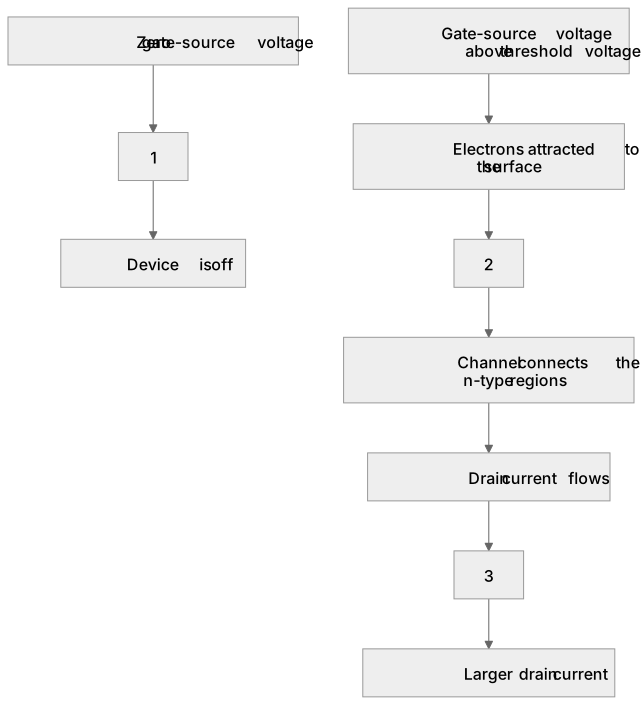
1Box 1
2Box 2
3Box 3
There is more to this lesson
The full lesson goes on to check your understanding and help you earn the marks. Create a free account to carry on, with your progress saved.
A week of Premium from your first lesson · Then the free plan continues · No card, no charge
Test your understanding of MOSFET (metal-oxide semiconducting field-effect transistor) (A-level only): Simplified structure, behaviour and characteristics.
Active recall beats re-reading. Take an instant quiz now to test what you’ve learned and lock it into long-term memory.
A week of Premium from your first lesson · Then the free plan continues · No card, no charge