AQA · A-Level · Physics
Course version: 7408 · Version from Sept 2016
Use in N-channel, enhancement mode only is required.
Full specification wording
MOSFET (metal-oxide semiconducting field-effect transistor) (A-level only): Use in N-channel, enhancement mode only is required.
The specification restricts MOSFET work to the N-channel enhancement type, so you must recognise its structure and explain why it needs a positive gate-source voltage to conduct.
Checked against the AQA 7408 specification (opens in a new tab) on .
- Point 3 of 3
- 4 key terms
Study notes
From the checked teaching notes for this specification point.
The idea
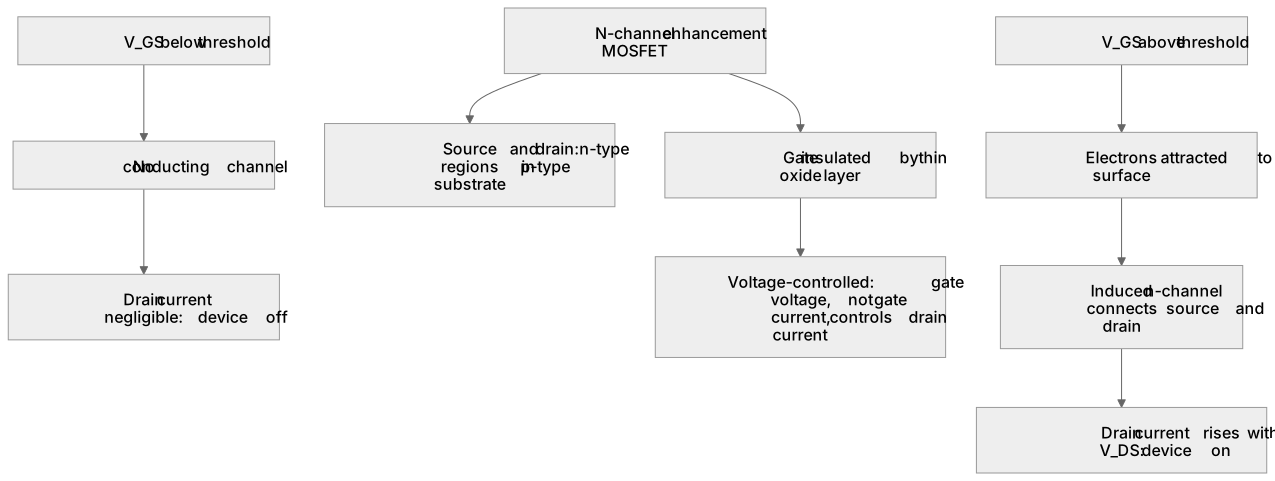
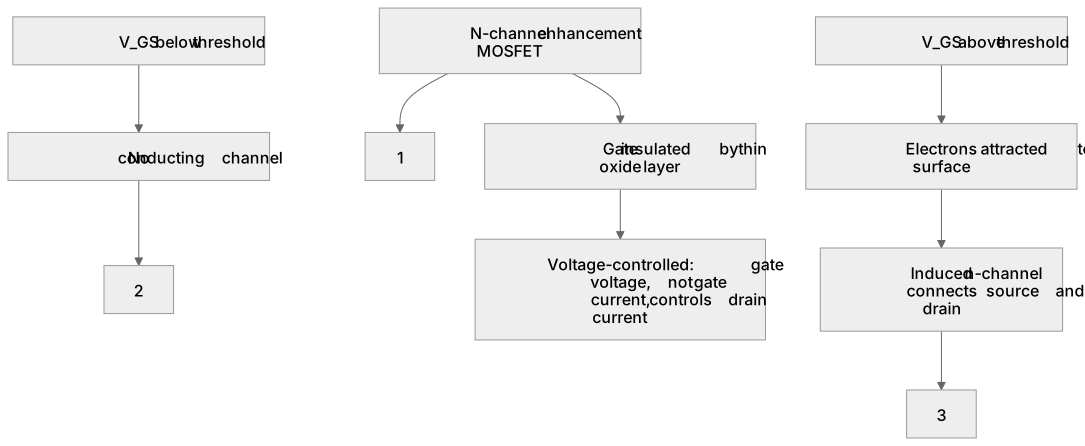
The specification restricts MOSFET work to the N-channel enhancement type, so you must recognise its structure and explain why it needs a positive gate-source voltage to conduct. In an N-channel device the source and drain are n-type regions in a p-type substrate; a thin insulating oxide layer separates the gate. With V_GS below the threshold voltage no conducting channel exists, so drain current is negligible. Raising V_GS above threshold attracts electrons to the surface, forming an induced n-channel that connects source and drain, and I_D then rises with V_DS. You should be able to describe this in terms of field effect and charge carriers, sketch the transfer characteristic, and use the device as a voltage-controlled switch or amplifier.
What earns the marks
- Identifies the source and drain as n-type regions formed within a p-type substrate, with a metal or polysilicon gate insulated by a thin oxide layer.
- Explains that a positive gate-source voltage above the threshold value induces an n-type conducting channel between source and drain.
- States that below threshold no channel exists, so the drain current is effectively zero and the device is off.
- Describes the MOSFET as a voltage-controlled device because the gate voltage, not a gate current, controls the drain current.
- Uses the transfer characteristic to show drain current rising once V_GS exceeds the threshold voltage.
- Applies the device as a switch, identifying the off state below threshold and the on state above it.
Common mistakes and how to put them right
Treating the gate as a forward-biased junction that draws steady current.
Put it right: The oxide insulates the gate, so gate current is negligible and control is by electric field.
Assuming any positive gate voltage switches the device on; the correction is that conduction begins only above the threshold voltage.
Confusing enhancement behaviour with depletion behaviour by expecting a channel at zero gate-source voltage.
Put it right: An enhancement MOSFET requires a gate-source voltage above threshold to form its channel.
Exam tips
- Sketch the transfer characteristic with V_GS on the horizontal axis and I_D on the vertical axis, marking the threshold voltage clearly.
- Use the phrase voltage-controlled when contrasting the MOSFET with a bipolar transistor, and link it to the insulated gate.
- When describing switching, state the gate-source voltage condition for each state rather than saying simply on or off.
Try the lesson
The start of the MOSFET (metal-oxide semiconducting field-effect transistor) (A-level only): Use in N-channel, enhancement mode only is required. lesson, made from checked teaching notes for this specification point.
Have a go first
An N-channel enhancement mode MOSFET has a threshold voltage of +2.0 V. Which of the following gate-source voltages would result in a conducting channel?
Listen
The specification restricts MOSFET work to the N-channel enhancement type, so you must recognise its structure and explain why it needs a positive gate-source voltage to conduct. In an N-channel device the source and drain are n-type regions in a p-type substrate; a thin insulating oxide layer separates the gate. With V_GS below the threshold voltage no conducting channel exists, so drain current is negligible. Raising V_GS above threshold attracts electrons to the surface, forming an induced n-channel that connects source and drain, and I_D then rises with V_DS. You should be able to describe this in terms of field effect and charge carriers, sketch the transfer characteristic, and use the device as a voltage-controlled switch or amplifier. A strong answer earns marks for these points. Identifies the source and drain as n-type regions formed within a p-type substrate, with a metal or polysilicon gate insulated by a thin oxide layer. Explains that a positive gate-source voltage above the threshold value induces an n-type conducting channel between source and drain. States that below threshold no channel exists, so the drain current is effectively zero and the device is off. Describes the MOSFET as a voltage-controlled device because the gate voltage, not a gate current, controls the drain current. A common slip: Treating the gate as a forward-biased junction that draws steady current. Instead, the oxide insulates the gate, so gate current is negligible and control is by electric field. Exam tip: Sketch the transfer characteristic with V_GS on the horizontal axis and I_D on the vertical axis, marking the threshold voltage clearly.
See it
Key words
Say what each word means before you turn the card.
Threshold voltage
Try answering aloud or in your head before turning the card.
Induced n-channel
Try answering aloud or in your head before turning the card.
Voltage-controlled device
Try answering aloud or in your head before turning the card.
Enhancement MOSFET
Try answering aloud or in your head before turning the card.
See every definition
- Threshold voltage
- The gate-source voltage above which electrons are attracted to the surface, forming an induced n-channel that connects source and drain.
- Induced n-channel
- A conducting channel formed between source and drain when a positive gate-source voltage above threshold attracts electrons to the surface.
- Voltage-controlled device
- A device in which the gate voltage, not a gate current, controls the drain current, because the oxide insulates the gate.
- Enhancement MOSFET
- A device that requires a gate-source voltage above threshold to form its channel, so no channel exists at zero gate-source voltage.
Label the diagram
Some boxes have lost their names. Pick the right name for each number.
1Box 1
2Box 2
3Box 3
There is more to this lesson
The full lesson goes on to check your understanding and help you earn the marks. Create a free account to carry on, with your progress saved.
A week of Premium from your first lesson · Then the free plan continues · No card, no charge
Test your understanding of MOSFET (metal-oxide semiconducting field-effect transistor) (A-level only): Use in N-channel, enhancement mode only is required.
Active recall beats re-reading. Take an instant quiz now to test what you’ve learned and lock it into long-term memory.
A week of Premium from your first lesson · Then the free plan continues · No card, no charge