AQA · A-Level · Physics
Course version: 7408 · Version from Sept 2016
The reasons why Newton’s theory was preferred.
Full specification wording
Newton’s corpuscular theory of light (A-level only): The reasons why Newton’s theory was preferred.
Newton’s corpuscular theory dominated for over a century for reasons that were as much about authority and evidence as about physics.
Checked against the AQA 7408 specification (opens in a new tab) on .
- Point 2 of 2
- 4 key terms
Study notes
From the checked teaching notes for this specification point.
The idea
Newton’s corpuscular theory dominated for over a century for reasons that were as much about authority and evidence as about physics. Newton was held in enormous scientific esteem, and his model fitted the observations then available: light travels in straight lines, casts sharp shadows, reflects predictably and refracts at a boundary. The wave theory of Huygens also predicted refraction, but it appeared to require a medium, the aether, and it seemed to imply that light could bend around obstacles, which was not obvious in everyday observation. Crucially, decisive evidence for interference and diffraction came later, so the particle model was not displaced until those experiments were performed and understood.
What earns the marks
- Explains that Newton’s high scientific reputation made his particle model highly influential.
- States that the corpuscular model accounted for straight-line travel, sharp shadows and reflection, which matched everyday observations.
- Notes that the particle model could also account for refraction at a boundary, so it was not immediately contradicted by simple optical experiments.
- Explains that the wave model appeared to need a medium, the aether, whose properties were uncertain.
- Notes that clear evidence for interference and diffraction, which the wave model explains, was not available until later experiments.
- Recognises that scientific theories are accepted or rejected on the basis of available evidence as well as the standing of their proponents.
Common mistakes and how to put them right
Saying Newton’s theory was preferred purely because it was correct.
Put it right: It was preferred because it fitted the evidence then available and because of Newton’s authority.
Claiming that no one had ever observed diffraction before the nineteenth century.
Put it right: Relevant effects were observed, but their significance for the nature of light was not established until later.
Stating that the aether was proved not to exist by Newton.
Put it right: The aether idea persisted into later physics and was abandoned only after further experimental and theoretical developments.
Exam tips
- Link each reason to a specific piece of evidence or to the state of knowledge at the time.
- Avoid presenting the preference as a simple mistake; explain it as a reasonable judgement given the evidence available.
- Use words such as authority, available evidence and aether to show awareness of the historical context.
Try the lesson
The start of the Newton’s corpuscular theory of light (A-level only): The reasons why Newton’s theory was preferred. lesson, made from checked teaching notes for this specification point.
Have a go first
Which feature of Newton’s corpuscular theory helped it to become the preferred theory of light for many years?
Listen
Newton’s corpuscular theory dominated for over a century for reasons that were as much about authority and evidence as about physics. Newton was held in enormous scientific esteem, and his model fitted the observations then available: light travels in straight lines, casts sharp shadows, reflects predictably and refracts at a boundary. The wave theory of Huygens also predicted refraction, but it appeared to require a medium, the aether, and it seemed to imply that light could bend around obstacles, which was not obvious in everyday observation. Crucially, decisive evidence for interference and diffraction came later, so the particle model was not displaced until those experiments were performed and understood. A strong answer earns marks for these points. Explains that Newton’s high scientific reputation made his particle model highly influential. States that the corpuscular model accounted for straight-line travel, sharp shadows and reflection, which matched everyday observations. Notes that the particle model could also account for refraction at a boundary, so it was not immediately contradicted by simple optical experiments. Explains that the wave model appeared to need a medium, the aether, whose properties were uncertain. A common slip: Saying Newton’s theory was preferred purely because it was correct. Instead, it was preferred because it fitted the evidence then available and because of Newton’s authority. Exam tip: Link each reason to a specific piece of evidence or to the state of knowledge at the time.
See it

Key words
Say what each word means before you turn the card.
Authority in science
Try answering aloud or in your head before turning the card.
The aether and the medium for light
Try answering aloud or in your head before turning the card.
Theory change in physics
Try answering aloud or in your head before turning the card.
Scientific method and evidence
Try answering aloud or in your head before turning the card.
See every definition
- Authority in science
- Newton was held in enormous scientific esteem, and this made his particle model highly influential.
- The aether and the medium for light
- The wave theory appeared to require a medium, the aether, whose properties were uncertain.
- Theory change in physics
- The particle model was not displaced until decisive evidence for interference and diffraction was performed and understood.
- Scientific method and evidence
- Theories are accepted or rejected on the basis of available evidence as well as the standing of their proponents.
Label the diagram
Some boxes have lost their names. Pick the right name for each number.
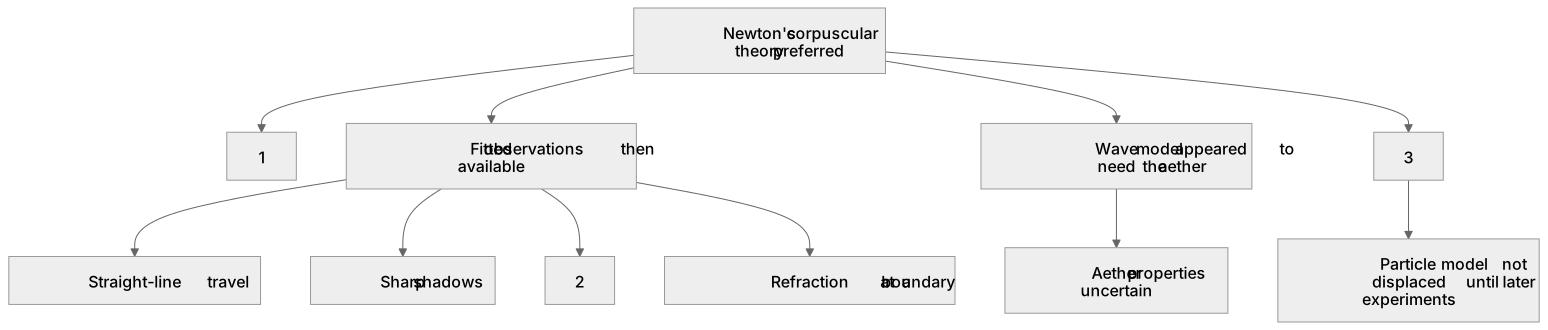
1Box 1
2Box 2
3Box 3
There is more to this lesson
The full lesson goes on to check your understanding and help you earn the marks. Create a free account to carry on, with your progress saved.
A week of Premium from your first lesson · Then the free plan continues · No card, no charge
Test your understanding of Newton’s corpuscular theory of light (A-level only): The reasons why Newton’s theory was preferred.
Active recall beats re-reading. Take an instant quiz now to test what you’ve learned and lock it into long-term memory.
A week of Premium from your first lesson · Then the free plan continues · No card, no charge