AQA · A-Level · Physics
Course version: 7408 · Version from Sept 2016
Gravity as a universal attractive force acting between all matter.
Full specification wording
Newton's law (A-level only): Gravity as a universal attractive force acting between all matter.
Gravity is a universal attractive force: every object with mass attracts every other object with mass, anywhere in the universe.
Checked against the AQA 7408 specification (opens in a new tab) on .
- 4 key terms
Study notes
From the checked teaching notes for this specification point.
The idea
Gravity is a universal attractive force: every object with mass attracts every other object with mass, anywhere in the universe. The force acts along the line joining the centres of mass and is always attractive, never repulsive. Its magnitude is given by Newton's law of gravitation, F = Gm₁m₂/r², where G = 6.67 × 10⁻¹¹ N m² kg⁻². For example, two 1.0 kg masses 1.0 m apart attract with F = 6.67 × 10⁻¹¹ N, tiny but real. The force is mutual: each mass pulls the other equally. It is universal because it applies to all matter, from atoms to galaxies, and it explains orbits, weight and tides.
What earns the marks
- State that gravity acts between any two masses and is always attractive.
- Use Newton's law of gravitation F = Gm₁m₂/r² to calculate the force between two point masses or uniform spheres.
- Explain that the force acts along the line joining the centres of mass and is an example of an inverse-square law.
- Recognise that the force on each mass is equal in magnitude and opposite in direction, consistent with Newton's third law.
- Apply the law to astronomical situations, such as calculating the force between a planet and its moon, using consistent SI units.
Common mistakes and how to put them right
Treating gravity as a contact force or as acting only near large planets.
Put it right: Gravity acts at a distance between all masses, however small.
Using the distance between surfaces rather than between centres of mass.
Put it right: For uniform spheres, r is the centre-to-centre distance.
Forgetting to square r or using r in km without converting to m.
Put it right: Use r² in metres and keep all quantities in SI units.
Exam tips
- Write the equation F = Gm₁m₂/r² before substituting values, and show the square of the distance explicitly.
- Check that masses are in kg and distance in m; convert km to m by multiplying by 10³.
- When comparing gravitational forces, calculate both values and state the ratio or difference clearly.
Try the lesson
The start of the Newton's law (A-level only): Gravity as a universal attractive force acting between all matter. lesson, made from checked teaching notes for this specification point.
Have a go first
Which statement best describes the fundamental nature of gravity as a force between two isolated objects?
Listen
Gravity is a universal attractive force: every object with mass attracts every other object with mass, anywhere in the universe. The force acts along the line joining the centres of mass and is always attractive, never repulsive. Its magnitude is given by Newton's law of gravitation, F = Gm₁m₂/r², where G = 6.67 × 10⁻¹¹ N m² kg⁻². For example, two 1.0 kg masses 1.0 m apart attract with F = 6.67 × 10⁻¹¹ N, tiny but real. The force is mutual: each mass pulls the other equally. It is universal because it applies to all matter, from atoms to galaxies, and it explains orbits, weight and tides. A strong answer earns marks for these points. State that gravity acts between any two masses and is always attractive. Use Newton's law of gravitation F = Gm₁m₂/r² to calculate the force between two point masses or uniform spheres. Explain that the force acts along the line joining the centres of mass and is an example of an inverse-square law. Recognise that the force on each mass is equal in magnitude and opposite in direction, consistent with Newton's third law. A common slip: Treating gravity as a contact force or as acting only near large planets. Instead, gravity acts at a distance between all masses, however small. Exam tip: Write the equation F = Gm₁m₂/r² before substituting values, and show the square of the distance explicitly.
See it

Key words
Say what each word means before you turn the card.
Universal attraction between all matter
Try answering aloud or in your head before turning the card.
Inverse-square law
Try answering aloud or in your head before turning the card.
Centre-of-mass separation
Try answering aloud or in your head before turning the card.
Newton's third law pair
Try answering aloud or in your head before turning the card.
See every definition
- Universal attraction between all matter
- Gravity is an attractive force that acts between all matter, anywhere in the universe, from atoms to galaxies.
- Inverse-square law
- The magnitude of the force is given by F = Gm₁m₂/r², so the force depends on the square of the separation r.
- Centre-of-mass separation
- The force acts along the line joining the centres of mass, and r is the centre-to-centre distance for uniform spheres.
- Newton's third law pair
- The force is mutual: each mass pulls the other equally, so the force on each mass is equal in magnitude and opposite in direction.
Label the diagram
Some boxes have lost their names. Pick the right name for each number.
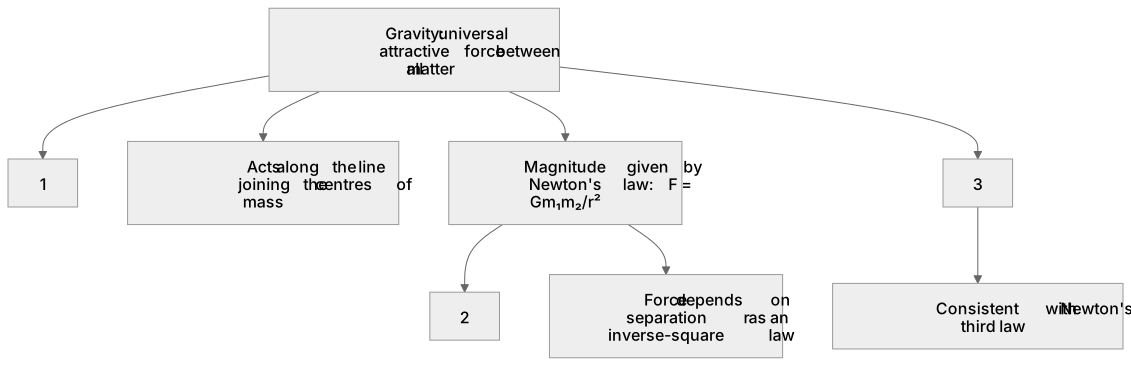
1Box 1
2Box 2
3Box 3
There is more to this lesson
The full lesson goes on to check your understanding and help you earn the marks. Create a free account to carry on, with your progress saved.
A week of Premium from your first lesson · Then the free plan continues · No card, no charge
Test your understanding of Newton's law (A-level only): Gravity as a universal attractive force acting between all matter.
Active recall beats re-reading. Take an instant quiz now to test what you’ve learned and lock it into long-term memory.
A week of Premium from your first lesson · Then the free plan continues · No card, no charge