AQA · A-Level · Physics
Course version: 7408 · Version from Sept 2016
PV = nRT γ adiabatic change : pV = constant isothermal change : pV =…
Full specification wording
Non-flow processes (A-level only): pV = nRT γ adiabatic change : pV = constant isothermal change : pV = constant at constant pressure W = pΔV Application of first law of thermodynamics to the above processes.
The ideal gas equation pV = nRT links pressure, volume, amount and temperature.
Checked against the AQA 7408 specification (opens in a new tab) on .
- Point 2 of 2
- 4 key terms
Study notes
From the checked teaching notes for this specification point.
The idea
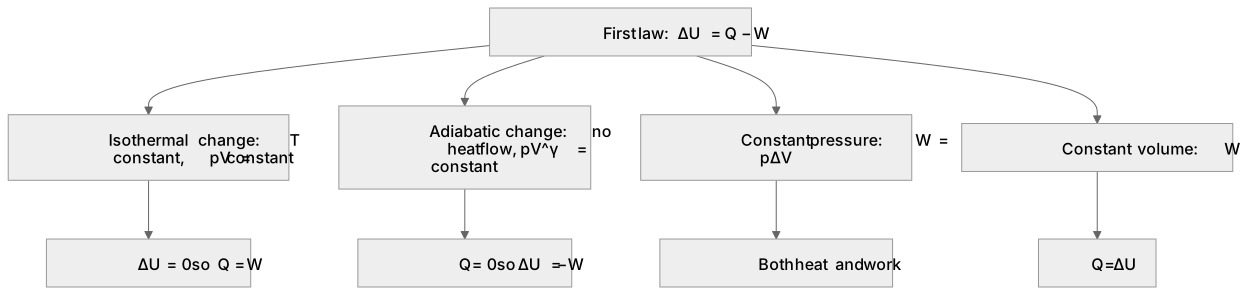
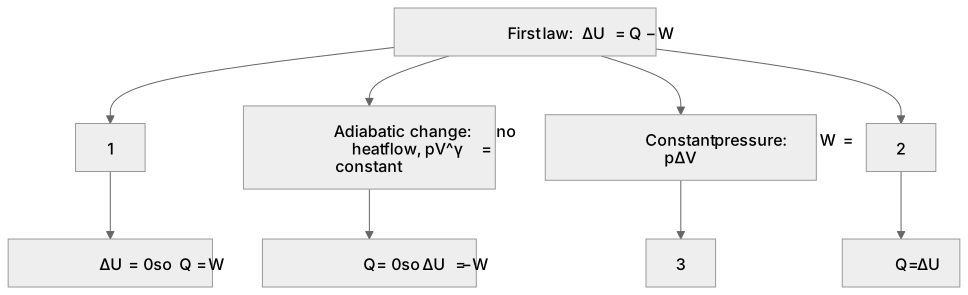
The ideal gas equation pV = nRT links pressure, volume, amount and temperature. For an isothermal change, T is fixed so pV is constant, giving a smooth p–V curve. For an adiabatic change, no heat flows, so pV^γ is constant, where γ = C_p/C_V; the curve is steeper than an isotherm. At constant pressure, work done by the gas is W = pΔV. The first law ΔU = Q − W then explains each path: isothermal has ΔU = 0 so Q = W; adiabatic has Q = 0 so ΔU = −W; constant pressure has both heat and work; constant volume has W = 0 so Q = ΔU.
What earns the marks
- Uses pV = nRT to relate state variables and to show that pV is constant when T is constant.
- States and applies pV^γ = constant for an adiabatic change, identifying γ as the ratio of principal molar heat capacities.
- Calculates work done at constant pressure using W = pΔV, with consistent units.
- Applies ΔU = Q − W to each process, setting the appropriate term to zero.
- Compares isothermal and adiabatic curves on a p–V diagram, noting the adiabatic curve is steeper through the same point.
- Uses the first law to deduce temperature change from work done when Q = 0.
Common mistakes and how to put them right
Writing pV = constant for an adiabatic change.
Put it right: Use pV^γ = constant, where γ is greater than 1.
Treating W = pΔV as valid for all processes.
Put it right: It applies only at constant pressure, otherwise use the area under the p–V curve.
Forgetting that γ is dimensionless and greater than 1 for gases.
Put it right: γ = C_p/C_V and is about 1.4 for diatomic gases.
Exam tips
- Quote the equation you use and state the condition that makes it valid.
- Check units of p and V before substituting into W = pΔV.
- For adiabatic questions, start from Q = 0 and link work done to internal energy change.
Try the lesson
The start of the Non-flow processes (A-level only): pV = nRT γ adiabatic change : pV = constant isothermal change : pV = constant at constant pressure W = pΔV Application of first law of thermodynamics to the above processes. lesson, made from checked teaching notes for this specification point.
Have a go first
For an ideal gas, which equation of state links pressure p, volume V, amount in moles n and thermodynamic temperature T?
Listen
The ideal gas equation pV = nRT links pressure, volume, amount and temperature. For an isothermal change, T is fixed so pV is constant, giving a smooth p–V curve. For an adiabatic change, no heat flows, so pV^γ is constant, where γ = C_p/C_V; the curve is steeper than an isotherm. At constant pressure, work done by the gas is W = pΔV. The first law ΔU = Q − W then explains each path: isothermal has ΔU = 0 so Q = W; adiabatic has Q = 0 so ΔU = −W; constant pressure has both heat and work; constant volume has W = 0 so Q = ΔU. A strong answer earns marks for these points. Uses pV = nRT to relate state variables and to show that pV is constant when T is constant. States and applies pV^γ = constant for an adiabatic change, identifying γ as the ratio of principal molar heat capacities. Calculates work done at constant pressure using W = pΔV, with consistent units. Applies ΔU = Q − W to each process, setting the appropriate term to zero. A common slip: Writing pV = constant for an adiabatic change. Instead, use pV^γ = constant, where γ is greater than 1. Exam tip: Quote the equation you use and state the condition that makes it valid.
See it
Key words
Say what each word means before you turn the card.
Ideal gas equation
Try answering aloud or in your head before turning the card.
Adiabatic change
Try answering aloud or in your head before turning the card.
Isothermal change
Try answering aloud or in your head before turning the card.
Work done by a gas
Try answering aloud or in your head before turning the card.
See every definition
- Ideal gas equation
- pV = nRT links pressure, volume, amount and temperature.
- Adiabatic change
- No heat flows, so pV^γ is constant, where γ = C_p/C_V; the curve is steeper than an isotherm.
- Isothermal change
- T is fixed so pV is constant, giving a smooth p–V curve.
- Work done by a gas
- At constant pressure, work done by the gas is W = pΔV.
Label the diagram
Some boxes have lost their names. Pick the right name for each number.
1Box 1
2Box 2
3Box 3
There is more to this lesson
The full lesson goes on to check your understanding and help you earn the marks. Create a free account to carry on, with your progress saved.
A week of Premium from your first lesson · Then the free plan continues · No card, no charge
Test your understanding of Non-flow processes (A-level only): pV = nRT γ adiabatic change : pV = constant isothermal change : pV = constant at constant pressure W = pΔV Application of first law of thermodynamics to the above processes.
Active recall beats re-reading. Take an instant quiz now to test what you’ve learned and lock it into long-term memory.
A week of Premium from your first lesson · Then the free plan continues · No card, no charge