AQA · A-Level · Physics
Course version: 7408 · Version from Sept 2016
Interpretation of equation as evidence for constant density of nuclear…
Full specification wording
Nuclear radius (A-level only): Interpretation of equation as evidence for constant density of nuclear material.
Scattering experiments show that nuclear radius R varies with nucleon number A according to R = r₀A^(1/3), where r₀ is approximately 1.2 × 10⁻¹⁵ m.
Checked against the AQA 7408 specification (opens in a new tab) on .
- Point 4 of 6
- 3 key terms
Study notes
From the checked teaching notes for this specification point.
The idea
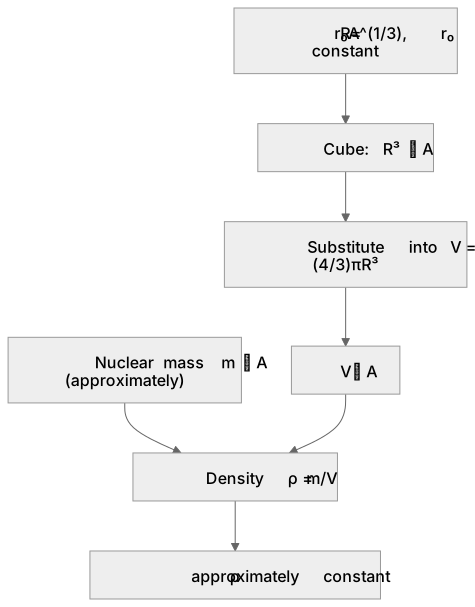
Scattering experiments show that nuclear radius R varies with nucleon number A according to R = r₀A^(1/3), where r₀ is approximately 1.2 × 10⁻¹⁵ m. Because volume depends on the cube of the radius, V = (4/3)πR³, substituting R gives V = (4/3)πr₀³A. Volume is therefore directly proportional to A, the number of nucleons. Since density is mass divided by volume, and nuclear mass is also approximately proportional to A, the ratio mass/volume stays constant. This is the evidence that nuclear material has a constant density, independent of the size of the nucleus. You should be able to combine the radius equation with the volume of a sphere and explain the proportional reasoning clearly.
What earns the marks
- State the relationship R = r₀A^(1/3) and identify r₀ as a constant.
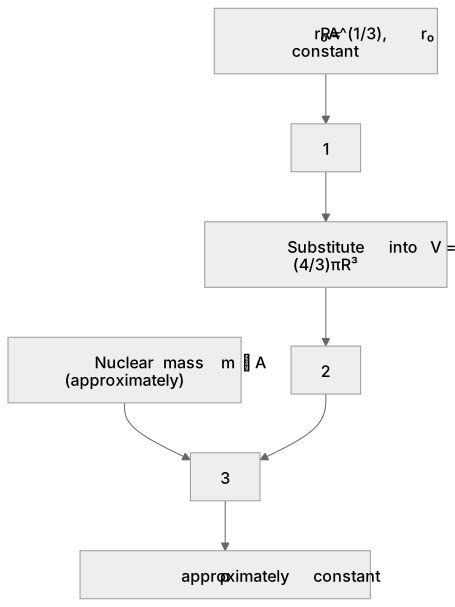
- Cube the radius relationship to show R³ ∝ A.
- Substitute R³ into the sphere volume formula V = (4/3)πR³ to obtain V ∝ A.
- Explain that nuclear mass is approximately proportional to A, so density ρ = m/V is approximately constant.
- Use the constant-density conclusion to compare different nuclei or to estimate a nuclear radius from a known value.
Common mistakes and how to put them right
Treating R as directly proportional to A rather than to A^(1/3).
Put it right by cubing both sides to relate volume to A.
Assuming nuclear density increases with nucleon number.
Put it right by showing that V ∝ A and m ∝ A, so density is constant.
Using the electron radius or atomic radius in place of the nuclear radius.
Put it right by using r₀ ≈ 1.2 × 10⁻¹⁵ m for nuclear calculations.
Exam tips
- Show the intermediate step R³ ∝ A before substituting into the volume formula, so the proportional reasoning is visible.
- Use the phrase 'approximately proportional' for mass and A, since binding energy causes a small difference.
- When comparing two nuclei, write the ratio of densities and cancel the constants to demonstrate constancy.
Try the lesson
The start of the Nuclear radius (A-level only): Interpretation of equation as evidence for constant density of nuclear material. lesson, made from checked teaching notes for this specification point.
Have a go first
The nuclear radius R is related to nucleon number A by R = r₀A^(1/3). What does the fact that R is proportional to A^(1/3) suggest about the volume of a nucleus?
Listen
Scattering experiments show that nuclear radius R varies with nucleon number A according to R = r₀A^(1/3), where r₀ is approximately 1.2 × 10⁻¹⁵ m. Because volume depends on the cube of the radius, V = (4/3)πR³, substituting R gives V = (4/3)πr₀³A. Volume is therefore directly proportional to A, the number of nucleons. Since density is mass divided by volume, and nuclear mass is also approximately proportional to A, the ratio mass/volume stays constant. This is the evidence that nuclear material has a constant density, independent of the size of the nucleus. You should be able to combine the radius equation with the volume of a sphere and explain the proportional reasoning clearly. A strong answer earns marks for these points. State the relationship R = r₀A^(1/3) and identify r₀ as a constant. Cube the radius relationship to show R³ ∝ A. Substitute R³ into the sphere volume formula V = (4/3)πR³ to obtain V ∝ A. Explain that nuclear mass is approximately proportional to A, so density ρ = m/V is approximately constant. A common slip: Treating R as directly proportional to A rather than to A^(1/3). Instead, cubing both sides to relate volume to A. Exam tip: Show the intermediate step R³ ∝ A before substituting into the volume formula, so the proportional reasoning is visible.
See it
Key words
Say what each word means before you turn the card.
Proportional reasoning in nuclear physics
Try answering aloud or in your head before turning the card.
Relationship between radius, volume and density
Try answering aloud or in your head before turning the card.
Scale and structure of the nucleus
Try answering aloud or in your head before turning the card.
See every definition
- Proportional reasoning in nuclear physics
- Combining the radius equation with the volume of a sphere to show that volume is directly proportional to A, the number of nucleons.
- Relationship between radius, volume and density
- Because volume depends on the cube of the radius, substituting R gives V = (4/3)πr₀³A, and since nuclear mass is also approximately proportional to A, the ratio mass/volume stays constant.
- Scale and structure of the nucleus
- The constant-density conclusion shows that nuclear material has a constant density, independent of the size of the nucleus.
Label the diagram
Some boxes have lost their names. Pick the right name for each number.
1Box 1
2Box 2
3Box 3
There is more to this lesson
The full lesson goes on to check your understanding and help you earn the marks. Create a free account to carry on, with your progress saved.
A week of Premium from your first lesson · Then the free plan continues · No card, no charge
Test your understanding of Nuclear radius (A-level only): Interpretation of equation as evidence for constant density of nuclear material.
Active recall beats re-reading. Take an instant quiz now to test what you’ve learned and lock it into long-term memory.
A week of Premium from your first lesson · Then the free plan continues · No card, no charge