AQA · A-Level · Physics
Course version: 7408 · Version from Sept 2016
Use of satellites in low orbits and geostationary orbits, to include plane…
Full specification wording
Orbits of planets and satellites (A-level only): Use of satellites in low orbits and geostationary orbits, to include plane and radius of geostationary orbit.
Satellites stay in orbit because gravity supplies the centripetal force.
Checked against the AQA 7408 specification (opens in a new tab) on .
- Point 4 of 4
- 4 key terms
Study notes
From the checked teaching notes for this specification point.
The idea
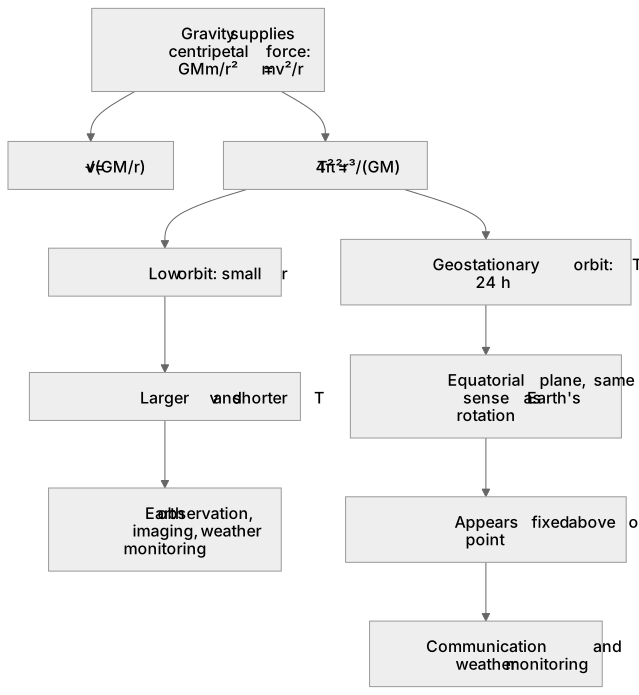
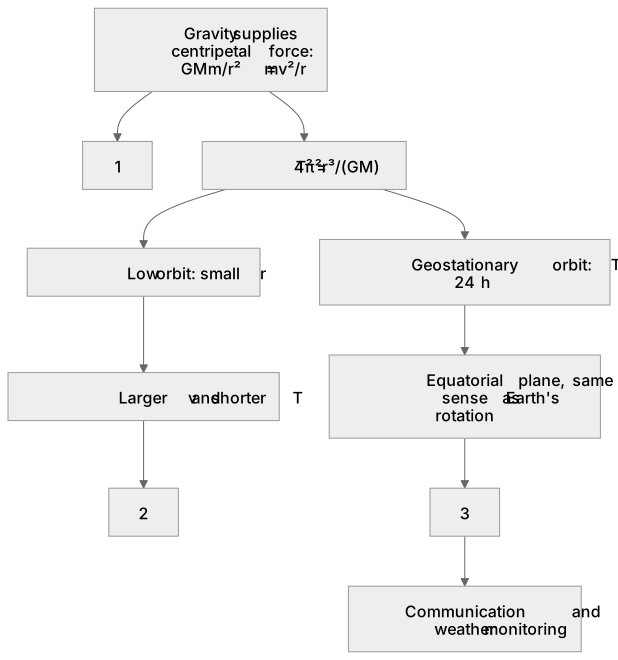
Satellites stay in orbit because gravity supplies the centripetal force. For a circular orbit, equate GMm/r² to mv²/r, giving v = √(GM/r) and T² = 4π²r³/(GM). A low orbit has a small radius, so it is fast and has a short period; these are used for Earth observation, imaging, and weather monitoring. A geostationary orbit has T = 24 hours, lies in the equatorial plane, and moves west to east so the satellite appears fixed above one point. Substituting T = 8.64 × 10⁴ s and GM = 3.99 × 10¹⁴ m³ s⁻² gives r ≈ 4.22 × 10⁷ m from Earth's centre, so the height above the surface is about 3.6 × 10⁷ m. The plane must contain the equator; any inclined orbit would drift north and south.
What earns the marks
- Gravitational force provides the centripetal force: GMm/r² = mv²/r, so v = √(GM/r).
- Period relation: T² = 4π²r³/(GM), so r³ = GMT²/(4π²).
- Low orbit: smaller r gives larger v and shorter T; typical periods are about 90 minutes, used for Earth observation and imaging.
- Geostationary orbit: T = 24 h = 8.64 × 10⁴ s, equatorial plane, same sense as Earth's rotation.
- Radius from centre r ≈ 4.22 × 10⁷ m; height above surface ≈ 3.6 × 10⁷ m.
- Geostationary satellites are used for communication and weather monitoring because the ground antenna can be fixed.
Common mistakes and how to put them right
Using the height above the surface as r in GMm/r² or T² = 4π²r³/(GM).
Put it right by adding Earth's radius, 6.37 × 10⁶ m, to the height.
Treating a geostationary orbit as merely any 24-hour orbit.
Put it right by stating it must also be equatorial and in the same sense as Earth's rotation.
Assuming a polar low-Earth orbit is geostationary.
Put it right by noting that a polar orbit does not keep a fixed position over the equator.
Exam tips
- Start orbital calculations by writing the force equation before substituting numbers, so the physics is clear.
- Convert 24 hours to seconds before using T² = 4π²r³/(GM).
- When asked for height, subtract Earth's radius from the orbital radius and state the unit.
- Use a clear sketch to show r measured from Earth's centre and the equatorial plane.
Try the lesson
The start of the Orbits of planets and satellites (A-level only): Use of satellites in low orbits and geostationary orbits, to include plane and radius of geostationary orbit. lesson, made from checked teaching notes for this specification point.
Have a go first
Which statement describes the orbit of a geostationary satellite?
Listen
Satellites stay in orbit because gravity supplies the centripetal force. For a circular orbit, equate GMm/r² to mv²/r, giving v = √(GM/r) and T² = 4π²r³/(GM). A low orbit has a small radius, so it is fast and has a short period; these are used for Earth observation, imaging, and weather monitoring. A geostationary orbit has T = 24 hours, lies in the equatorial plane, and moves west to east so the satellite appears fixed above one point. Substituting T = 8.64 × 10⁴ s and GM = 3.99 × 10¹⁴ m³ s⁻² gives r ≈ 4.22 × 10⁷ m from Earth's centre, so the height above the surface is about 3.6 × 10⁷ m. The plane must contain the equator; any inclined orbit would drift north and south. A strong answer earns marks for these points. Gravitational force provides the centripetal force: GMm/r² = mv²/r, so v = √(GM/r). Period relation: T² = 4π²r³/(GM), so r³ = GMT²/(4π²). Low orbit: smaller r gives larger v and shorter T; typical periods are about 90 minutes, used for Earth observation and imaging. Geostationary orbit: T = 24 h = 8.64 × 10⁴ s, equatorial plane, same sense as Earth's rotation. A common slip: Using the height above the surface as r in GMm/r² or T² = 4π²r³/(GM). Instead, adding Earth's radius, 6.37 × 10⁶ m, to the height. Exam tip: Start orbital calculations by writing the force equation before substituting numbers, so the physics is clear.
See it
Key words
Say what each word means before you turn the card.
Low orbit
Try answering aloud or in your head before turning the card.
Geostationary orbit
Try answering aloud or in your head before turning the card.
Radius of geostationary orbit
Try answering aloud or in your head before turning the card.
Equatorial plane
Try answering aloud or in your head before turning the card.
See every definition
- Low orbit
- A small radius orbit, so it is fast and has a short period, used for Earth observation, imaging, and weather monitoring.
- Geostationary orbit
- Has T = 24 hours, lies in the equatorial plane, and moves west to east so the satellite appears fixed above one point.
- Radius of geostationary orbit
- Substituting T = 8.64 × 10⁴ s and GM = 3.99 × 10¹⁴ m³ s⁻² gives r ≈ 4.22 × 10⁷ m from Earth's centre.
- Equatorial plane
- The plane must contain the equator; any inclined orbit would drift north and south.
Label the diagram
Some boxes have lost their names. Pick the right name for each number.
1Box 1
2Box 2
3Box 3
There is more to this lesson
The full lesson goes on to check your understanding and help you earn the marks. Create a free account to carry on, with your progress saved.
A week of Premium from your first lesson · Then the free plan continues · No card, no charge
Test your understanding of Orbits of planets and satellites (A-level only): Use of satellites in low orbits and geostationary orbits, to include plane and radius of geostationary orbit.
Active recall beats re-reading. Take an instant quiz now to test what you’ve learned and lock it into long-term memory.
A week of Premium from your first lesson · Then the free plan continues · No card, no charge