AQA · A-Level · Physics
Course version: 7408 · Version from Sept 2016
Students should be able to describe the action of a simple polar molecule…
Full specification wording
Parallel plate capacitor (A-level only): Students should be able to describe the action of a simple polar molecule that rotates in the presence of an electric field.
A polar molecule has a permanent separation of charge, behaving as a tiny electric dipole.
Checked against the AQA 7408 specification (opens in a new tab) on .
- 4 key terms
Study notes
From the checked teaching notes for this specification point.
The idea
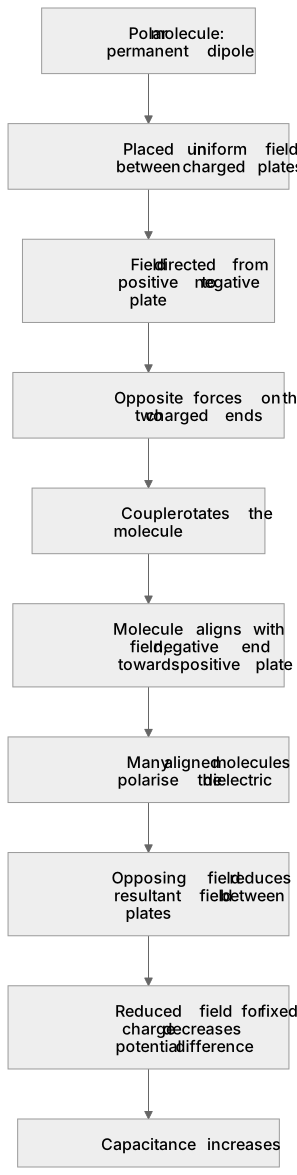
A polar molecule has a permanent separation of charge, behaving as a tiny electric dipole. When placed between charged parallel plates, it experiences a uniform electric field directed from the positive to the negative plate. The field exerts opposite forces on the dipole's ends, producing a couple that rotates the molecule until its negative end points towards the positive plate. The molecule aligns with the field. This alignment causes polarisation in dielectrics: aligned dipoles create an opposing electric field. This reduces the resultant field between the plates. For a fixed charge, a reduced electric field decreases the potential difference across the plates, which consequently increases the capacitance of the capacitor.
What earns the marks
- A polar molecule has a permanent dipole because its positive and negative charge centres do not coincide.
- The electric field between the plates is directed from the positive plate to the negative plate.
- The field exerts opposite forces on the two charged ends of the molecule, creating a couple.
- The couple rotates the molecule until it aligns with the field, with its negative end towards the positive plate.
- Alignment of many polar molecules polarises the dielectric and reduces the resultant field between the plates.
- A reduced resultant field for a fixed charge decreases the potential difference across the plates (V = Ed), increasing capacitance (C = Q/V).
Common mistakes and how to put them right
Saying the molecule moves from one plate to the other.
Put it right: The molecule rotates about its centre and remains in place.
Saying both ends of the molecule are attracted to the same plate.
Put it right: Opposite charges attract, so the negative end is attracted to the positive plate and the positive end to the negative plate.
Saying the molecule has no charge separation until the field is applied.
Put it right: A polar molecule has a permanent dipole even without an external field.
Exam tips
- State clearly that the field is uniform between parallel plates and directed from the positive plate to the negative plate.
- Use the terms dipole, couple and alignment, and explain the rotation in terms of opposite forces on opposite charges.
Try the lesson
The start of the Parallel plate capacitor (A-level only): Students should be able to describe the action of a simple polar molecule that rotates in the presence of an electric field. lesson, made from checked teaching notes for this specification point.
Have a go first
A simple polar molecule is placed between two charged parallel plates. Which statement describes the action of the molecule in the electric field?
Listen
A polar molecule has a permanent separation of charge, behaving as a tiny electric dipole. When placed between charged parallel plates, it experiences a uniform electric field directed from the positive to the negative plate. The field exerts opposite forces on the dipole's ends, producing a couple that rotates the molecule until its negative end points towards the positive plate. The molecule aligns with the field. This alignment causes polarisation in dielectrics: aligned dipoles create an opposing electric field. This reduces the resultant field between the plates. For a fixed charge, a reduced electric field decreases the potential difference across the plates, which consequently increases the capacitance of the capacitor. A strong answer earns marks for these points. A polar molecule has a permanent dipole because its positive and negative charge centres do not coincide. The electric field between the plates is directed from the positive plate to the negative plate. The field exerts opposite forces on the two charged ends of the molecule, creating a couple. The couple rotates the molecule until it aligns with the field, with its negative end towards the positive plate. A common slip: Saying the molecule moves from one plate to the other: the error is confusing rotation with translation. Instead, the molecule rotates about its centre and remains in place. Exam tip: State clearly that the field is uniform between parallel plates and directed from the positive plate to the negative plate.
See it
Key words
Say what each word means before you turn the card.
Polar molecule
Try answering aloud or in your head before turning the card.
Electric field between the plates
Try answering aloud or in your head before turning the card.
Couple
Try answering aloud or in your head before turning the card.
Polarisation of a dielectric
Try answering aloud or in your head before turning the card.
See every definition
- Polar molecule
- Has a permanent dipole because its positive and negative charge centres do not coincide.
- Electric field between the plates
- Directed from the positive plate to the negative plate and is uniform between parallel plates.
- Couple
- Created because the field exerts opposite forces on the two charged ends of the molecule.
- Polarisation of a dielectric
- Caused by the alignment of many polar molecules, which reduces the resultant field between the plates.
Label the diagram
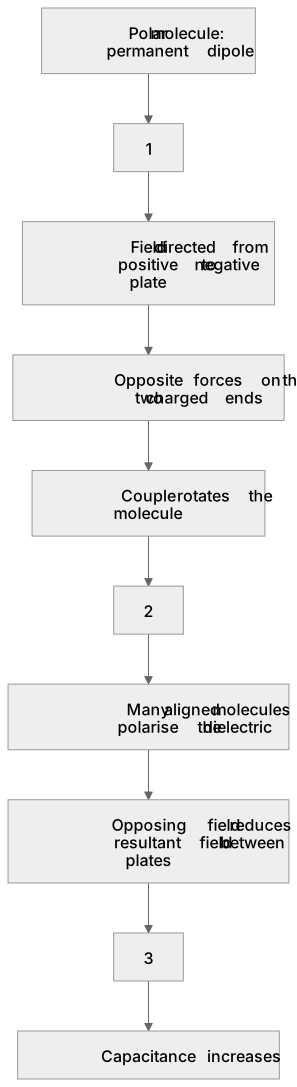
Some boxes have lost their names. Pick the right name for each number.
1Box 1
2Box 2
3Box 3
There is more to this lesson
The full lesson goes on to check your understanding and help you earn the marks. Create a free account to carry on, with your progress saved.
A week of Premium from your first lesson · Then the free plan continues · No card, no charge
Test your understanding of Parallel plate capacitor (A-level only): Students should be able to describe the action of a simple polar molecule that rotates in the presence of an electric field.
Active recall beats re-reading. Take an instant quiz now to test what you’ve learned and lock it into long-term memory.
A week of Premium from your first lesson · Then the free plan continues · No card, no charge