AQA · A-Level · Physics
Course version: 7408 · Version from Sept 2016
Four fundamental interactions: gravity, electromagnetic, weak nuclear,…
Full specification wording
Particle interactions: Four fundamental interactions: gravity, electromagnetic, weak nuclear, strong nuclear. (The strong nuclear force may be referred to as the strong interaction.) The concept of exchange particles to explain forces between elementary particles.
All forces between particles are grouped into four fundamental interactions.
Checked against the AQA 7408 specification (opens in a new tab) on .
- Point 1 of 3
- 4 key terms
Study notes
From the checked teaching notes for this specification point.
The idea
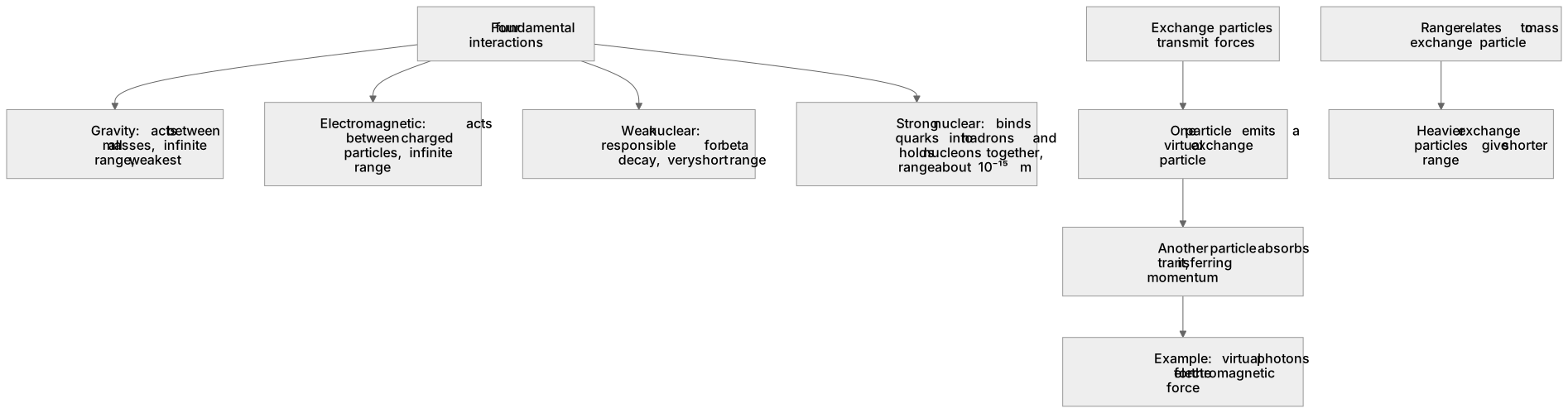
All forces between particles are grouped into four fundamental interactions. Gravity acts between all masses and has infinite range but is by far the weakest. The electromagnetic interaction acts between charged particles, also with infinite range. The weak nuclear interaction is responsible for beta decay and acts over a very short range. The strong nuclear interaction binds quarks into hadrons and holds nucleons together, acting over about 10⁻¹⁵ m. Forces are transmitted by exchange particles: a particle emits a virtual exchange particle, which is absorbed by another, transferring momentum. For example, the electromagnetic force between two electrons is explained by exchanging virtual photons. The range and strength of each interaction relate to the mass of its exchange particle.
What earns the marks
- State that gravity acts between all masses and is the weakest of the four interactions, with infinite range.
- State that the electromagnetic interaction acts between charged particles and has infinite range.
- State that the weak nuclear interaction is responsible for beta decay and has a very short range.
- State that the strong nuclear interaction binds quarks and holds nucleons together, with range about 10⁻¹⁵ m.
- Explain that forces between particles are transmitted by the exchange of virtual particles, such as virtual photons for the electromagnetic force.
- Relate the range of an interaction to the mass of its exchange particle, with heavier exchange particles giving shorter range.
Common mistakes and how to put them right
Confusing the strong nuclear force with the weak nuclear force.
Put it right: The strong force binds quarks and nucleons, while the weak force causes beta decay.
Thinking gravity is the strongest force because it dominates on large scales.
Put it right: In fact it is the weakest but acts over infinite range and on all masses.
Believing exchange particles are real detectable particles.
Put it right: They are virtual and exist only during the interaction.
Forgetting that the electromagnetic force acts only between charged particles, not between all particles.
Exam tips
- Learn a table of the four interactions with their relative strengths, ranges and exchange particles.
- When explaining exchange particles, always state that a virtual particle is emitted by one particle and absorbed by another, transferring momentum.
- Use the phrase 'strong nuclear force may also be called the strong interaction' to show awareness of alternative terminology.
- Link the range of an interaction to the mass of its exchange particle: heavier exchange particles give shorter range.
Try the lesson
The start of the Particle interactions: Four fundamental interactions: gravity, electromagnetic, weak nuclear, strong nuclear. (The strong nuclear force may be referred to as the strong interaction.) The concept of exchange particles to explain forces between elementary particles. lesson, made from checked teaching notes for this specification point.
Have a go first
Which of the following correctly pairs a fundamental interaction with its corresponding exchange particle?
Listen
All forces between particles are grouped into four fundamental interactions. Gravity acts between all masses and has infinite range but is by far the weakest. The electromagnetic interaction acts between charged particles, also with infinite range. The weak nuclear interaction is responsible for beta decay and acts over a very short range. The strong nuclear interaction binds quarks into hadrons and holds nucleons together, acting over about 10⁻¹⁵ m. Forces are transmitted by exchange particles: a particle emits a virtual exchange particle, which is absorbed by another, transferring momentum. For example, the electromagnetic force between two electrons is explained by exchanging virtual photons. The range and strength of each interaction relate to the mass of its exchange particle. A strong answer earns marks for these points. State that gravity acts between all masses and is the weakest of the four interactions, with infinite range. State that the electromagnetic interaction acts between charged particles and has infinite range. State that the weak nuclear interaction is responsible for beta decay and has a very short range. State that the strong nuclear interaction binds quarks and holds nucleons together, with range about 10⁻¹⁵ m. Exam tip: Learn a table of the four interactions with their relative strengths, ranges and exchange particles.
See it
Key words
Say what each word means before you turn the card.
Fundamental interactions
Try answering aloud or in your head before turning the card.
Exchange particles
Try answering aloud or in your head before turning the card.
Virtual particles
Try answering aloud or in your head before turning the card.
Range and strength
Try answering aloud or in your head before turning the card.
See every definition
- Fundamental interactions
- Gravity, electromagnetic, weak nuclear and strong nuclear are the four interactions into which all forces between particles are grouped.
- Exchange particles
- Forces between elementary particles are explained by particles that transmit the force between them.
- Virtual particles
- A particle emits one, which is absorbed by another, transferring momentum; such particles exist only during the interaction.
- Range and strength
- The range and strength of each interaction relate to the mass of its exchange particle, with heavier exchange particles giving shorter range.
Label the diagram
Some boxes have lost their names. Pick the right name for each number.
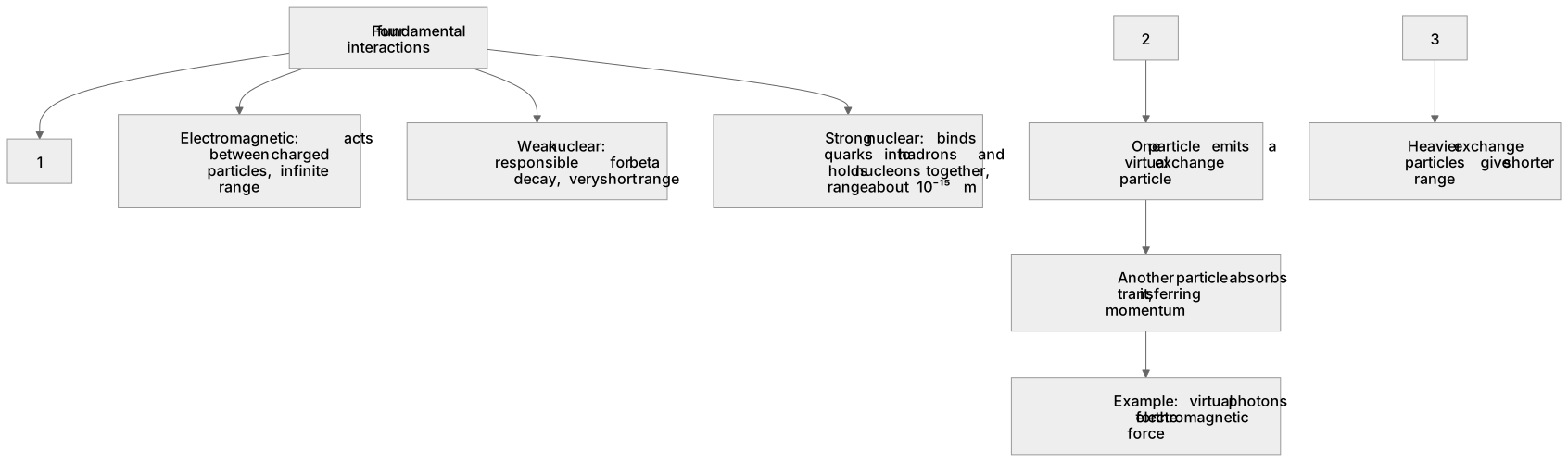
1Box 1
2Box 2
3Box 3
There is more to this lesson
The full lesson goes on to check your understanding and help you earn the marks. Create a free account to carry on, with your progress saved.
A week of Premium from your first lesson · Then the free plan continues · No card, no charge
Test your understanding of Particle interactions: Four fundamental interactions: gravity, electromagnetic, weak nuclear, strong nuclear. (The strong nuclear force may be referred to as the strong interaction.) The concept of exchange particles to explain forces between elementary particles.
Active recall beats re-reading. Take an instant quiz now to test what you’ve learned and lock it into long-term memory.
A week of Premium from your first lesson · Then the free plan continues · No card, no charge