AQA · A-Level · Physics
Course version: 7408 · Version from Sept 2016
For every type of particle, there is a corresponding antiparticle.
Full specification wording
Particles, antiparticles and photons: For every type of particle, there is a corresponding antiparticle.
Antiparticles are a fundamental feature of particle physics: each particle species has a partner with the same rest mass but opposite electric charge and opposite quantum numbers such as baryon…
Checked against the AQA 7408 specification (opens in a new tab) on .
- Point 1 of 4
- 4 key terms
Study notes
From the checked teaching notes for this specification point.
The idea
Antiparticles are a fundamental feature of particle physics: each particle species has a partner with the same rest mass but opposite electric charge and opposite quantum numbers such as baryon number, lepton number and strangeness. For example, the electron e⁻ has an antiparticle called the positron e⁺; the proton p has an antiparticle called the antiproton p̄. Some neutral particles, such as the photon, are their own antiparticles. When a particle meets its antiparticle they can annihilate, converting their combined rest energy into photons, often two gamma-ray photons. Conversely, a photon with sufficient energy can produce a particle–antiparticle pair in pair production. Recognising that antiparticles exist for every particle type allows you to predict annihilation products and to interpret particle tracks in detectors.
What earns the marks
- States that each particle species has a corresponding antiparticle with the same rest mass.
- States that the antiparticle has opposite electric charge to the particle, for example electron e⁻ and positron e⁺.
- States that other quantum numbers such as baryon number, lepton number and strangeness are opposite in sign for the antiparticle.
- Recognises that some neutral particles, such as the photon, are their own antiparticles.
- Describes annihilation as a particle and its antiparticle converting their combined rest energy into photons, commonly two gamma-ray photons.
- Describes pair production as a photon converting into a particle–antiparticle pair when it has sufficient energy.
- Uses conservation laws, including conservation of charge, energy and momentum, to check whether a proposed particle reaction is possible.
Common mistakes and how to put them right
Thinking that an antiparticle has negative mass.
Put it right: The rest mass is identical to that of the particle; it is charge and certain quantum numbers that are opposite.
Assuming that every antiparticle is negatively charged.
Put it right: The positron e⁺ is positively charged, and the antiproton p̄ is negatively charged, so charge sign depends on the particle.
Believing that neutral particles cannot have antiparticles.
Put it right: Neutral particles can have distinct antiparticles, for example the neutron and antineutron, while some neutral particles such as the photon are their own antiparticles.
Writing annihilation as producing a single photon without considering momentum conservation.
Put it right: In the centre-of-momentum frame, two photons are typically produced so that total momentum can be zero.
Exam tips
- When asked to compare a particle and its antiparticle, structure your answer around rest mass, charge and at least one quantum number such as baryon number or lepton number.
- Use standard symbols correctly, including e⁻, e⁺, p, p̄, n and n̄, and state the charge with a superscript sign.
- For annihilation and pair production questions, always check conservation of charge, energy and momentum before committing to a final answer.
- If a question gives rest energies in MeV, remember that annihilation converts rest energy into photon energy, so the total photon energy equals the total rest energy of the particle–antiparticle pair.
Try the lesson
The start of the Particles, antiparticles and photons: For every type of particle, there is a corresponding antiparticle. lesson, made from checked teaching notes for this specification point.
Have a go first
Which particle is the antiparticle of the electron?
Listen
Antiparticles are a fundamental feature of particle physics: each particle species has a partner with the same rest mass but opposite electric charge and opposite quantum numbers such as baryon number, lepton number and strangeness. For example, the electron e⁻ has an antiparticle called the positron e⁺; the proton p has an antiparticle called the antiproton p̄. Some neutral particles, such as the photon, are their own antiparticles. When a particle meets its antiparticle they can annihilate, converting their combined rest energy into photons, often two gamma-ray photons. Conversely, a photon with sufficient energy can produce a particle–antiparticle pair in pair production. Recognising that antiparticles exist for every particle type allows you to predict annihilation products and to interpret particle tracks in detectors. A strong answer earns marks for these points. States that each particle species has a corresponding antiparticle with the same rest mass. States that the antiparticle has opposite electric charge to the particle, for example electron e⁻ and positron e⁺. States that other quantum numbers such as baryon number, lepton number and strangeness are opposite in sign for the antiparticle. Recognises that some neutral particles, such as the photon, are their own antiparticles. A common slip: Thinking that an antiparticle has negative mass. Instead, the rest mass is identical to that of the particle; it is charge and certain quantum numbers that are opposite. Exam tip: When asked to compare a particle and its antiparticle, structure your answer around rest mass, charge and at least one quantum number such as baryon number or lepton number.
See it

Key words
Say what each word means before you turn the card.
Antiparticle
Try answering aloud or in your head before turning the card.
Annihilation
Try answering aloud or in your head before turning the card.
Pair production
Try answering aloud or in your head before turning the card.
Conservation laws in particle interactions
Try answering aloud or in your head before turning the card.
See every definition
- Antiparticle
- For every type of particle there is a corresponding one with the same rest mass but opposite electric charge and opposite quantum numbers such as baryon number, lepton number and strangeness.
- Annihilation
- When a particle meets its antiparticle they can convert their combined rest energy into photons, often two gamma-ray photons.
- Pair production
- A photon with sufficient energy can produce a particle–antiparticle pair.
- Conservation laws in particle interactions
- Conservation of charge, energy and momentum are used to check whether a proposed particle reaction is possible.
Label the diagram
Some boxes have lost their names. Pick the right name for each number.
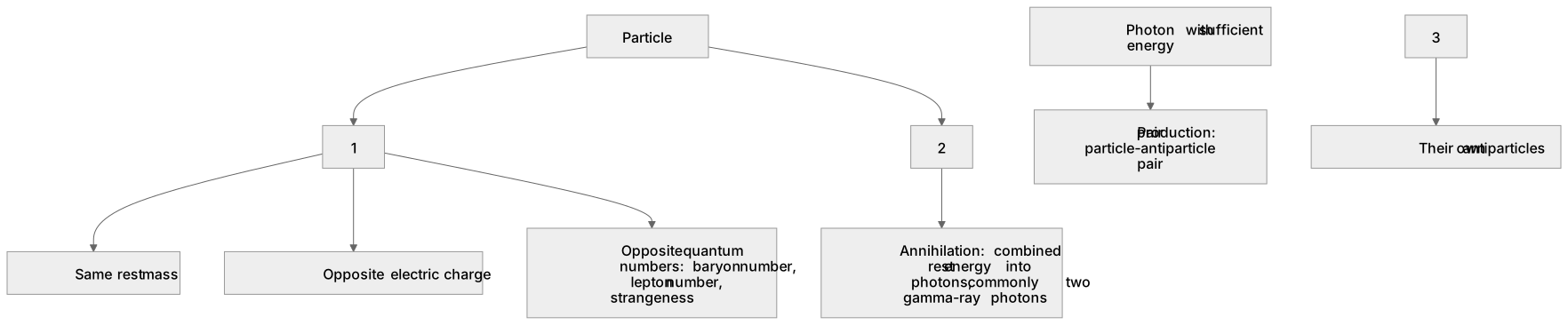
1Box 1
2Box 2
3Box 3
There is more to this lesson
The full lesson goes on to check your understanding and help you earn the marks. Create a free account to carry on, with your progress saved.
A week of Premium from your first lesson · Then the free plan continues · No card, no charge
Test your understanding of Particles, antiparticles and photons: For every type of particle, there is a corresponding antiparticle.
Active recall beats re-reading. Take an instant quiz now to test what you’ve learned and lock it into long-term memory.
A week of Premium from your first lesson · Then the free plan continues · No card, no charge