AQA · A-Level · Physics
Course version: 7408 · Version from Sept 2016
Condition for holding a charged oil droplet, of charge Q, stationary…
Full specification wording
Principle of Millikan’s determination of the electronic charge, e (A-level only): Condition for holding a charged oil droplet, of charge Q, stationary between oppositely charged parallel plates.
In Millikan’s experiment, a charged oil droplet is held stationary between two horizontal parallel plates connected to a voltage supply.
Checked against the AQA 7408 specification (opens in a new tab) on .
- Point 1 of 5
- 4 key terms
Study notes
From the checked teaching notes for this specification point.
The idea
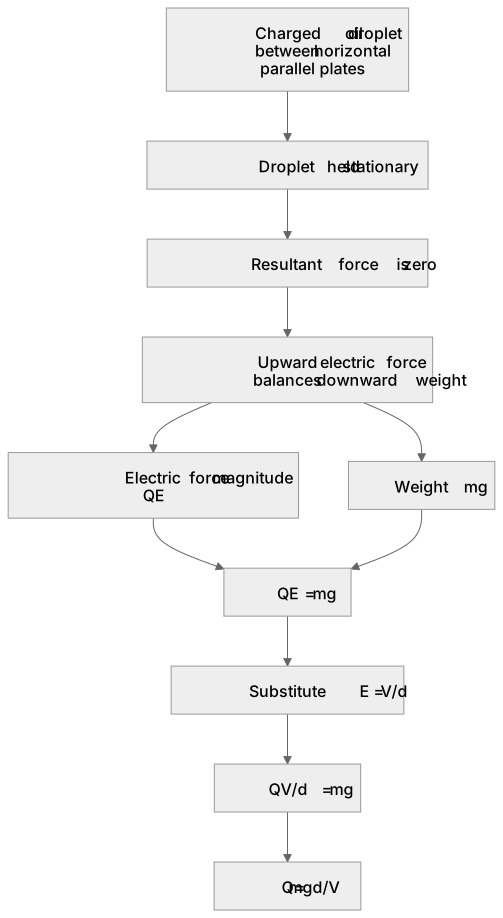
In Millikan’s experiment, a charged oil droplet is held stationary between two horizontal parallel plates connected to a voltage supply. For the droplet to remain at rest, the resultant force on it must be zero. The forces are the weight mg acting downwards and the electric force acting upwards. The electric force has magnitude QE, where Q is the droplet’s charge and E is the uniform electric field strength between the plates. The field is related to the potential difference V and plate separation d by E = V/d. The condition is therefore QE = mg, or QV/d = mg. This allows the charge Q to be found from measurements of V, d and m. In Millikan’s method, the droplet’s mass is determined from its terminal velocity when falling without the electric field, and the charge is found to be an integer multiple of the elementary charge e.
What earns the marks
- For the droplet to be stationary, the resultant force must be zero, so the upward electric force balances the downward weight.
- The electric force on a charge Q in a uniform field E has magnitude QE, and its direction depends on the sign of Q and the direction of E.
- The uniform field between parallel plates is E = V/d, where V is the potential difference and d is the plate separation.
- The weight of the droplet is mg, where m is its mass and g is the gravitational field strength.
- The condition is QE = mg, which may be written QV/d = mg.
- The charge Q can be calculated from Q = mgd/V once m, g, d and V are known.
- In Millikan’s experiment, the droplet is held stationary by adjusting V, and the measured charges are found to be multiples of e.
Common mistakes and how to put them right
Omitting the electric field relation.
Put it right: QV/d = mg.
Forgetting that forces must balance.
Put it right: QE = mg.
Assuming the droplet is uncharged.
Put it right: The droplet carries a charge Q.
Exam tips
- Begin by stating that the droplet is in equilibrium, so the resultant force is zero.
- Write the force balance as QE = mg and then substitute E = V/d to obtain QV/d = mg.
- When calculating, keep consistent SI units and rearrange carefully before substituting numbers.
Try the lesson
The start of the Principle of Millikan’s determination of the electronic charge, e (A-level only): Condition for holding a charged oil droplet, of charge Q, stationary between oppositely charged parallel plates. lesson, made from checked teaching notes for this specification point.
Have a go first
In Millikan’s experiment, a charged oil droplet is held stationary between two oppositely charged horizontal plates. Which condition must be satisfied?
Listen
In Millikan’s experiment, a charged oil droplet is held stationary between two horizontal parallel plates connected to a voltage supply. For the droplet to remain at rest, the resultant force on it must be zero. The forces are the weight mg acting downwards and the electric force acting upwards. The electric force has magnitude QE, where Q is the droplet’s charge and E is the uniform electric field strength between the plates. The field is related to the potential difference V and plate separation d by E = V/d. The condition is therefore QE = mg, or QV/d = mg. This allows the charge Q to be found from measurements of V, d and m. In Millikan’s method, the droplet’s mass is determined from its terminal velocity when falling without the electric field, and the charge is found to be an integer multiple of the elementary charge e. A strong answer earns marks for these points. For the droplet to be stationary, the resultant force must be zero, so the upward electric force balances the downward weight. The electric force on a charge Q in a uniform field E has magnitude QE, and its direction depends on the sign of Q and the direction of E. The uniform field between parallel plates is E = V/d, where V is the potential difference and d is the plate separation. The weight of the droplet is mg, where m is its mass and g is the gravitational field strength. A common slip: Omitting the electric field relation: the error is using QV = mg without including plate separation. Instead, QV/d = mg. Exam tip: Begin by stating that the droplet is in equilibrium, so the resultant force is zero.
See it
Key words
Say what each word means before you turn the card.
Equilibrium of forces
Try answering aloud or in your head before turning the card.
Uniform electric fields
Try answering aloud or in your head before turning the card.
Electric force on a charge
Try answering aloud or in your head before turning the card.
Measurement of elementary charge
Try answering aloud or in your head before turning the card.
See every definition
- Equilibrium of forces
- The condition in which the resultant force on the droplet is zero, so the upward electric force balances the downward weight.
- Uniform electric fields
- The field between parallel plates, related to the potential difference V and plate separation d by E = V/d.
- Electric force on a charge
- A force of magnitude QE on a charge Q in a uniform field E, whose direction depends on the sign of Q and the direction of E.
- Measurement of elementary charge
- Millikan’s method, in which the droplet is held stationary by adjusting V and the measured charges are found to be multiples of e.
Label the diagram
Some boxes have lost their names. Pick the right name for each number.
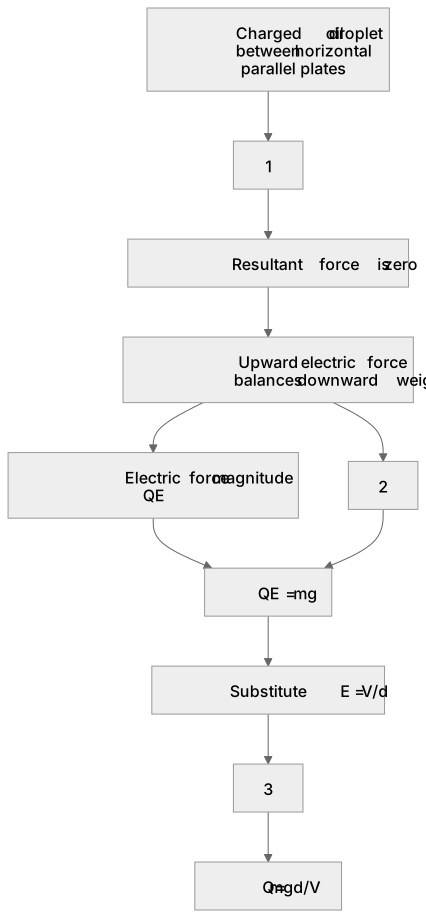
1Box 1
2Box 2
3Box 3
There is more to this lesson
The full lesson goes on to check your understanding and help you earn the marks. Create a free account to carry on, with your progress saved.
A week of Premium from your first lesson · Then the free plan continues · No card, no charge
Test your understanding of Principle of Millikan’s determination of the electronic charge, e (A-level only): Condition for holding a charged oil droplet, of charge Q, stationary between oppositely charged parallel plates.
Active recall beats re-reading. Take an instant quiz now to test what you’ve learned and lock it into long-term memory.
A week of Premium from your first lesson · Then the free plan continues · No card, no charge