AQA · A-Level · Physics
Course version: 7408 · Version from Sept 2016
Quantisation of electric charge.
Full specification wording
Principle of Millikan’s determination of the electronic charge, e (A-level only): Quantisation of electric charge.
Quantisation of electric charge means that any electric charge is an integer multiple of a fundamental unit, the elementary charge e.
Checked against the AQA 7408 specification (opens in a new tab) on .
- Point 5 of 5
- 3 key terms
Study notes
From the checked teaching notes for this specification point.
The idea
Quantisation of electric charge means that any electric charge is an integer multiple of a fundamental unit, the elementary charge e. In Millikan’s experiment, tiny charged oil droplets were balanced or moved by an electric field, and their charges were calculated from force balances. The measured charges were always close to whole-number multiples of about 1.60 × 10⁻¹⁹ C, never arbitrary fractions of it. This showed that charge comes in discrete packets, now understood as the charge carried by electrons and protons. The elementary charge magnitude is e = 1.60 × 10⁻¹⁹ C, and a body’s charge can be written Q = ne, where n is an integer.
What earns the marks
- Quantisation means electric charge exists only in discrete amounts that are integer multiples of the elementary charge e.
- The elementary charge magnitude is e = 1.60 × 10⁻¹⁹ C, equal to the magnitude of the charge on an electron or proton.
- For a charged body, Q = ne where n is an integer, so possible charges include 0, ±e, ±2e and so on.
- Millikan’s oil-drop results supported quantisation because measured droplet charges clustered around integer multiples of e.
- The value of e obtained from the smallest common charge is consistent with the charge on a single electron.
- Quantisation explains why charge is not transferred in arbitrarily small continuous amounts in everyday electrostatic processes.
Common mistakes and how to put them right
Writing that charge can take any value.
Put it right by stating that charge is quantised as integer multiples of e.
Confusing e with the base of natural logarithms.
Put it right by using e specifically for the elementary charge magnitude, 1.60 × 10⁻¹⁹ C.
Forgetting that n must be an integer in Q = ne.
Put it right by checking that calculated values of n are whole numbers within experimental uncertainty.
Exam tips
- Use Q = ne and show that n is an integer when interpreting Millikan-type data.
- Quote e = 1.60 × 10⁻¹⁹ C with the correct unit and sign convention when explaining charge quantisation.
- Link the experimental observation of whole-number multiples directly to the word quantisation in your answer.
Try the lesson
The start of the Principle of Millikan’s determination of the electronic charge, e (A-level only): Quantisation of electric charge. lesson, made from checked teaching notes for this specification point.
Have a go first
Which statement describes the quantisation of electric charge as shown by Millikan's oil-drop experiment?
Listen
Quantisation of electric charge means that any electric charge is an integer multiple of a fundamental unit, the elementary charge e. In Millikan’s experiment, tiny charged oil droplets were balanced or moved by an electric field, and their charges were calculated from force balances. The measured charges were always close to whole-number multiples of about 1.60 × 10⁻¹⁹ C, never arbitrary fractions of it. This showed that charge comes in discrete packets, now understood as the charge carried by electrons and protons. The elementary charge magnitude is e = 1.60 × 10⁻¹⁹ C, and a body’s charge can be written Q = ne, where n is an integer. A strong answer earns marks for these points. Quantisation means electric charge exists only in discrete amounts that are integer multiples of the elementary charge e. The elementary charge magnitude is e = 1.60 × 10⁻¹⁹ C, equal to the magnitude of the charge on an electron or proton. For a charged body, Q = ne where n is an integer, so possible charges include 0, ±e, ±2e and so on. Millikan’s oil-drop results supported quantisation because measured droplet charges clustered around integer multiples of e. A common slip: Writing that charge can take any value. Instead, stating that charge is quantised as integer multiples of e. Exam tip: Use Q = ne and show that n is an integer when interpreting Millikan-type data.
See it
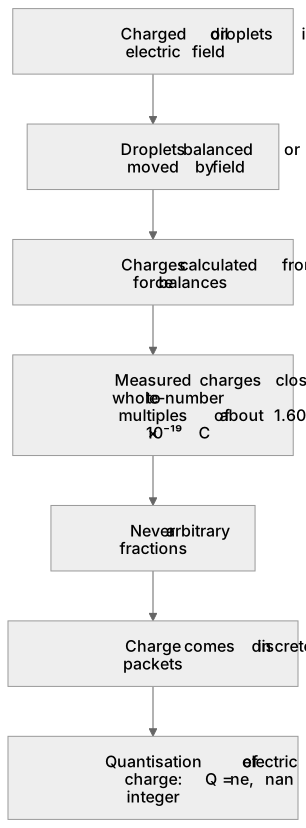
Put it in order
Put these steps in the order they happen.
- 1. Quantisation of electric charge: Q = ne, n an integer
- 2. Charge comes in discrete packets
- 3. Charges calculated from force balances
- 4. Never arbitrary fractions
- 5. Charged oil droplets in electric field
- 6. Droplets balanced or moved by field
- 7. Measured charges close to whole-number multiples of about 1.60 × 10⁻¹⁹ C
Key words
Say what each word means before you turn the card.
Elementary charge
Try answering aloud or in your head before turning the card.
Quantisation of electric charge
Try answering aloud or in your head before turning the card.
Millikan’s oil-drop experiment
Try answering aloud or in your head before turning the card.
See every definition
- Elementary charge
- A fundamental unit of charge, with magnitude e = 1.60 × 10⁻¹⁹ C, equal to the magnitude of the charge on an electron or proton.
- Quantisation of electric charge
- Electric charge exists only in discrete amounts that are integer multiples of the elementary charge e, never arbitrary fractions of it.
- Millikan’s oil-drop experiment
- Tiny charged oil droplets were balanced or moved by an electric field, and their charges were calculated from force balances, clustering around integer multiples of e.
Label the diagram
Some boxes have lost their names. Pick the right name for each number.
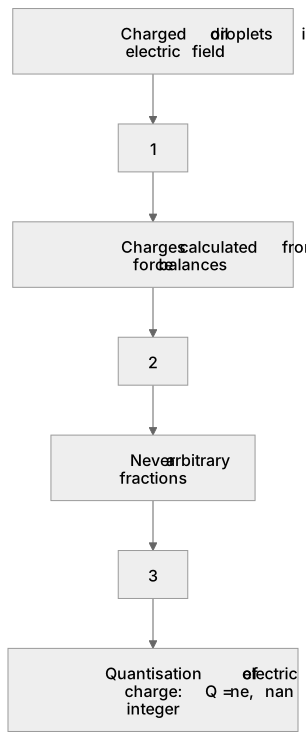
1Box 1
2Box 2
3Box 3
There is more to this lesson
The full lesson goes on to check your understanding and help you earn the marks. Create a free account to carry on, with your progress saved.
A week of Premium from your first lesson · Then the free plan continues · No card, no charge
Test your understanding of Principle of Millikan’s determination of the electronic charge, e (A-level only): Quantisation of electric charge.
Active recall beats re-reading. Take an instant quiz now to test what you’ve learned and lock it into long-term memory.
A week of Premium from your first lesson · Then the free plan continues · No card, no charge