AQA · A-Level · Physics
Course version: 7408 · Version from Sept 2016
2l μ The formation of stationary waves by two waves of the same frequency…
Full specification wording
Principle of superposition of waves and formation of stationary waves: 2l μ The formation of stationary waves by two waves of the same frequency travelling in opposite directions.
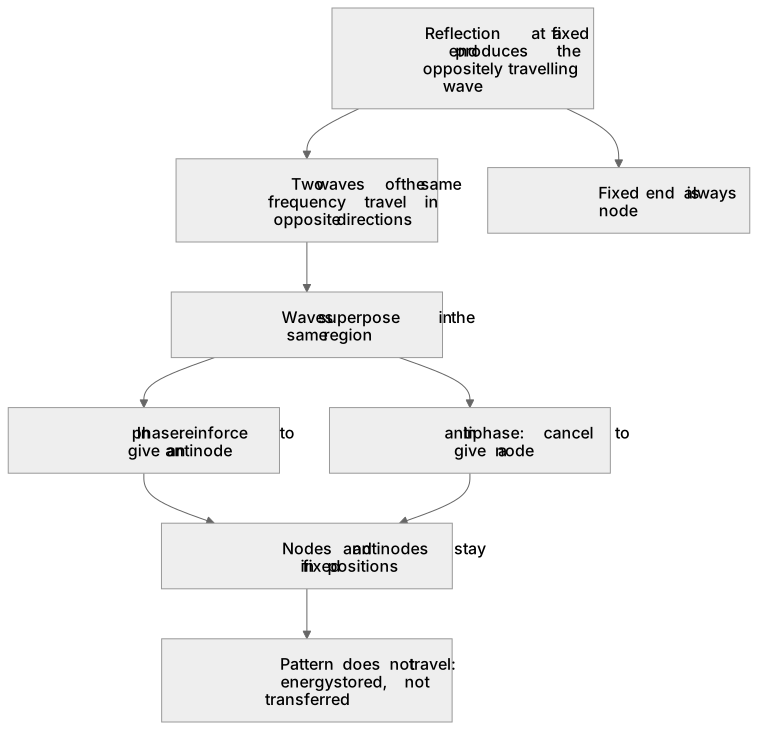
A stationary wave forms when two progressive waves of the same frequency and similar amplitude travel in opposite directions through the same region and superpose.
Checked against the AQA 7408 specification (opens in a new tab) on .
- Point 3 of 7
- 4 key terms
Study notes
From the checked teaching notes for this specification point.
The idea
A stationary wave forms when two progressive waves of the same frequency and similar amplitude travel in opposite directions through the same region and superpose. On a stretched string, a wave travelling towards a fixed end reflects and travels back, so the incident and reflected waves meet. Where the waves are in phase they reinforce to give an antinode; where they are in antiphase they cancel to give a node. The pattern does not travel along the string: the nodes and antinodes stay in fixed positions, and energy is stored rather than transferred. The frequency is the same for both waves, so the pattern has that frequency, but the distance between adjacent nodes is half the wavelength. The speed of transverse waves on a string is given by v = √(T/μ), where T is the tension and μ is the mass per unit length, so the frequency of a given mode depends on tension, length and μ.
What earns the marks
- Stationary waves form when two waves of the same frequency travel in opposite directions and superpose.
- The waves must have the same frequency; if the frequencies differ, the pattern of nodes and antinodes moves and is not stationary.
- Reinforcement occurs where the waves arrive in phase, giving an antinode; cancellation occurs where they arrive in antiphase, giving a node.
- The nodes and antinodes remain in fixed positions, so the stationary wave does not transfer energy along the string.
- On a string, reflection at a fixed end produces the oppositely travelling wave, and the fixed end is always a node.
- The wave speed on a string is v = √(T/μ), where T is the tension and μ is the mass per unit length, linking the mode frequency to the physical properties of the string.
Common mistakes and how to put them right
Saying that a stationary wave is produced by a single wave bouncing back and forth.
Put it right by describing two waves of the same frequency travelling in opposite directions that superpose.
Believing that energy travels along a stationary wave from one end to the other.
Put it right by stating that energy is stored between the nodes and there is no net transfer along the string.
Using v = fλ with the node-to-node distance as λ.
Put it right by using the full wavelength, which is twice the node-to-node distance.
Exam tips
- State explicitly that the two waves have the same frequency and travel in opposite directions; both conditions are needed for a stationary wave.
- Link any calculation to the boundary condition that a fixed end is a node, then use L = nλ/2 before applying v = fλ.
- If a question gives tension and mass per unit length, calculate v = √(T/μ) first, then combine it with the allowed wavelengths to find frequencies.
Try the lesson
The start of the Principle of superposition of waves and formation of stationary waves: 2l μ The formation of stationary waves by two waves of the same frequency travelling in opposite directions. lesson, made from checked teaching notes for this specification point.
Have a go first
Which two waves can combine to form a stationary wave?
Listen
A stationary wave forms when two progressive waves of the same frequency and similar amplitude travel in opposite directions through the same region and superpose. On a stretched string, a wave travelling towards a fixed end reflects and travels back, so the incident and reflected waves meet. Where the waves are in phase they reinforce to give an antinode; where they are in antiphase they cancel to give a node. The pattern does not travel along the string: the nodes and antinodes stay in fixed positions, and energy is stored rather than transferred. The frequency is the same for both waves, so the pattern has that frequency, but the distance between adjacent nodes is half the wavelength. The speed of transverse waves on a string is given by v = √(T/μ), where T is the tension and μ is the mass per unit length, so the frequency of a given mode depends on tension, length and μ. A strong answer earns marks for these points. Stationary waves form when two waves of the same frequency travel in opposite directions and superpose. The waves must have the same frequency; if the frequencies differ, the pattern of nodes and antinodes moves and is not stationary. Reinforcement occurs where the waves arrive in phase, giving an antinode; cancellation occurs where they arrive in antiphase, giving a node. The nodes and antinodes remain in fixed positions, so the stationary wave does not transfer energy along the string. A common slip: Saying that a stationary wave is produced by a single wave bouncing back and forth. Instead, describing two waves of the same frequency travelling in opposite directions that superpose. Exam tip: State explicitly that the two waves have the same frequency and travel in opposite directions; both conditions are needed for a stationary wave.
See it
Key words
Say what each word means before you turn the card.
Stationary wave
Try answering aloud or in your head before turning the card.
Node
Try answering aloud or in your head before turning the card.
Antinode
Try answering aloud or in your head before turning the card.
Wave speed on a stretched string
Try answering aloud or in your head before turning the card.
See every definition
- Stationary wave
- A pattern formed when two waves of the same frequency travelling in opposite directions superpose, with nodes and antinodes in fixed positions.
- Node
- A point where the waves arrive in antiphase and cancel.
- Antinode
- A point where the waves arrive in phase and reinforce.
- Wave speed on a stretched string
- Given by v = √(T/μ), where T is the tension and μ is the mass per unit length.
Label the diagram
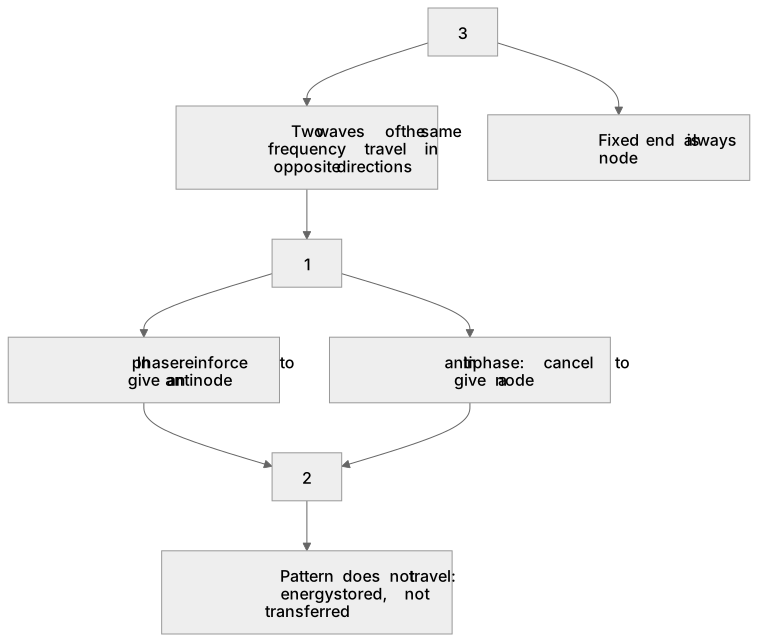
Some boxes have lost their names. Pick the right name for each number.
1Box 1
2Box 2
3Box 3
There is more to this lesson
The full lesson goes on to check your understanding and help you earn the marks. Create a free account to carry on, with your progress saved.
A week of Premium from your first lesson · Then the free plan continues · No card, no charge
Test your understanding of Principle of superposition of waves and formation of stationary waves: 2l μ The formation of stationary waves by two waves of the same frequency travelling in opposite directions.
Active recall beats re-reading. Take an instant quiz now to test what you’ve learned and lock it into long-term memory.
A week of Premium from your first lesson · Then the free plan continues · No card, no charge