AQA · A-Level · Physics
Course version: 7408 · Version from Sept 2016
Stationary waves on strings will be described in terms of harmonics. The…
Full specification wording
Principle of superposition of waves and formation of stationary waves: Stationary waves on strings will be described in terms of harmonics. The terms fundamental (for first harmonic) and overtone will not be used.
A stationary wave on a string forms when two identical progressive waves travelling in opposite directions superpose.
Checked against the AQA 7408 specification (opens in a new tab) on .
- Point 6 of 7
- 4 key terms
Study notes
From the checked teaching notes for this specification point.
The idea
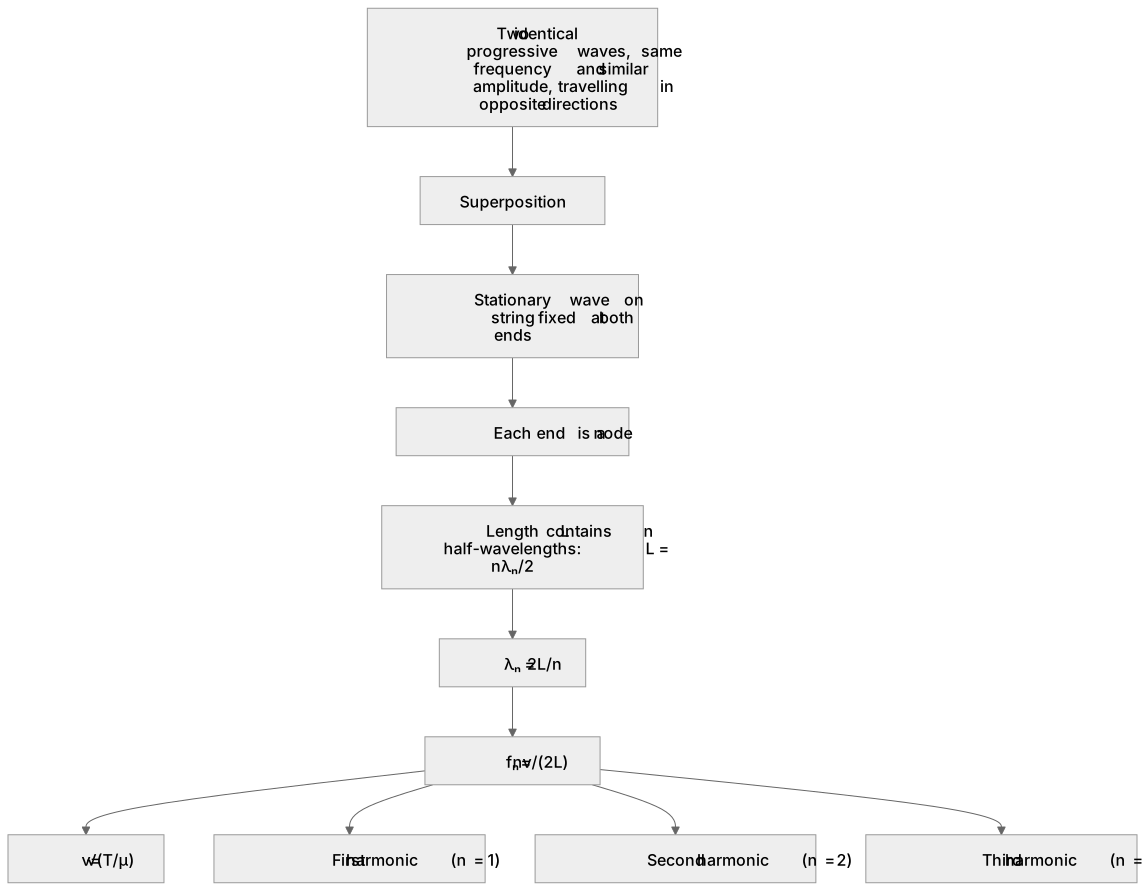
A stationary wave on a string forms when two identical progressive waves travelling in opposite directions superpose. For a string fixed at both ends, the ends must be nodes, so only certain wavelengths fit: L = nλₙ/2, giving λₙ = 2L/n. The allowed frequencies are fₙ = nv/(2L), where v = √(T/μ), T is tension and μ is mass per unit length. AQA requires these modes to be described as harmonics: first harmonic (n = 1), second harmonic (n = 2), third harmonic (n = 3), and so on. The labels fundamental and overtone must not be used.
For example: A 0.80 m string with v = 240 m s⁻¹ has first-harmonic frequency 150 Hz, second harmonic 300 Hz and third harmonic 450 Hz.
What earns the marks
- A stationary wave on a string is produced by the superposition of two progressive waves of the same frequency and similar amplitude travelling in opposite directions along the string.
- For a string fixed at both ends, each end is a node, so the length L contains a whole number n of half-wavelengths: L = nλₙ/2, hence λₙ = 2L/n.
- The harmonic number n equals the number of half-wavelengths on the string and also the number of antinodes present.
- The frequency of the nth harmonic is fₙ = nv/(2L), where v is the wave speed on the string.
- The wave speed is given by v = √(T/μ), where T is the tension and μ is the mass per unit length, so fₙ = (n/2L)√(T/μ).
- The first harmonic is the lowest-frequency stationary-wave mode; the second harmonic has twice that frequency and the third harmonic three times it, for an ideal string.
- Answers must use harmonic terminology: first harmonic, second harmonic, third harmonic; the terms fundamental and overtone are not used in this specification.
Common mistakes and how to put them right
Writing that the string length equals one wavelength for the first harmonic.
Put it right: The length equals one half-wavelength, so λ₁ = 2L.
Calling the lowest mode the fundamental or labelling higher modes as overtones.
Put it right: Use first harmonic, second harmonic and third harmonic.
Assuming frequency is directly proportional to tension.
Put it right: fₙ ∝ √T, because v = √(T/μ).
Treating the harmonic number as the number of nodes.
Put it right: n is the number of half-wavelengths and the number of antinodes, while the number of nodes is n + 1.
Exam tips
- Sketch the string for n = 1, 2 and 3, labelling nodes N and antinodes A, then count half-wavelengths to choose the correct relationship.
- When a question gives tension and mass per unit length, calculate v = √(T/μ) first, then substitute into fₙ = nv/(2L).
- Use harmonic vocabulary throughout; avoid the words fundamental and overtone even if they appear in general reading.
- Check unit consistency: convert grams per metre to kilograms per metre and centimetres to metres before calculating.
Try the lesson
The start of the Principle of superposition of waves and formation of stationary waves: Stationary waves on strings will be described in terms of harmonics. The terms fundamental (for first harmonic) and overtone will not be used. lesson, made from checked teaching notes for this specification point.
Have a go first
A string fixed at both ends forms a stationary wave. How many antinodes are present in the third harmonic?
Listen
A stationary wave on a string forms when two identical progressive waves travelling in opposite directions superpose. For a string fixed at both ends, the ends must be nodes, so only certain wavelengths fit: L = nλₙ/2, giving λₙ = 2L/n. The allowed frequencies are fₙ = nv/(2L), where v = √(T/μ), T is tension and μ is mass per unit length. AQA requires these modes to be described as harmonics: first harmonic (n = 1), second harmonic (n = 2), third harmonic (n = 3), and so on. The labels fundamental and overtone must not be used. For example, a 0.80 m string with v = 240 m s⁻¹ has first-harmonic frequency 150 Hz, second harmonic 300 Hz and third harmonic 450 Hz. A strong answer earns marks for these points. A stationary wave on a string is produced by the superposition of two progressive waves of the same frequency and similar amplitude travelling in opposite directions along the string. For a string fixed at both ends, each end is a node, so the length L contains a whole number n of half-wavelengths: L = nλₙ/2, hence λₙ = 2L/n. The harmonic number n equals the number of half-wavelengths on the string and also the number of antinodes present. The frequency of the nth harmonic is fₙ = nv/(2L), where v is the wave speed on the string. A common slip: Writing that the string length equals one wavelength for the first harmonic. Instead, the length equals one half-wavelength, so λ₁ = 2L. Exam tip: Sketch the string for n = 1, 2 and 3, labelling nodes N and antinodes A, then count half-wavelengths to choose the correct relationship.
See it
Key words
Say what each word means before you turn the card.
Stationary wave on a string
Try answering aloud or in your head before turning the card.
Harmonics
Try answering aloud or in your head before turning the card.
Harmonic number n
Try answering aloud or in your head before turning the card.
Wave speed on a string
Try answering aloud or in your head before turning the card.
See every definition
- Stationary wave on a string
- Forms when two identical progressive waves travelling in opposite directions superpose, with each end of a string fixed at both ends being a node.
- Harmonics
- The allowed modes of a string fixed at both ends, described as first harmonic (n = 1), second harmonic (n = 2), third harmonic (n = 3), and so on.
- Harmonic number n
- Equals the number of half-wavelengths on the string and also the number of antinodes present.
- Wave speed on a string
- Given by v = √(T/μ), where T is the tension and μ is the mass per unit length.
Label the diagram
Some boxes have lost their names. Pick the right name for each number.
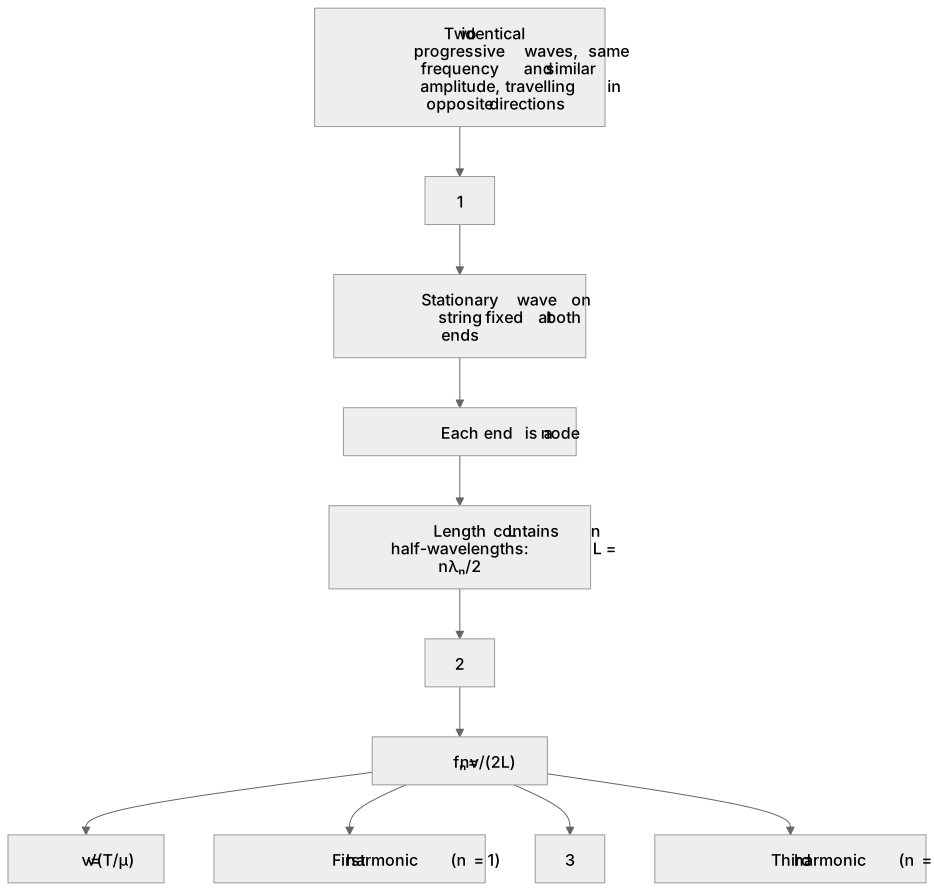
1Box 1
2Box 2
3Box 3
There is more to this lesson
The full lesson goes on to check your understanding and help you earn the marks. Create a free account to carry on, with your progress saved.
A week of Premium from your first lesson · Then the free plan continues · No card, no charge
Test your understanding of Principle of superposition of waves and formation of stationary waves: Stationary waves on strings will be described in terms of harmonics. The terms fundamental (for first harmonic) and overtone will not be used.
Active recall beats re-reading. Take an instant quiz now to test what you’ve learned and lock it into long-term memory.
A week of Premium from your first lesson · Then the free plan continues · No card, no charge