AQA · A-Level · Physics
Course version: 7408 · Version from Sept 2016
Qualitative understanding of the effect of air resistance on the…
Full specification wording
Projectile motion: Qualitative understanding of the effect of air resistance on the trajectory of a projectile and on the factors that affect the maximum speed of a vehicle.
Final Result: Air resistance makes a projectile's descent steeper than its ascent and reduces maximum vehicle speed.
Checked against the AQA 7408 specification (opens in a new tab) on .
- Point 7 of 7
- 4 key terms
Study notes
From the checked teaching notes for this specification point.
The idea
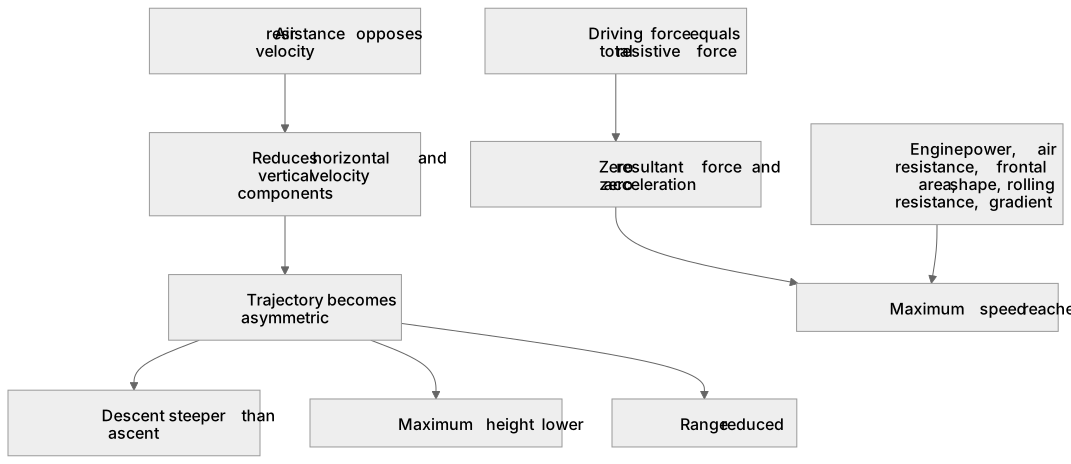
Final Result: Air resistance makes a projectile's descent steeper than its ascent and reduces maximum vehicle speed. In ideal projectile motion, the path is a symmetric parabola. With air resistance, drag opposes velocity, causing the projectile to decelerate horizontally throughout. The trajectory becomes asymmetric: the descent is steeper than the ascent, maximum height is lower, and range is reduced. For vehicles, maximum speed occurs when driving force equals total resistive forces, yielding zero acceleration. Factors affecting maximum speed include engine power, air resistance (dependent on speed, shape, frontal area), rolling resistance, and road gradient.
What earns the marks
- Explains that air resistance opposes the velocity of a projectile at every point, reducing both horizontal and vertical velocity components.
- Describes the resulting trajectory as asymmetric, with reduced range, lower maximum height, and a descent that is steeper than the ascent.
- States that a vehicle reaches maximum speed when the driving force equals the total resistive force, giving zero resultant force and zero acceleration.
- Identifies factors affecting maximum speed, such as engine power, air resistance, frontal area, shape, rolling resistance and gradient.
- Explains that increasing speed increases air resistance, so a greater driving force is needed to maintain or increase speed.
Common mistakes and how to put them right
Claiming the projectile still follows a perfect parabola with air resistance.
Put it right by describing an asymmetric path with reduced range.
Saying maximum speed occurs when driving force is maximum.
Put it right by stating it occurs when driving force equals total resistive force.
Ignoring rolling resistance or gradient and attributing maximum speed only to air resistance.
Put it right by listing several resistive factors.
Exam tips
- Sketch the ideal and real trajectories side by side to show the asymmetry clearly, ensuring the descent is drawn steeper.
- Use the balance-of-forces argument: at maximum speed, resultant force is zero, so acceleration is zero.
- When listing factors, group them as driving factors and resistive factors to structure your answer.
Try the lesson
The start of the Projectile motion: Qualitative understanding of the effect of air resistance on the trajectory of a projectile and on the factors that affect the maximum speed of a vehicle. lesson, made from checked teaching notes for this specification point.
Have a go first
A projectile is launched in air rather than in a vacuum. Compared with the vacuum trajectory, how does air resistance change the path?
Listen
Final Result: Air resistance makes a projectile's descent steeper than its ascent and reduces maximum vehicle speed. In ideal projectile motion, the path is a symmetric parabola. With air resistance, drag opposes velocity, causing the projectile to decelerate horizontally throughout. The trajectory becomes asymmetric: the descent is steeper than the ascent, maximum height is lower, and range is reduced. For vehicles, maximum speed occurs when driving force equals total resistive forces, yielding zero acceleration. Factors affecting maximum speed include engine power, air resistance (dependent on speed, shape, frontal area), rolling resistance, and road gradient. A strong answer earns marks for these points. Explains that air resistance opposes the velocity of a projectile at every point, reducing both horizontal and vertical velocity components. Describes the resulting trajectory as asymmetric, with reduced range, lower maximum height, and a descent that is steeper than the ascent. States that a vehicle reaches maximum speed when the driving force equals the total resistive force, giving zero resultant force and zero acceleration. Identifies factors affecting maximum speed, such as engine power, air resistance, frontal area, shape, rolling resistance and gradient. A common slip: Claiming the projectile still follows a perfect parabola with air resistance. Instead, describing an asymmetric path with reduced range. Exam tip: Sketch the ideal and real trajectories side by side to show the asymmetry clearly, ensuring the descent is drawn steeper.
See it
Key words
Say what each word means before you turn the card.
Projectile motion with drag
Try answering aloud or in your head before turning the card.
Terminal velocity and force balance
Try answering aloud or in your head before turning the card.
Vehicle dynamics
Try answering aloud or in your head before turning the card.
Qualitative modelling
Try answering aloud or in your head before turning the card.
See every definition
- Projectile motion with drag
- Air resistance opposes the velocity of a projectile at every point, reducing both horizontal and vertical velocity components and making the trajectory asymmetric.
- Terminal velocity and force balance
- A vehicle reaches maximum speed when the driving force equals the total resistive force, giving zero resultant force and zero acceleration.
- Vehicle dynamics
- Factors affecting maximum speed include engine power, air resistance, frontal area, shape, rolling resistance and gradient.
- Qualitative modelling
- With air resistance the trajectory becomes asymmetric, with reduced range, lower maximum height, and a descent that is steeper than the ascent.
Label the diagram
Some boxes have lost their names. Pick the right name for each number.
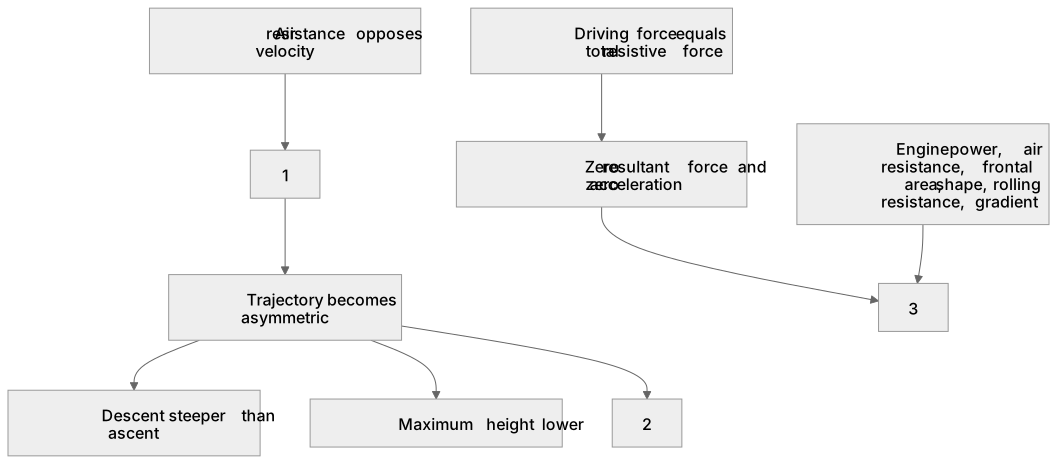
1Box 1
2Box 2
3Box 3
There is more to this lesson
The full lesson goes on to check your understanding and help you earn the marks. Create a free account to carry on, with your progress saved.
A week of Premium from your first lesson · Then the free plan continues · No card, no charge
Test your understanding of Projectile motion: Qualitative understanding of the effect of air resistance on the trajectory of a projectile and on the factors that affect the maximum speed of a vehicle.
Active recall beats re-reading. Take an instant quiz now to test what you’ve learned and lock it into long-term memory.
A week of Premium from your first lesson · Then the free plan continues · No card, no charge