AQA · A-Level · Physics
Course version: 7408 · Version from Sept 2016
Applications eg relevance to storage of radioactive waste, radioactive…
Full specification wording
Radioactive decay (A-level only): Applications eg relevance to storage of radioactive waste, radioactive dating etc.
Radioactive decay has practical consequences because each nuclide has a characteristic half-life and type of emission.
Checked against the AQA 7408 specification (opens in a new tab) on .
- 2 key terms
Study notes
From the checked teaching notes for this specification point.
The idea
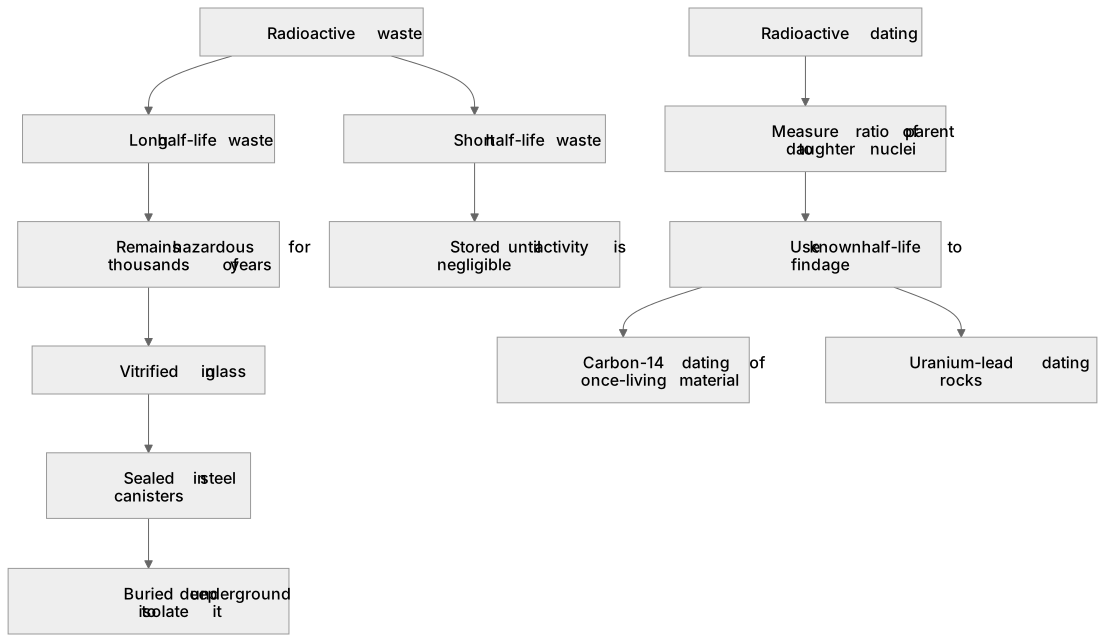
Radioactive decay has practical consequences because each nuclide has a characteristic half-life and type of emission. In waste storage, long half-life nuclides such as plutonium-239 remain hazardous for thousands of years, so they are vitrified in glass, sealed in steel canisters and buried deep underground to isolate them while activity falls. Short half-life waste can be stored until its activity is negligible. In radioactive dating, the ratio of parent to daughter nuclei is measured. For carbon-14 dating, living material exchanges carbon until death; afterwards carbon-14 decays with a half-life of about 5730 years, so the remaining fraction gives an age up to roughly 50000 years. For rocks, uranium-lead dating uses a very long half-life, so it works over billions of years. The same decay equations and half-life calculations underpin both applications.
What earns the marks
- State that the hazard of radioactive waste depends on half-life, activity and type of radiation emitted.
- Explain that long half-life waste remains radioactive for a very long time, so isolation from the environment is needed.
- Describe storage methods such as vitrification, sealing in canisters and deep geological disposal.
- Explain that short half-life waste can be stored until its activity has fallen to a safe level.
- Describe radioactive dating as using the ratio of parent to daughter nuclei and the known half-life.
- Apply the decay equation or half-life relationship to calculate an age or a remaining fraction.
- Compare carbon-14 dating with uranium-lead dating in terms of useful range and half-life.
Common mistakes and how to put them right
Thinking that a long half-life means the waste is safe because activity is low.
Put it right: A long half-life means it stays radioactive for a very long time, so isolation is needed for thousands of years.
Confusing half-life with the time for all activity to stop.
Put it right: Activity halves in each half-life and never reaches exactly zero in a finite time.
Using carbon-14 dating for samples older than about 50000 years or for non-living material.
Put it right: Carbon-14 has a relatively short half-life and only dates once-living material over a limited range.
Exam tips
- Link each application to the half-life value and the type of radiation emitted, not just to the word radioactive.
- Show the decay calculation clearly, including the fraction remaining and the number of half-lives.
- Use precise terms such as parent nuclei, daughter nuclei, activity, half-life and isolation when describing waste storage.
Try the lesson
The start of the Radioactive decay (A-level only): Applications eg relevance to storage of radioactive waste, radioactive dating etc. lesson, made from checked teaching notes for this specification point.
Have a go first
Which property of a radioactive waste material determines how long it must be stored safely?
Listen
Radioactive decay has practical consequences because each nuclide has a characteristic half-life and type of emission. In waste storage, long half-life nuclides such as plutonium-239 remain hazardous for thousands of years, so they are vitrified in glass, sealed in steel canisters and buried deep underground to isolate them while activity falls. Short half-life waste can be stored until its activity is negligible. In radioactive dating, the ratio of parent to daughter nuclei is measured. For carbon-14 dating, living material exchanges carbon until death; afterwards carbon-14 decays with a half-life of about 5730 years, so the remaining fraction gives an age up to roughly 50000 years. For rocks, uranium-lead dating uses a very long half-life, so it works over billions of years. The same decay equations and half-life calculations underpin both applications. A strong answer earns marks for these points. State that the hazard of radioactive waste depends on half-life, activity and type of radiation emitted. Explain that long half-life waste remains radioactive for a very long time, so isolation from the environment is needed. Describe storage methods such as vitrification, sealing in canisters and deep geological disposal. Explain that short half-life waste can be stored until its activity has fallen to a safe level. A common slip: Thinking that a long half-life means the waste is safe because activity is low. Instead, a long half-life means it stays radioactive for a very long time, so isolation is needed for thousands of years. Exam tip: Link each application to the half-life value and the type of radiation emitted, not just to the word radioactive.
See it
Key words
Say what each word means before you turn the card.
Half-life
Try answering aloud or in your head before turning the card.
Radioactive dating
Try answering aloud or in your head before turning the card.
See every definition
- Half-life
- The time in which activity halves, so it never reaches exactly zero in a finite time.
- Radioactive dating
- A method using the ratio of parent to daughter nuclei and the known half-life to calculate an age.
Label the diagram
Some boxes have lost their names. Pick the right name for each number.
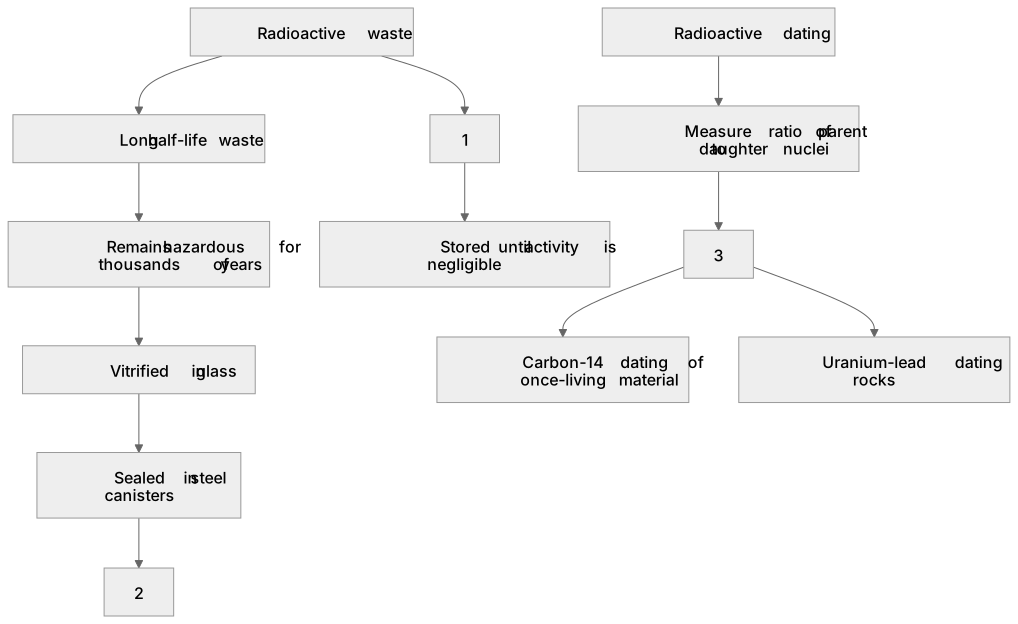
1Box 1
2Box 2
3Box 3
There is more to this lesson
The full lesson goes on to check your understanding and help you earn the marks. Create a free account to carry on, with your progress saved.
A week of Premium from your first lesson · Then the free plan continues · No card, no charge
Test your understanding of Radioactive decay (A-level only): Applications eg relevance to storage of radioactive waste, radioactive dating etc.
Active recall beats re-reading. Take an instant quiz now to test what you’ve learned and lock it into long-term memory.
A week of Premium from your first lesson · Then the free plan continues · No card, no charge