AQA · A-Level · Physics
Course version: 7408 · Version from Sept 2016
Cassegrain arrangement using a parabolic concave primary mirror and convex…
Full specification wording
Reflecting telescopes (A-level only): Cassegrain arrangement using a parabolic concave primary mirror and convex secondary mirror.
A Cassegrain reflecting telescope collects light with a large parabolic concave primary mirror.
Checked against the AQA 7408 specification (opens in a new tab) on .
- Point 1 of 3
- 4 key terms
Study notes
From the checked teaching notes for this specification point.
The idea
A Cassegrain reflecting telescope collects light with a large parabolic concave primary mirror. Parallel rays from a distant object reflect to the primary focus, but before reaching it they meet a small convex secondary mirror placed near the focus. The secondary mirror reflects the converging beam back through a hole in the centre of the primary mirror to a final focus behind the primary, where the eyepiece or detector sits. The parabolic primary removes spherical aberration for on-axis parallel rays, while the convex secondary increases the effective focal length and allows a long focal length to be folded into a compact tube. The secondary also causes some obstruction of the incoming light. The arrangement is assessed by explaining the path of rays, the role of each mirror and the advantages of the folded design.
What earns the marks
- States that the primary mirror is concave and parabolic, and that it collects parallel light from a distant object.
- Explains that the convex secondary mirror is placed before the primary focus and reflects the converging beam back through a hole in the primary mirror.
- Describes the final image forming behind the primary mirror, where the eyepiece or detector is placed.
- Explains that the parabolic primary avoids spherical aberration for on-axis parallel rays.
- Explains that the convex secondary increases the effective focal length and folds the optical path so the telescope is compact.
- Recognises that the secondary mirror obstructs part of the incoming light and may introduce diffraction effects.
Common mistakes and how to put them right
Stating that the secondary mirror is concave.
Put it right by identifying it as convex, which diverges the converging beam and increases the effective focal length.
Placing the secondary mirror after the primary focus.
Put it right by placing it before the primary focus so it intercepts the converging beam.
Claiming that the final image forms in front of the primary mirror.
Put it right by stating that the beam passes through a hole in the primary and forms the final image behind it.
Saying that a parabolic mirror removes all aberrations.
Put it right by stating that it removes spherical aberration for on-axis parallel rays, while other aberrations such as coma can remain off-axis.
Exam tips
- Draw a clear ray diagram with parallel rays entering, reflecting from the parabolic primary, meeting the convex secondary before the primary focus, then passing through the central hole to the final focus.
- Label the primary focus, the secondary mirror and the final focus, and use arrows to show the direction of travel of the light.
- When explaining advantages, link the folded path to compactness and the convex secondary to increased effective focal length, rather than listing features without reasons.
Try the lesson
The start of the Reflecting telescopes (A-level only): Cassegrain arrangement using a parabolic concave primary mirror and convex secondary mirror. lesson, made from checked teaching notes for this specification point.
Have a go first
In a Cassegrain reflecting telescope, which type of mirror is used as the secondary mirror?
Listen
A Cassegrain reflecting telescope collects light with a large parabolic concave primary mirror. Parallel rays from a distant object reflect to the primary focus, but before reaching it they meet a small convex secondary mirror placed near the focus. The secondary mirror reflects the converging beam back through a hole in the centre of the primary mirror to a final focus behind the primary, where the eyepiece or detector sits. The parabolic primary removes spherical aberration for on-axis parallel rays, while the convex secondary increases the effective focal length and allows a long focal length to be folded into a compact tube. The secondary also causes some obstruction of the incoming light. The arrangement is assessed by explaining the path of rays, the role of each mirror and the advantages of the folded design. A strong answer earns marks for these points. States that the primary mirror is concave and parabolic, and that it collects parallel light from a distant object. Explains that the convex secondary mirror is placed before the primary focus and reflects the converging beam back through a hole in the primary mirror. Describes the final image forming behind the primary mirror, where the eyepiece or detector is placed. Explains that the parabolic primary avoids spherical aberration for on-axis parallel rays. A common slip: Stating that the secondary mirror is concave. Instead, identifying it as convex, which diverges the converging beam and increases the effective focal length. Exam tip: Draw a clear ray diagram with parallel rays entering, reflecting from the parabolic primary, meeting the convex secondary before the primary focus, then passing through the central hole to the final focus.
See it
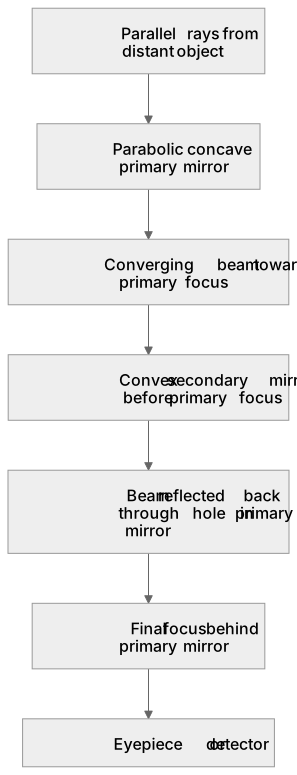
Put it in order
Put these steps in the order they happen.
- 1. Eyepiece or detector
- 2. Final focus behind primary mirror
- 3. Converging beam towards primary focus
- 4. Beam reflected back through hole in primary mirror
- 5. Parallel rays from distant object
- 6. Parabolic concave primary mirror
- 7. Convex secondary mirror before primary focus
Key words
Say what each word means before you turn the card.
Parabolic concave primary mirror
Try answering aloud or in your head before turning the card.
Convex secondary mirror
Try answering aloud or in your head before turning the card.
Folded optical path
Try answering aloud or in your head before turning the card.
Central obstruction
Try answering aloud or in your head before turning the card.
See every definition
- Parabolic concave primary mirror
- Collects parallel light from a distant object and removes spherical aberration for on-axis parallel rays.
- Convex secondary mirror
- Placed before the primary focus, it reflects the converging beam back through a hole in the centre of the primary mirror.
- Folded optical path
- The convex secondary increases the effective focal length and allows a long focal length to be folded into a compact tube.
- Central obstruction
- The secondary mirror causes some obstruction of the incoming light.
Label the diagram
Some boxes have lost their names. Pick the right name for each number.
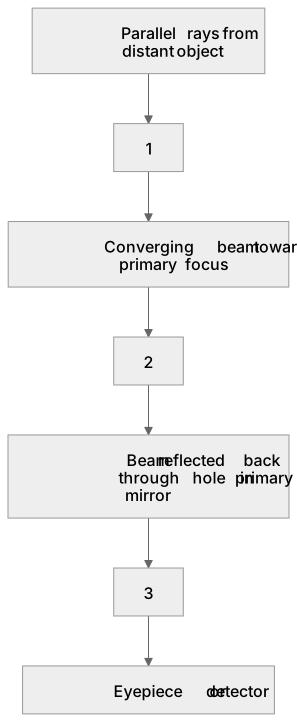
1Box 1
2Box 2
3Box 3
There is more to this lesson
The full lesson goes on to check your understanding and help you earn the marks. Create a free account to carry on, with your progress saved.
A week of Premium from your first lesson · Then the free plan continues · No card, no charge
Test your understanding of Reflecting telescopes (A-level only): Cassegrain arrangement using a parabolic concave primary mirror and convex secondary mirror.
Active recall beats re-reading. Take an instant quiz now to test what you’ve learned and lock it into long-term memory.
A week of Premium from your first lesson · Then the free plan continues · No card, no charge