AQA · A-Level · Physics
Course version: 7408 · Version from Sept 2016
Relative merits of reflectors and refractors including a qualitative…
Full specification wording
Reflecting telescopes (A-level only): Relative merits of reflectors and refractors including a qualitative treatment of spherical and chromatic aberration.
Refracting telescopes use a convex objective lens, which disperses white light because refractive index varies with wavelength.
Checked against the AQA 7408 specification (opens in a new tab) on .
- Point 3 of 3
- 4 key terms
Study notes
From the checked teaching notes for this specification point.
The idea
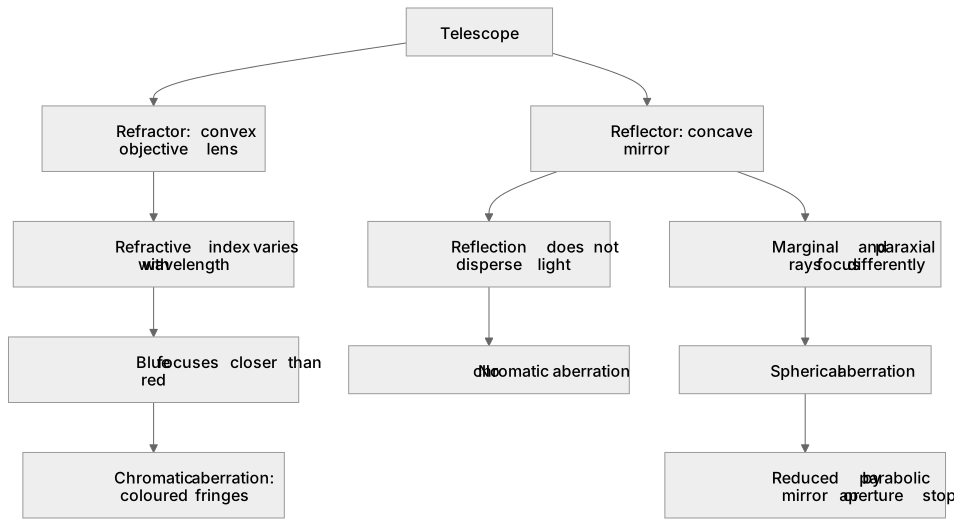
Refracting telescopes use a convex objective lens, which disperses white light because refractive index varies with wavelength. Blue light focuses closer to the lens than red light, producing coloured fringes called chromatic aberration. A reflector uses a concave mirror, and reflection does not disperse light, so chromatic aberration is absent. However, spherical mirrors bring marginal parallel rays to a slightly different focus than paraxial rays, causing spherical aberration; this is reduced by using a parabolic mirror or an aperture stop. Large refractors also sag under their own weight and absorb some light, while large mirrors are easier to support and can be made larger. Refractors may need a long tube and have a practical aperture limit.
What earns the marks
- Chromatic aberration arises in refractors because the focal length of a lens depends on wavelength, so different colours focus at different points.
- Reflectors avoid chromatic aberration because reflection at a mirror does not depend on wavelength.
- Spherical aberration arises when a spherical mirror brings marginal rays to a different focus from paraxial rays.
- Spherical aberration can be reduced by using a parabolic mirror or by restricting the aperture.
- Large mirrors are easier to support than large lenses, which may sag, and mirrors can be made in larger apertures.
- A refractor may absorb some light in the lens and requires a long tube, whereas a reflector can be more compact for a given aperture.
Common mistakes and how to put them right
Claiming that mirrors suffer chromatic aberration.
Put it right by stating that reflection does not disperse light, so chromatic aberration is absent in reflectors.
Confusing spherical aberration with chromatic aberration.
Put it right by linking spherical aberration to mirror or lens shape and chromatic aberration to wavelength-dependent focal length.
Stating that a parabolic mirror removes all aberrations.
Put it right by noting that it removes spherical aberration but other aberrations can remain.
Exam tips
- Compare reflectors and refractors point by point rather than describing each separately.
- Use the terms chromatic aberration and spherical aberration precisely, linking each to its cause.
- Support each merit or drawback with a brief physical reason, such as wavelength-dependent refraction or support of a large mirror.
Try the lesson
The start of the Reflecting telescopes (A-level only): Relative merits of reflectors and refractors including a qualitative treatment of spherical and chromatic aberration. lesson, made from checked teaching notes for this specification point.
Have a go first
Which advantage does a reflecting telescope have over a simple refracting telescope of similar aperture?
Listen
Refracting telescopes use a convex objective lens, which disperses white light because refractive index varies with wavelength. Blue light focuses closer to the lens than red light, producing coloured fringes called chromatic aberration. A reflector uses a concave mirror, and reflection does not disperse light, so chromatic aberration is absent. However, spherical mirrors bring marginal parallel rays to a slightly different focus than paraxial rays, causing spherical aberration; this is reduced by using a parabolic mirror or an aperture stop. Large refractors also sag under their own weight and absorb some light, while large mirrors are easier to support and can be made larger. Refractors may need a long tube and have a practical aperture limit. A strong answer earns marks for these points. Chromatic aberration arises in refractors because the focal length of a lens depends on wavelength, so different colours focus at different points. Reflectors avoid chromatic aberration because reflection at a mirror does not depend on wavelength. Spherical aberration arises when a spherical mirror brings marginal rays to a different focus from paraxial rays. Spherical aberration can be reduced by using a parabolic mirror or by restricting the aperture. A common slip: Claiming that mirrors suffer chromatic aberration. Instead, stating that reflection does not disperse light, so chromatic aberration is absent in reflectors. Exam tip: Compare reflectors and refractors point by point rather than describing each separately.
See it
Key words
Say what each word means before you turn the card.
Chromatic aberration
Try answering aloud or in your head before turning the card.
Spherical aberration
Try answering aloud or in your head before turning the card.
Parabolic mirror
Try answering aloud or in your head before turning the card.
Aperture stop
Try answering aloud or in your head before turning the card.
See every definition
- Chromatic aberration
- Arises in refractors because the focal length of a lens depends on wavelength, so different colours focus at different points.
- Spherical aberration
- Arises when a spherical mirror brings marginal rays to a different focus from paraxial rays.
- Parabolic mirror
- Reduces spherical aberration, which arises when a spherical mirror brings marginal rays to a different focus from paraxial rays.
- Aperture stop
- Reduces spherical aberration, which arises when a spherical mirror brings marginal rays to a different focus from paraxial rays.
Label the diagram
Some boxes have lost their names. Pick the right name for each number.
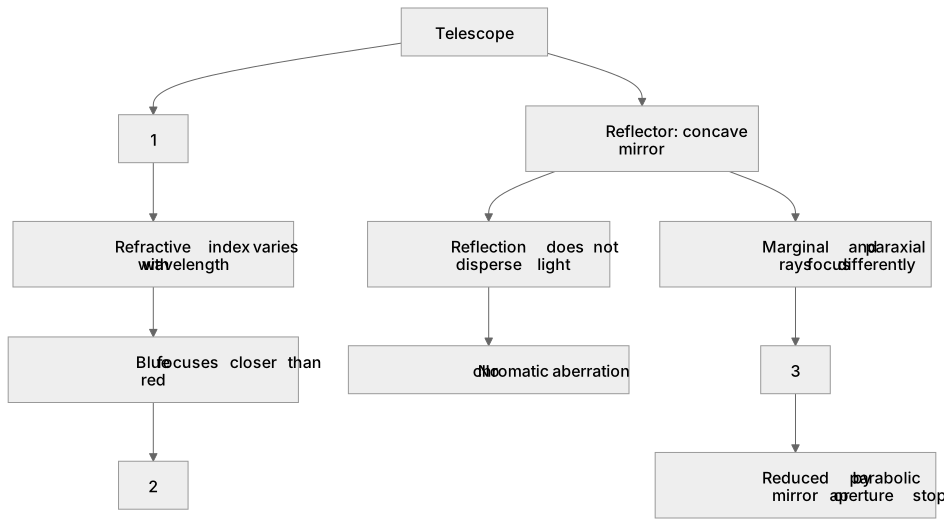
1Box 1
2Box 2
3Box 3
There is more to this lesson
The full lesson goes on to check your understanding and help you earn the marks. Create a free account to carry on, with your progress saved.
A week of Premium from your first lesson · Then the free plan continues · No card, no charge
Test your understanding of Reflecting telescopes (A-level only): Relative merits of reflectors and refractors including a qualitative treatment of spherical and chromatic aberration.
Active recall beats re-reading. Take an instant quiz now to test what you’ve learned and lock it into long-term memory.
A week of Premium from your first lesson · Then the free plan continues · No card, no charge