AQA · A-Level · Physics
Course version: 7408 · Version from Sept 2016
Refraction at a plane surface: Material and modal dispersion.
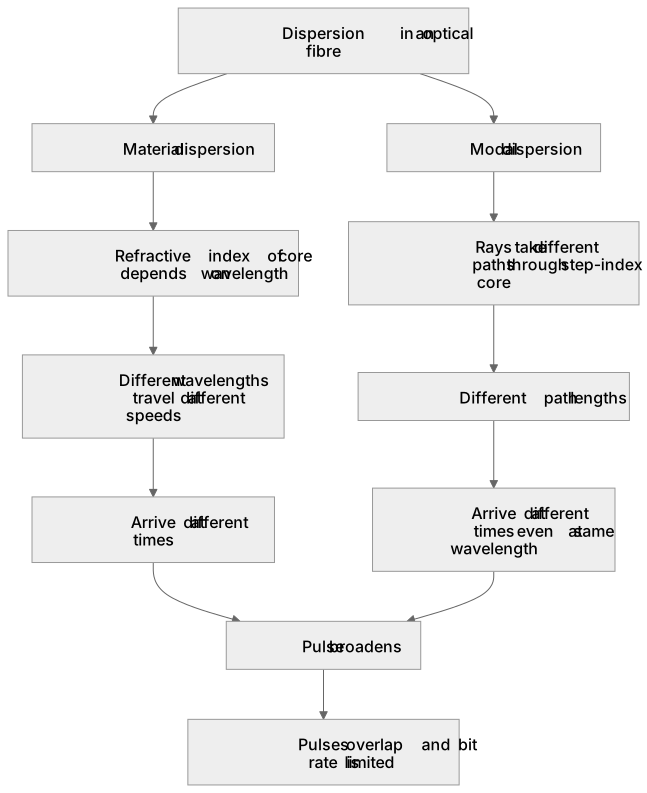
Dispersion in an optical fibre broadens a pulse of light so that pulses can overlap and limit the bit rate.
Checked against the AQA 7408 specification (opens in a new tab) on .
- Point 2 of 3
- 2 key terms
Study notes
From the checked teaching notes for this specification point.
The idea
Dispersion in an optical fibre broadens a pulse of light so that pulses can overlap and limit the bit rate. Material dispersion arises because the refractive index of the core depends on wavelength, so different wavelengths in a source travel at different speeds and arrive at different times. Modal dispersion arises because rays taking different paths through a step-index core have different path lengths, so they arrive at different times even at the same wavelength. You should be able to distinguish the two causes, explain how each broadens a pulse, and suggest how using a monochromatic source or a narrower core reduces the effect.
What earns the marks
- Material dispersion occurs because the refractive index of the core varies with wavelength, so different wavelengths travel at different speeds and spread out in time.
- Modal dispersion occurs because rays follow different zig-zag paths of different lengths in a step-index core, so they take different times to reach the far end.
- Using a monochromatic source such as a laser reduces material dispersion because the range of wavelengths present is very small.
- Reducing the core diameter or using a single-mode fibre reduces modal dispersion because fewer ray paths are available.
- Material and modal dispersion are separate mechanisms: one depends on wavelength spread, the other on path-length spread, and both can occur together in a step-index fibre.
Common mistakes and how to put them right
Treating material and modal dispersion as the same effect.
Put it right by stating that material dispersion depends on wavelength-dependent refractive index while modal dispersion depends on different path lengths.
Claiming that modal dispersion is reduced by using a brighter source.
Put it right by explaining that reducing the number of available paths, for example with a narrower core, is what reduces modal dispersion.
Assuming a monochromatic source removes all dispersion.
Put it right by stating that it removes material dispersion but modal dispersion can still occur in a step-index fibre.
Exam tips
- Use a sketch of two rays with different path lengths to show how modal dispersion delays one ray relative to another.
- When comparing the two effects, state the cause, the quantity that varies and the consequence for pulse arrival time in each case.
- Link pulse broadening to bit rate by explaining that overlapping pulses make it impossible to distinguish successive bits reliably.
Try the lesson
The start of the Refraction at a plane surface: Material and modal dispersion. lesson, made from checked teaching notes for this specification point.
Have a go first
Which type of dispersion in an optical fibre is caused by light travelling along different paths of different lengths within the core?
Listen
Dispersion in an optical fibre broadens a pulse of light so that pulses can overlap and limit the bit rate. Material dispersion arises because the refractive index of the core depends on wavelength, so different wavelengths in a source travel at different speeds and arrive at different times. Modal dispersion arises because rays taking different paths through a step-index core have different path lengths, so they arrive at different times even at the same wavelength. You should be able to distinguish the two causes, explain how each broadens a pulse, and suggest how using a monochromatic source or a narrower core reduces the effect. A strong answer earns marks for these points. Material dispersion occurs because the refractive index of the core varies with wavelength, so different wavelengths travel at different speeds and spread out in time. Modal dispersion occurs because rays follow different zig-zag paths of different lengths in a step-index core, so they take different times to reach the far end. Using a monochromatic source such as a laser reduces material dispersion because the range of wavelengths present is very small. Reducing the core diameter or using a single-mode fibre reduces modal dispersion because fewer ray paths are available. A common slip: Treating material and modal dispersion as the same effect. Instead, stating that material dispersion depends on wavelength-dependent refractive index while modal dispersion depends on different path lengths. Exam tip: Use a sketch of two rays with different path lengths to show how modal dispersion delays one ray relative to another.
See it
Key words
Say what each word means before you turn the card.
Material dispersion
Try answering aloud or in your head before turning the card.
Modal dispersion
Try answering aloud or in your head before turning the card.
See every definition
- Material dispersion
- Arises because the refractive index of the core depends on wavelength, so different wavelengths in a source travel at different speeds and arrive at different times.
- Modal dispersion
- Arises because rays taking different paths through a step-index core have different path lengths, so they arrive at different times even at the same wavelength.
Label the diagram
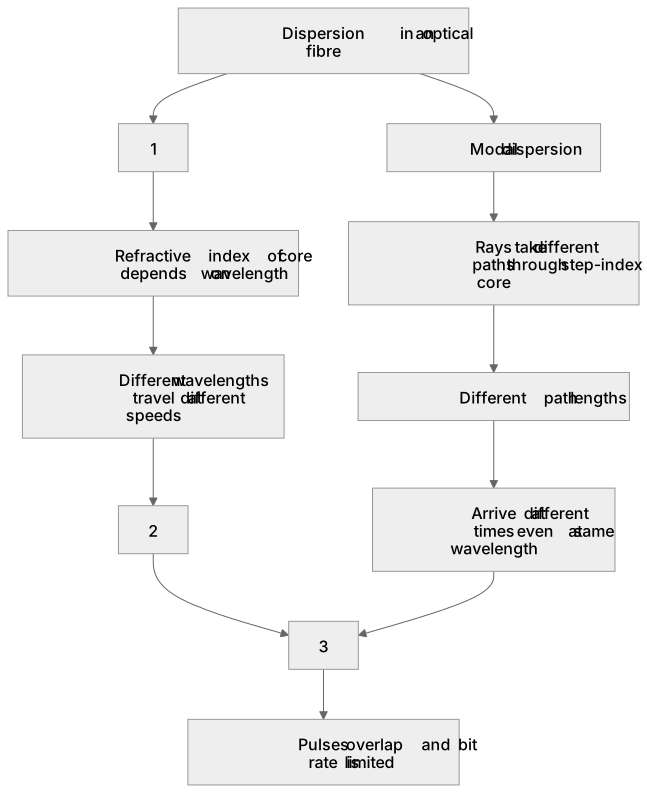
Some boxes have lost their names. Pick the right name for each number.
1Box 1
2Box 2
3Box 3
There is more to this lesson
The full lesson goes on to check your understanding and help you earn the marks. Create a free account to carry on, with your progress saved.
A week of Premium from your first lesson · Then the free plan continues · No card, no charge
Test your understanding of Refraction at a plane surface: Material and modal dispersion.
Active recall beats re-reading. Take an instant quiz now to test what you’ve learned and lock it into long-term memory.
A week of Premium from your first lesson · Then the free plan continues · No card, no charge