AQA · A-Level · Physics
Course version: 7408 · Version from Sept 2016
RA Resistivity, ρ = L Description of the qualitative effect of temperature…
Full specification wording
Resistivity: RA Resistivity, ρ = L Description of the qualitative effect of temperature on the resistance of metal conductors and thermistors.
Resistivity is defined by ρ = RA/L, where R is resistance, A is cross-sectional area and L is length.
Checked against the AQA 7408 specification (opens in a new tab) on .
- Point 1 of 6
- 4 key terms
Study notes
From the checked teaching notes for this specification point.
The idea
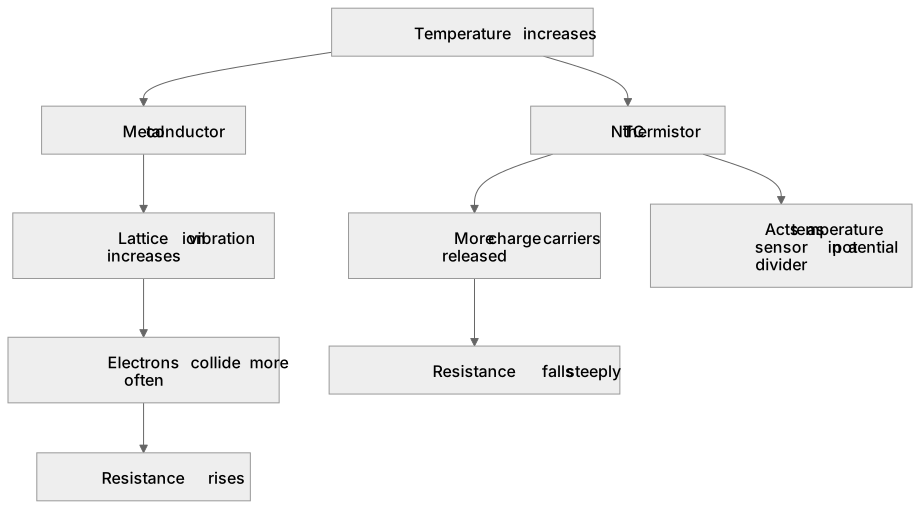
Resistivity is defined by ρ = RA/L, where R is resistance, A is cross-sectional area and L is length. Rearranged, R = ρL/A, so resistance rises with length and falls with area for a given material. The unit of resistivity is the ohm metre (Ω m). Temperature affects resistance differently in metals and thermistors. In a metal conductor, heating increases lattice ion vibration, so electrons collide more often and resistance rises; the change is roughly linear over a limited range. In a negative temperature coefficient thermistor, heating releases more charge carriers, so resistance falls steeply. A thermistor therefore acts as a temperature sensor in a potential divider.
What earns the marks
- States and rearranges ρ = RA/L, using consistent SI units of Ω m for resistivity, m² for area and m for length.
- Explains that increasing temperature in a metal increases lattice vibrations, increasing electron scattering and so increasing resistance.
- Explains that increasing temperature in an NTC thermistor increases the number of charge carriers, decreasing resistance.
- Describes a practical use of a thermistor, such as in a potential divider circuit for temperature sensing or control.
- Distinguishes between the small, roughly linear change in a metal and the large, non-linear change in a thermistor.
Common mistakes and how to put them right
Using the diameter instead of the radius when calculating cross-sectional area.
Put it right: Halve the diameter first, then use A = πr².
Mixing units, such as using mm² or cm in the resistivity equation.
Put it right: Convert all lengths to metres and areas to m² before substituting.
Claiming that heating always increases resistance.
Put it right: Specify that this applies to metal conductors, whereas an NTC thermistor shows a decrease.
Exam tips
- Write the rearranged equation before substituting values so the examiner can follow your method.
- When describing temperature effects, name the mechanism: lattice vibration and scattering for metals, charge carrier release for thermistors.
- Link thermistor behaviour to a circuit context, such as the output potential difference of a potential divider changing with temperature.
Try the lesson
The start of the Resistivity: RA Resistivity, ρ = L Description of the qualitative effect of temperature on the resistance of metal conductors and thermistors. lesson, made from checked teaching notes for this specification point.
Have a go first
Which equation relates the resistance R of a uniform wire to its resistivity ρ, length L and cross-sectional area A?
Listen
Resistivity is defined by ρ = RA/L, where R is resistance, A is cross-sectional area and L is length. Rearranged, R = ρL/A, so resistance rises with length and falls with area for a given material. The unit of resistivity is the ohm metre (Ω m). Temperature affects resistance differently in metals and thermistors. In a metal conductor, heating increases lattice ion vibration, so electrons collide more often and resistance rises; the change is roughly linear over a limited range. In a negative temperature coefficient thermistor, heating releases more charge carriers, so resistance falls steeply. A thermistor therefore acts as a temperature sensor in a potential divider. A strong answer earns marks for these points. States and rearranges ρ = RA/L, using consistent SI units of Ω m for resistivity, m² for area and m for length. Explains that increasing temperature in a metal increases lattice vibrations, increasing electron scattering and so increasing resistance. Explains that increasing temperature in an NTC thermistor increases the number of charge carriers, decreasing resistance. Describes a practical use of a thermistor, such as in a potential divider circuit for temperature sensing or control. A common slip: Using the diameter instead of the radius when calculating cross-sectional area. Instead, halve the diameter first, then use A = πr². Exam tip: Write the rearranged equation before substituting values so the examiner can follow your method.
See it
Key words
Say what each word means before you turn the card.
Resistivity
Try answering aloud or in your head before turning the card.
Temperature and resistance
Try answering aloud or in your head before turning the card.
Charge carriers and scattering
Try answering aloud or in your head before turning the card.
Sensor circuits
Try answering aloud or in your head before turning the card.
See every definition
- Resistivity
- Defined by ρ = RA/L, where R is resistance, A is cross-sectional area and L is length, with unit the ohm metre (Ω m).
- Temperature and resistance
- In a metal conductor, heating increases lattice ion vibration, so electrons collide more often and resistance rises; in a negative temperature coefficient thermistor, heating releases more charge carriers, so resistance falls steeply.
- Charge carriers and scattering
- In a metal, increased lattice vibrations increase electron scattering; in an NTC thermistor, heating releases more charge carriers.
- Sensor circuits
- A thermistor acts as a temperature sensor in a potential divider.
Label the diagram
Some boxes have lost their names. Pick the right name for each number.
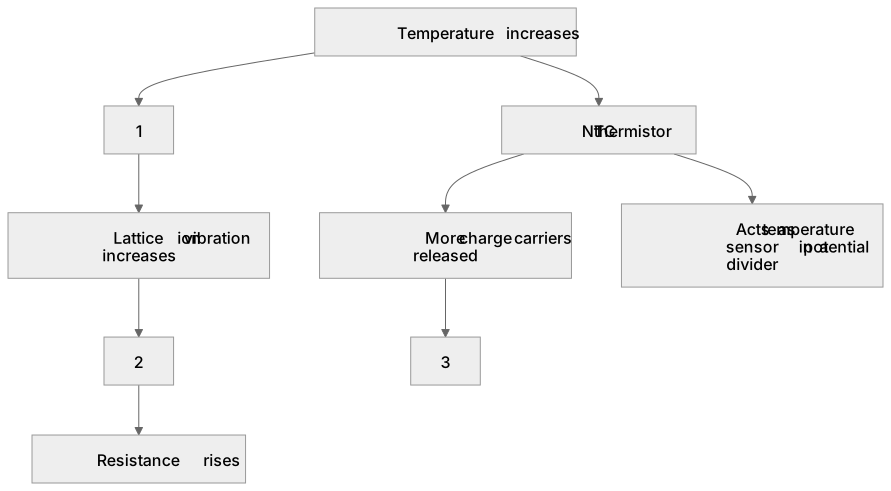
1Box 1
2Box 2
3Box 3
There is more to this lesson
The full lesson goes on to check your understanding and help you earn the marks. Create a free account to carry on, with your progress saved.
A week of Premium from your first lesson · Then the free plan continues · No card, no charge
Test your understanding of Resistivity: RA Resistivity, ρ = L Description of the qualitative effect of temperature on the resistance of metal conductors and thermistors.
Active recall beats re-reading. Take an instant quiz now to test what you’ve learned and lock it into long-term memory.
A week of Premium from your first lesson · Then the free plan continues · No card, no charge