AQA · A-Level · Physics
Course version: 7408 · Version from Sept 2016
Qualitative study of Rutherford scattering.
Full specification wording
Rutherford scattering (A-level only): Qualitative study of Rutherford scattering.
Rutherford scattering is the deflection of alpha particles fired at a thin metal foil.
Checked against the AQA 7408 specification (opens in a new tab) on .
- Point 1 of 8
- 3 key terms
Study notes
From the checked teaching notes for this specification point.
The idea
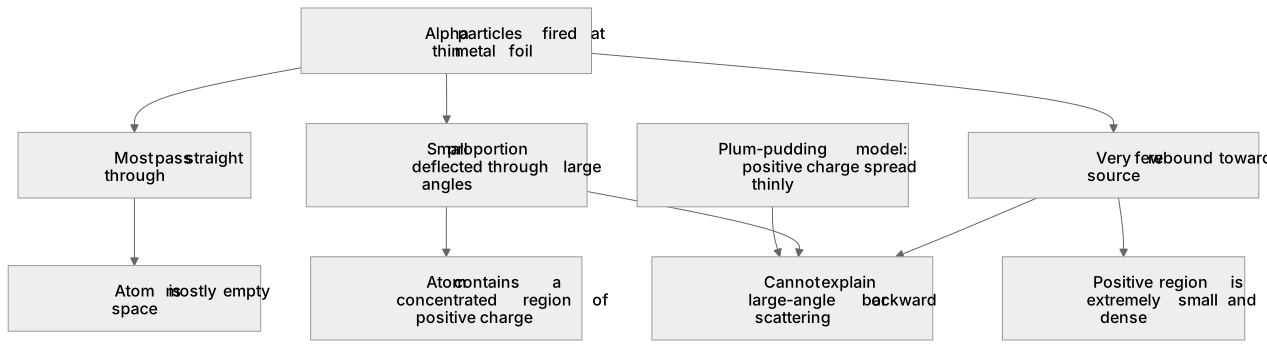
Rutherford scattering is the deflection of alpha particles fired at a thin metal foil. Most pass straight through, showing the atom is mostly empty space. A small fraction deflect at large angles, and a very few rebound, showing a tiny, dense, positively charged central nucleus. The qualitative study means explaining these observations without calculation: compare the observed pattern with the plum-pudding model, which predicted only small deflections. The closer an alpha particle approaches a nucleus, the stronger the electrostatic repulsion and the greater the deflection. The nucleus must be much smaller than the atom and contain most of its mass, since it can reverse a fast alpha particle.
What earns the marks
- Most alpha particles pass through the foil with little or no deflection, so most of the atom is empty space.
- A small proportion are deflected through large angles, so the atom contains a concentrated region of positive charge.
- Very few are deflected back towards the source, so this positive region is extremely small and dense.
- The deflection is caused by electrostatic repulsion between the positive alpha particle and the positive nucleus.
- The closer the alpha particle passes to a nucleus, the greater the repulsive force and the larger the deflection.
- The plum-pudding model cannot explain large-angle or backward scattering because its positive charge is spread thinly throughout the atom.
Common mistakes and how to put them right
Saying alpha particles are attracted to the nucleus.
Put it right: The error is ignoring that both alpha particle and nucleus are positive, so the force is repulsive.
Claiming most alpha particles are deflected.
Put it right: The error is reversing the observed pattern; most pass through nearly undeflected.
Stating that the nucleus is the same size as the atom.
Put it right: The error is ignoring that backward scattering requires a very small, dense nucleus.
Exam tips
- Link each observation to a conclusion about atomic structure rather than describing the apparatus alone.
- Use the phrase 'electrostatic repulsion' when explaining why an alpha particle changes direction.
- When comparing with the plum-pudding model, state explicitly which observation it cannot explain.
Try the lesson
The start of the Rutherford scattering (A-level only): Qualitative study of Rutherford scattering. lesson, made from checked teaching notes for this specification point.
Have a go first
In the Rutherford scattering experiment, most of the alpha particles passed straight through the gold foil. What does this observation suggest about the structure of the atom?
Listen
Rutherford scattering is the deflection of alpha particles fired at a thin metal foil. Most pass straight through, showing the atom is mostly empty space. A small fraction deflect at large angles, and a very few rebound, showing a tiny, dense, positively charged central nucleus. The qualitative study means explaining these observations without calculation: compare the observed pattern with the plum-pudding model, which predicted only small deflections. The closer an alpha particle approaches a nucleus, the stronger the electrostatic repulsion and the greater the deflection. The nucleus must be much smaller than the atom and contain most of its mass, since it can reverse a fast alpha particle. A strong answer earns marks for these points. Most alpha particles pass through the foil with little or no deflection, so most of the atom is empty space. A small proportion are deflected through large angles, so the atom contains a concentrated region of positive charge. Very few are deflected back towards the source, so this positive region is extremely small and dense. The deflection is caused by electrostatic repulsion between the positive alpha particle and the positive nucleus. Exam tip: Link each observation to a conclusion about atomic structure rather than describing the apparatus alone.
See it
Key words
Say what each word means before you turn the card.
Electrostatic forces
Try answering aloud or in your head before turning the card.
Experimental evidence
Try answering aloud or in your head before turning the card.
Scientific models
Try answering aloud or in your head before turning the card.
See every definition
- Electrostatic forces
- The repulsion between the positive alpha particle and the positive nucleus, which causes the deflection.
- Experimental evidence
- The pattern of alpha-particle scattering, which provides evidence for a small, dense, positively charged nucleus.
- Scientific models
- The Rutherford model and the plum-pudding model, compared using the scattering evidence.
Label the diagram
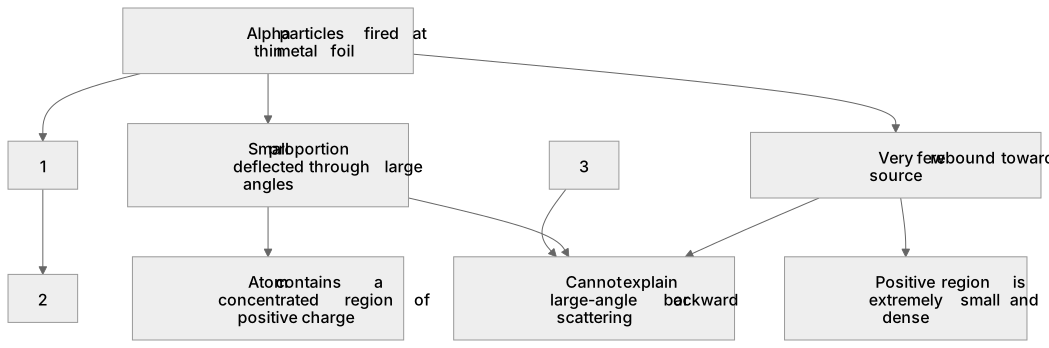
Some boxes have lost their names. Pick the right name for each number.
1Box 1
2Box 2
3Box 3
There is more to this lesson
The full lesson goes on to check your understanding and help you earn the marks. Create a free account to carry on, with your progress saved.
A week of Premium from your first lesson · Then the free plan continues · No card, no charge
Test your understanding of Rutherford scattering (A-level only): Qualitative study of Rutherford scattering.
Active recall beats re-reading. Take an instant quiz now to test what you’ve learned and lock it into long-term memory.
A week of Premium from your first lesson · Then the free plan continues · No card, no charge