AQA · A-Level · Physics
Course version: 7408 · Version from Sept 2016
Fuel used, remote handling of fuel, shielding, emergency shut-down.
Full specification wording
Safety aspects (A-level only): Fuel used, remote handling of fuel, shielding, emergency shut-down.
Nuclear reactors use fuel such as enriched uranium, often as uranium dioxide, in sealed fuel rods.
Checked against the AQA 7408 specification (opens in a new tab) on .
- Point 1 of 3
- 4 key terms
Study notes
From the checked teaching notes for this specification point.
The idea
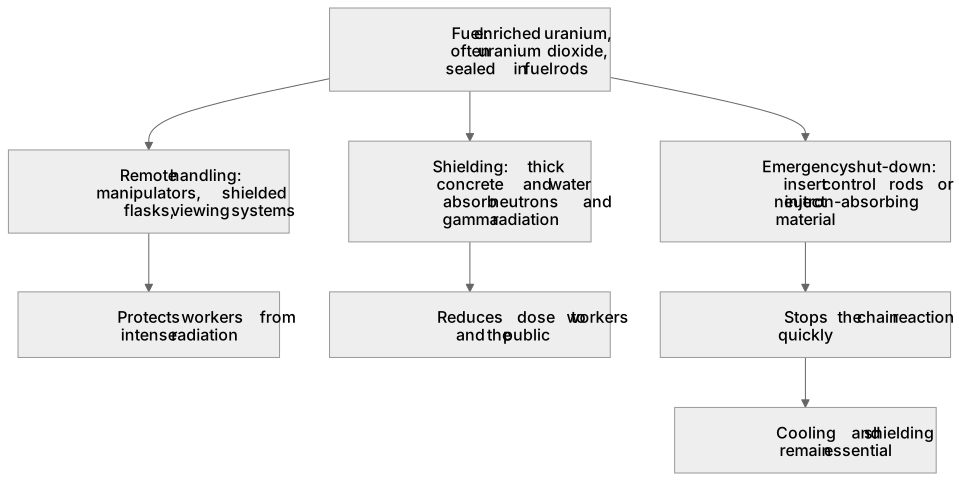
Nuclear reactors use fuel such as enriched uranium, often as uranium dioxide, in sealed fuel rods. Because the fuel is intensely radioactive and produces heat, it must be handled remotely using manipulators, shielded flasks and viewing systems. Shielding, commonly thick concrete and water, absorbs neutrons and gamma radiation to protect workers and the public. An emergency shut-down inserts control rods or injects neutron-absorbing material to stop the chain reaction quickly.
What earns the marks
- Identifies a suitable nuclear fuel, such as enriched uranium or uranium dioxide, and explains that it is sealed inside fuel rods or pins.
- Explains that remote handling is needed because spent or irradiated fuel emits intense beta and gamma radiation, so workers use manipulators, lead or concrete flasks and remote cameras.
- Describes shielding as thick concrete, water or lead that absorbs gamma radiation and neutrons, reducing dose to workers and the public.
- Explains that emergency shut-down rapidly inserts control rods or injects a neutron absorber such as boron to reduce the neutron population and stop the chain reaction.
- Links each safety measure to a specific hazard, for example shielding reduces external gamma dose while remote handling reduces inhalation and contact risk.
- Recognises that safety systems are designed to be fail-safe and may include multiple independent shut-down mechanisms.
Common mistakes and how to put them right
Treating shielding as only for alpha radiation.
Put it right: Alpha particles are stopped by dead skin or paper, so reactor shielding mainly targets gamma rays and neutrons.
Confusing control rods with fuel rods.
Put it right: Control rods absorb neutrons to control or stop the reaction, while fuel rods contain the fissile material.
Assuming emergency shut-down instantly removes all radioactivity.
Put it right: Shut-down stops the chain reaction but fission products continue to emit decay heat and radiation, so cooling and shielding remain essential.
Exam tips
- For each safety feature, state the hazard it reduces and the physical process involved, such as neutron absorption or gamma attenuation.
- Use comparative language when describing shielding, for example thick concrete is more effective than a thin lead sheet for gamma rays.
- When explaining emergency shut-down, refer to reducing the neutron multiplication factor or stopping the chain reaction rather than simply switching off the reactor.
Try the lesson
The start of the Safety aspects (A-level only): Fuel used, remote handling of fuel, shielding, emergency shut-down. lesson, made from checked teaching notes for this specification point.
Have a go first
In a nuclear reactor, which material is used as the fuel because its nuclei can undergo fission when struck by a neutron?
Listen
Nuclear reactors use fuel such as enriched uranium, often as uranium dioxide, in sealed fuel rods. Because the fuel is intensely radioactive and produces heat, it must be handled remotely using manipulators, shielded flasks and viewing systems. Shielding, commonly thick concrete and water, absorbs neutrons and gamma radiation to protect workers and the public. An emergency shut-down inserts control rods or injects neutron-absorbing material to stop the chain reaction quickly. A strong answer earns marks for these points. Identifies a suitable nuclear fuel, such as enriched uranium or uranium dioxide, and explains that it is sealed inside fuel rods or pins. Explains that remote handling is needed because spent or irradiated fuel emits intense beta and gamma radiation, so workers use manipulators, lead or concrete flasks and remote cameras. Describes shielding as thick concrete, water or lead that absorbs gamma radiation and neutrons, reducing dose to workers and the public. Explains that emergency shut-down rapidly inserts control rods or injects a neutron absorber such as boron to reduce the neutron population and stop the chain reaction. A common slip: Treating shielding as only for alpha radiation. Instead, alpha particles are stopped by dead skin or paper, so reactor shielding mainly targets gamma rays and neutrons. Exam tip: For each safety feature, state the hazard it reduces and the physical process involved, such as neutron absorption or gamma attenuation.
See it
Key words
Say what each word means before you turn the card.
Remote handling
Try answering aloud or in your head before turning the card.
Shielding
Try answering aloud or in your head before turning the card.
Emergency shut-down
Try answering aloud or in your head before turning the card.
Fail-safe
Try answering aloud or in your head before turning the card.
See every definition
- Remote handling
- Needed because spent or irradiated fuel emits intense beta and gamma radiation, so workers use manipulators, lead or concrete flasks and remote cameras.
- Shielding
- Thick concrete, water or lead that absorbs gamma radiation and neutrons, reducing dose to workers and the public.
- Emergency shut-down
- Rapidly inserts control rods or injects a neutron absorber such as boron to reduce the neutron population and stop the chain reaction.
- Fail-safe
- Safety systems are designed to be fail-safe and may include multiple independent shut-down mechanisms.
Label the diagram
Some boxes have lost their names. Pick the right name for each number.
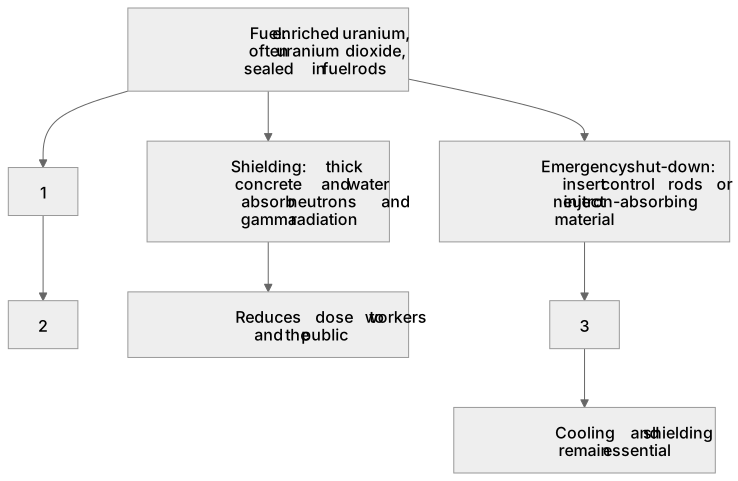
1Box 1
2Box 2
3Box 3
There is more to this lesson
The full lesson goes on to check your understanding and help you earn the marks. Create a free account to carry on, with your progress saved.
A week of Premium from your first lesson · Then the free plan continues · No card, no charge
Test your understanding of Safety aspects (A-level only): Fuel used, remote handling of fuel, shielding, emergency shut-down.
Active recall beats re-reading. Take an instant quiz now to test what you’ve learned and lock it into long-term memory.
A week of Premium from your first lesson · Then the free plan continues · No card, no charge