AQA · A-Level · Physics
Course version: 7408 · Version from Sept 2016
Problems may be solved either by the use of resolved forces or the use of…
Full specification wording
Scalars and vectors: Problems may be solved either by the use of resolved forces or the use of a closed triangle.
When several coplanar forces act at a point, you can analyse equilibrium in two equivalent ways.
Checked against the AQA 7408 specification (opens in a new tab) on .
- Point 8 of 10
- 4 key terms
Study notes
From the checked teaching notes for this specification point.
The idea
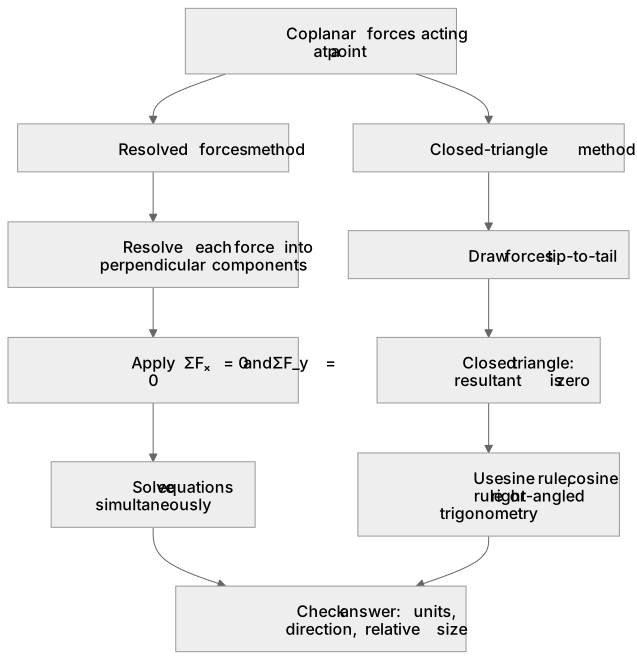
When several coplanar forces act at a point, you can analyse equilibrium in two equivalent ways. Resolving splits every force into perpendicular components, usually horizontal and vertical, then applies ΣFₓ = 0 and ΣF_y = 0. The closed-triangle method draws the forces tip-to-tail; if they form a closed triangle, the resultant is zero. For example, a 50 N weight on a string pulled sideways by a horizontal force with the string at 30° to the vertical: resolving gives T cos 30° = 50 N and T sin 30° = F, so T ≈ 57.7 N and F ≈ 28.9 N. A closed triangle with the same three forces gives the same values by trigonometry. Choose whichever method suits the geometry, but show the full vector diagram or component equations so the reasoning is clear.
What earns the marks
- State that a body in equilibrium has zero resultant force, so the vector sum of all forces acting at the point is zero.
- Resolve each force into two perpendicular directions, commonly horizontal and vertical, using F cos θ and F sin θ with θ measured from the chosen axis.
- Apply ΣFₓ = 0 and ΣF_y = 0 simultaneously to form solvable equations for unknown magnitudes or angles.
- Draw a closed vector triangle with forces placed tip-to-tail, ensuring each arrow direction represents the force acting on the point.
- Use sine rule, cosine rule or right-angled trigonometry on the closed triangle to determine an unknown force or angle.
- Check that the answer is physically sensible, including units, direction and relative size compared with the given forces.
Common mistakes and how to put them right
Using the wrong trigonometric ratio for a component.
Put it right: The component along an axis is F cos θ when θ is measured from that axis, and F sin θ when θ is measured from the perpendicular axis. Always mark θ on the diagram before choosing.
Drawing the closed triangle with arrows tail-to-tail rather than tip-to-tail.
Put it right: The corrected diagram has each force arrow starting where the previous one ends, and the triangle closes only when the resultant is zero.
Forgetting that the two resolution equations must be solved together.
Put it right: Substituting a value from one equation into the other, or ignoring one direction, loses the link between the unknowns.
Exam tips
- Sketch the forces at the point and label every angle relative to a clearly chosen axis before writing any equation.
- If the geometry is a right-angled triangle, resolving is usually quicker; if three forces form a scalene triangle, the sine rule or cosine rule may be more efficient.
- Keep full calculator precision through intermediate steps and round only the final answer to an appropriate number of significant figures.
Try the lesson
The start of the Scalars and vectors: Problems may be solved either by the use of resolved forces or the use of a closed triangle. lesson, made from checked teaching notes for this specification point.
Have a go first
A force of 50 N acts at 30° above the horizontal. Which single calculation gives the horizontal component of this force?
Listen
When several coplanar forces act at a point, you can analyse equilibrium in two equivalent ways. Resolving splits every force into perpendicular components, usually horizontal and vertical, then applies ΣFₓ = 0 and ΣF_y = 0. The closed-triangle method draws the forces tip-to-tail; if they form a closed triangle, the resultant is zero. For example, a 50 N weight on a string pulled sideways by a horizontal force with the string at 30° to the vertical: resolving gives T cos 30° = 50 N and T sin 30° = F, so T ≈ 57.7 N and F ≈ 28.9 N. A closed triangle with the same three forces gives the same values by trigonometry. Choose whichever method suits the geometry, but show the full vector diagram or component equations so the reasoning is clear. A strong answer earns marks for these points. State that a body in equilibrium has zero resultant force, so the vector sum of all forces acting at the point is zero. Resolve each force into two perpendicular directions, commonly horizontal and vertical, using F cos θ and F sin θ with θ measured from the chosen axis. Apply ΣFₓ = 0 and ΣF_y = 0 simultaneously to form solvable equations for unknown magnitudes or angles. Draw a closed vector triangle with forces placed tip-to-tail, ensuring each arrow direction represents the force acting on the point. Exam tip: Sketch the forces at the point and label every angle relative to a clearly chosen axis before writing any equation.
See it
Key words
Say what each word means before you turn the card.
Resolved forces
Try answering aloud or in your head before turning the card.
Closed-triangle method
Try answering aloud or in your head before turning the card.
Equilibrium
Try answering aloud or in your head before turning the card.
Trigonometry in physical problems
Try answering aloud or in your head before turning the card.
See every definition
- Resolved forces
- Splitting every force into perpendicular components, usually horizontal and vertical, then applying ΣFₓ = 0 and ΣF_y = 0.
- Closed-triangle method
- Drawing the forces tip-to-tail so that if they form a closed triangle, the resultant is zero.
- Equilibrium
- A body in equilibrium has zero resultant force, so the vector sum of all forces acting at the point is zero.
- Trigonometry in physical problems
- Using sine rule, cosine rule or right-angled trigonometry on the closed triangle to determine an unknown force or angle.
Label the diagram
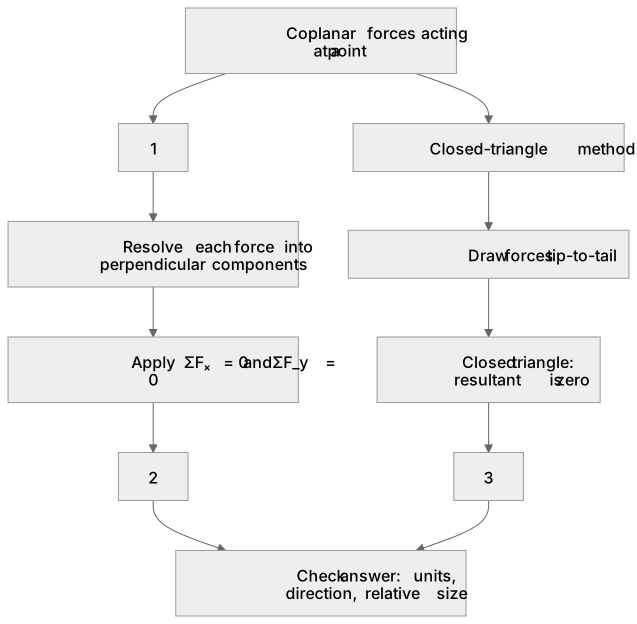
Some boxes have lost their names. Pick the right name for each number.
1Box 1
2Box 2
3Box 3
There is more to this lesson
The full lesson goes on to check your understanding and help you earn the marks. Create a free account to carry on, with your progress saved.
A week of Premium from your first lesson · Then the free plan continues · No card, no charge
Test your understanding of Scalars and vectors: Problems may be solved either by the use of resolved forces or the use of a closed triangle.
Active recall beats re-reading. Take an instant quiz now to test what you’ve learned and lock it into long-term memory.
A week of Premium from your first lesson · Then the free plan continues · No card, no charge