AQA · A-Level · Physics
Course version: 7408 · Version from Sept 2016
Resolution of vectors into two components at right angles to each other.
Full specification wording
Scalars and vectors: Resolution of vectors into two components at right angles to each other.
Resolution replaces one vector by two perpendicular vectors whose combined effect is identical.
Checked against the AQA 7408 specification (opens in a new tab) on .
- Point 6 of 10
- 4 key terms
Study notes
From the checked teaching notes for this specification point.
The idea
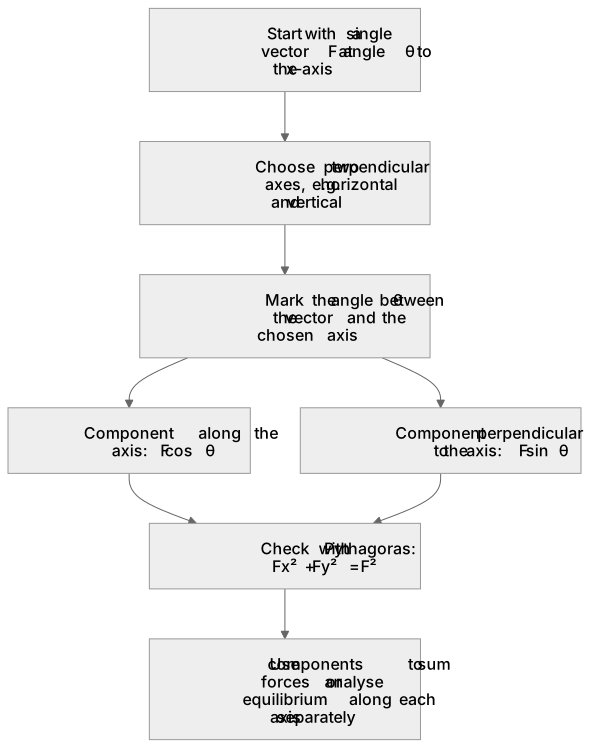
Resolution replaces one vector by two perpendicular vectors whose combined effect is identical. Choose axes, usually horizontal and vertical or along and perpendicular to a surface, then project the vector onto each axis using trigonometry. For a vector F at angle θ to the x-axis, the x-component is F cos θ and the y-component is F sin θ. Check with Pythagoras: Fx² + Fy² = F². For example, a 50 N force at 30° above the horizontal gives 50 cos 30° ≈ 43 N horizontally and 50 sin 30° = 25 N vertically. The components are not extra forces; they are a mathematical replacement that simplifies adding vectors and applying Newton's laws along each axis independently.
What earns the marks
- State that resolution replaces a single vector by two perpendicular components with the same combined effect as the original vector.
- Select suitable perpendicular axes for the physical situation, such as horizontal and vertical or parallel and perpendicular to a slope.
- Identify the angle between the vector and the chosen axis and apply the correct trigonometric projection, for example F cos θ along the axis and F sin θ perpendicular to it.
- Check the result using Fx² + Fy² = F² and confirm that each component is smaller than the original vector unless the vector lies along an axis.
- Use resolved components to sum forces or analyse equilibrium along each axis separately, keeping directions consistent with a stated positive sense.
Common mistakes and how to put them right
Swapping sine and cosine because the wrong angle was identified.
Put it right: Mark the angle between the vector and the axis, then use cosine for the component along that axis and sine for the perpendicular component.
Treating the components as additional real forces acting alongside the original vector.
Put it right: State clearly that the components replace the original vector for calculation purposes.
Forgetting that a component can be negative when it points in the negative direction of the chosen axis.
Put it right: Assign a positive sense first and include the sign in later calculations.
Exam tips
- Sketch the vector and both axes before substituting numbers; label the angle you are using so the sine or cosine choice is visible.
- Keep at least three significant figures through intermediate steps and round only the final answer to the precision justified by the data.
- After calculating components, perform a quick Pythagoras check to catch a swapped sine and cosine.
- Write the resolved components with their directions, for example 43 N horizontally and 25 N vertically, rather than giving bare numbers.
Try the lesson
The start of the Scalars and vectors: Resolution of vectors into two components at right angles to each other. lesson, made from checked teaching notes for this specification point.
Have a go first
A force of 50 N acts at 0° to the horizontal. What is the horizontal component of this force?
Listen
Resolution replaces one vector by two perpendicular vectors whose combined effect is identical. Choose axes, usually horizontal and vertical or along and perpendicular to a surface, then project the vector onto each axis using trigonometry. For a vector F at angle θ to the x-axis, the x-component is F cos θ and the y-component is F sin θ. Check with Pythagoras: Fx² + Fy² = F². For example, a 50 N force at 30° above the horizontal gives 50 cos 30° ≈ 43 N horizontally and 50 sin 30° = 25 N vertically. The components are not extra forces; they are a mathematical replacement that simplifies adding vectors and applying Newton's laws along each axis independently. A strong answer earns marks for these points. State that resolution replaces a single vector by two perpendicular components with the same combined effect as the original vector. Select suitable perpendicular axes for the physical situation, such as horizontal and vertical or parallel and perpendicular to a slope. Identify the angle between the vector and the chosen axis and apply the correct trigonometric projection, for example F cos θ along the axis and F sin θ perpendicular to it. Check the result using Fx² + Fy² = F² and confirm that each component is smaller than the original vector unless the vector lies along an axis. Exam tip: Sketch the vector and both axes before substituting numbers; label the angle you are using so the sine or cosine choice is visible.
See it
Key words
Say what each word means before you turn the card.
Resolution
Try answering aloud or in your head before turning the card.
Perpendicular components
Try answering aloud or in your head before turning the card.
Trigonometry
Try answering aloud or in your head before turning the card.
Pythagoras check
Try answering aloud or in your head before turning the card.
See every definition
- Resolution
- Replaces one vector by two perpendicular vectors whose combined effect is identical, not extra forces but a mathematical replacement.
- Perpendicular components
- Two vectors at right angles to each other whose combined effect is identical to the original vector.
- Trigonometry
- Used to project a vector onto each axis, giving F cos θ along the axis and F sin θ perpendicular to it.
- Pythagoras check
- Confirms resolved components using Fx² + Fy² = F², catching a swapped sine and cosine.
Label the diagram
Some boxes have lost their names. Pick the right name for each number.
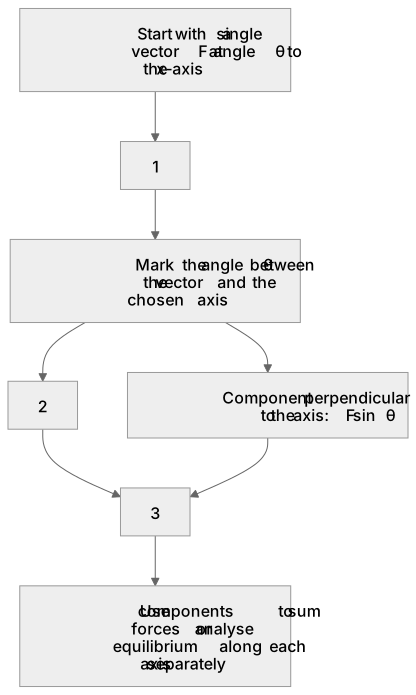
1Box 1
2Box 2
3Box 3
There is more to this lesson
The full lesson goes on to check your understanding and help you earn the marks. Create a free account to carry on, with your progress saved.
A week of Premium from your first lesson · Then the free plan continues · No card, no charge
Test your understanding of Scalars and vectors: Resolution of vectors into two components at right angles to each other.
Active recall beats re-reading. Take an instant quiz now to test what you’ve learned and lock it into long-term memory.
A week of Premium from your first lesson · Then the free plan continues · No card, no charge