AQA · A-Level · Physics
Course version: 7408 · Version from Sept 2016
The strong nuclear force; its role in keeping the nucleus stable;…
Full specification wording
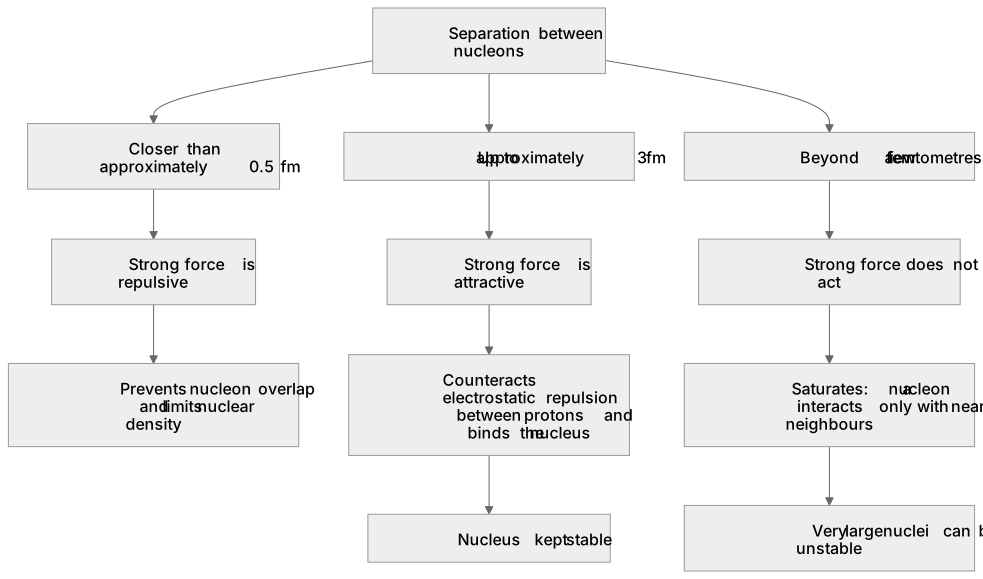
Stable and unstable nuclei: The strong nuclear force; its role in keeping the nucleus stable; short-range attraction up to approximately 3 fm, very-short range repulsion closer than approximately 0.5 fm.
The strong nuclear force acts between nucleons and holds the nucleus together despite electrostatic repulsion between protons.
Checked against the AQA 7408 specification (opens in a new tab) on .
- Point 1 of 4
- 4 key terms
Study notes
From the checked teaching notes for this specification point.
The idea
The strong nuclear force acts between nucleons and holds the nucleus together despite electrostatic repulsion between protons. It is attractive between nucleons separated by up to about 3 fm, which stabilises nuclei by binding protons and neutrons; at separations below about 0.5 fm it becomes repulsive, preventing nucleons from collapsing into each other and limiting nuclear density. It is much stronger than the electrostatic force at these ranges but acts only over short distances, so it saturates: a nucleon interacts only with near neighbours. For example, in helium-4 the two protons repel electrically, yet the strong force between all nucleon pairs keeps the nucleus bound. In larger nuclei, the short range means the strong force cannot easily stabilise the whole nucleus, contributing to instability.
What earns the marks
- States that the strong nuclear force acts between nucleons (protons and neutrons) and is attractive at separations up to approximately 3 fm.
- Explains that this attraction counteracts the electrostatic repulsion between protons and binds the nucleus, keeping it stable.
- States that at separations closer than approximately 0.5 fm the strong force becomes repulsive, preventing nucleon overlap and limiting nuclear density.
- Notes that the strong force is short-range and much stronger than the electrostatic force at nucleon separations, but does not act beyond a few femtometres.
- Applies the range idea to explain why the strong force saturates and why very large nuclei can be unstable.
Common mistakes and how to put them right
Treating the strong force as purely attractive at all separations.
Put it right: It is repulsive below about 0.5 fm.
Confusing the strong force with the electrostatic force or claiming it acts on electrons.
Put it right: It acts between nucleons only.
Assuming the strong force has infinite range like gravity or electrostatics.
Put it right: It is short-range, with attraction up to about 3 fm.
Exam tips
- Sketch a force–separation graph with repulsion below 0.5 fm, attraction up to about 3 fm and zero beyond, labelling the axes with force and separation in fm.
- Use the phrase 'short-range attraction up to approximately 3 fm' and 'very-short range repulsion closer than approximately 0.5 fm' when explaining stability.
- Link the range to nuclear size: compare the diameter of a nucleus with 3 fm to justify why the strong force acts only between neighbouring nucleons.
Try the lesson
The start of the Stable and unstable nuclei: The strong nuclear force; its role in keeping the nucleus stable; short-range attraction up to approximately 3 fm, very-short range repulsion closer than approximately 0.5 fm. lesson, made from checked teaching notes for this specification point.
Have a go first
Which force acts between nucleons to hold a nucleus together?
Listen
The strong nuclear force acts between nucleons and holds the nucleus together despite electrostatic repulsion between protons. It is attractive between nucleons separated by up to about 3 fm, which stabilises nuclei by binding protons and neutrons; at separations below about 0.5 fm it becomes repulsive, preventing nucleons from collapsing into each other and limiting nuclear density. It is much stronger than the electrostatic force at these ranges but acts only over short distances, so it saturates: a nucleon interacts only with near neighbours. For example, in helium-4 the two protons repel electrically, yet the strong force between all nucleon pairs keeps the nucleus bound. In larger nuclei, the short range means the strong force cannot easily stabilise the whole nucleus, contributing to instability. A strong answer earns marks for these points. States that the strong nuclear force acts between nucleons (protons and neutrons) and is attractive at separations up to approximately 3 fm. Explains that this attraction counteracts the electrostatic repulsion between protons and binds the nucleus, keeping it stable. States that at separations closer than approximately 0.5 fm the strong force becomes repulsive, preventing nucleon overlap and limiting nuclear density. Notes that the strong force is short-range and much stronger than the electrostatic force at nucleon separations, but does not act beyond a few femtometres. A common slip: Treating the strong force as purely attractive at all separations. Instead, it is repulsive below about 0.5 fm. Exam tip: Sketch a force–separation graph with repulsion below 0.5 fm, attraction up to about 3 fm and zero beyond, labelling the axes with force and separation in fm.
See it
Key words
Say what each word means before you turn the card.
Nuclear stability
Try answering aloud or in your head before turning the card.
Fundamental forces and their ranges
Try answering aloud or in your head before turning the card.
Nucleon interactions
Try answering aloud or in your head before turning the card.
Binding and saturation of the strong force
Try answering aloud or in your head before turning the card.
See every definition
- Nuclear stability
- Kept by the strong nuclear force acting between nucleons, which counteracts the electrostatic repulsion between protons and binds the nucleus.
- Fundamental forces and their ranges
- The strong force is short-range, acting only over a few femtometres, with attraction up to approximately 3 fm and repulsion closer than approximately 0.5 fm.
- Nucleon interactions
- Attractive between nucleons separated by up to about 3 fm, becoming repulsive below about 0.5 fm to prevent nucleons collapsing into each other.
- Binding and saturation of the strong force
- Because it acts only over short distances, a nucleon interacts only with near neighbours, so the force saturates and cannot easily stabilise a whole large nucleus.
Label the diagram
Some boxes have lost their names. Pick the right name for each number.
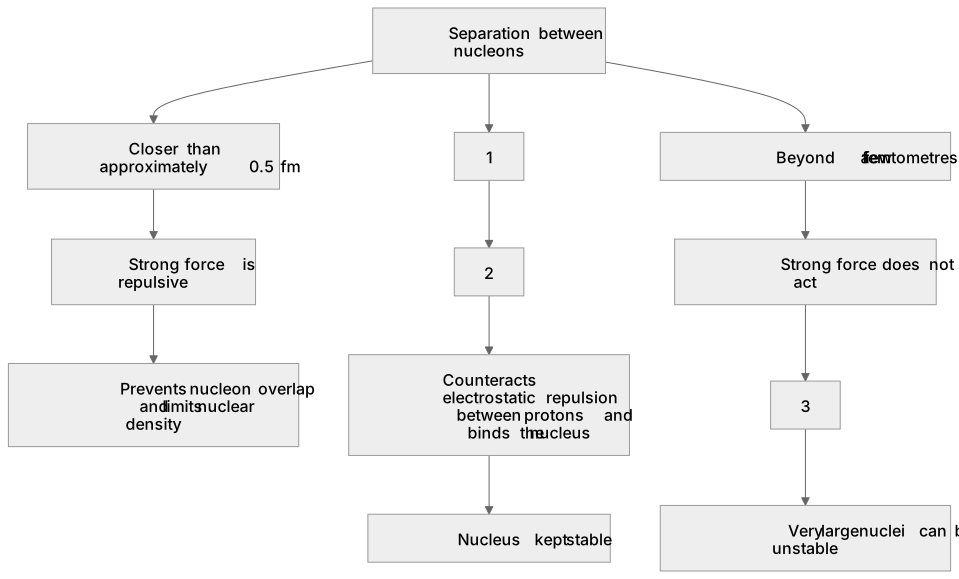
1Box 1
2Box 2
3Box 3
There is more to this lesson
The full lesson goes on to check your understanding and help you earn the marks. Create a free account to carry on, with your progress saved.
A week of Premium from your first lesson · Then the free plan continues · No card, no charge
Test your understanding of Stable and unstable nuclei: The strong nuclear force; its role in keeping the nucleus stable; short-range attraction up to approximately 3 fm, very-short range repulsion closer than approximately 0.5 fm.
Active recall beats re-reading. Take an instant quiz now to test what you’ve learned and lock it into long-term memory.
A week of Premium from your first lesson · Then the free plan continues · No card, no charge