AQA · A-Level · Physics
Course version: 7408 · Version from Sept 2016
The ultraviolet catastrophe and black-body radiation.
Full specification wording
The discovery of photoelectricity (A-level only): The ultraviolet catastrophe and black-body radiation.
A black body absorbs and emits radiation across all wavelengths.
Checked against the AQA 7408 specification (opens in a new tab) on .
- Point 1 of 4
- 4 key terms
Study notes
From the checked teaching notes for this specification point.
The idea
A black body absorbs and emits radiation across all wavelengths. Classical physics, using the Rayleigh–Jeans law, predicted that intensity would rise without limit as wavelength decreased, implying infinite energy emission in the ultraviolet region. This impossible prediction is the ultraviolet catastrophe. Planck resolved it by proposing that energy is emitted or absorbed in discrete quanta, with energy E = hf. This quantisation suppressed high-frequency emission and matched the observed black-body spectrum. The failure of classical theory and Planck's quantum hypothesis were key steps towards quantum physics and the later explanation of the photoelectric effect.
What earns the marks
- Defines a black body as an object that absorbs and emits radiation at all wavelengths, with a spectrum depending on temperature.
- States that classical wave theory predicts intensity increasing without limit as wavelength decreases, the ultraviolet catastrophe.
- Explains that this prediction conflicts with observed black-body spectra, which peak at a wavelength and fall to zero at short wavelengths.
- Describes Planck's hypothesis that energy is emitted or absorbed in discrete quanta of energy E = hf.
- Explains that quantisation limits high-frequency emission because fewer oscillators can acquire large energy quanta, removing the divergence.
Common mistakes and how to put them right
Stating that the ultraviolet catastrophe is an observed phenomenon.
Put it right: It is a failed classical prediction.
Claiming that classical theory predicts a peak in the spectrum.
Put it right: It predicts a continuous rise towards short wavelengths.
Confusing the quantum hypothesis with the photoelectric effect.
Put it right: Quantisation of energy was proposed to explain black-body radiation before being applied to photoelectricity.
Exam tips
- Sketch the observed black-body curve and the classical prediction on the same axes to contrast them.
- Use the phrase 'ultraviolet catastrophe' only for the classical prediction, not for the observed spectrum.
- State E = hf and explain how a minimum quantum size suppresses high-frequency emission.
Try the lesson
The start of the The discovery of photoelectricity (A-level only): The ultraviolet catastrophe and black-body radiation. lesson, made from checked teaching notes for this specification point.
Have a go first
What name is given to the failure of classical wave theory to predict the observed black-body radiation curve at short wavelengths?
Listen
A black body absorbs and emits radiation across all wavelengths. Classical physics, using the Rayleigh–Jeans law, predicted that intensity would rise without limit as wavelength decreased, implying infinite energy emission in the ultraviolet region. This impossible prediction is the ultraviolet catastrophe. Planck resolved it by proposing that energy is emitted or absorbed in discrete quanta, with energy E = hf. This quantisation suppressed high-frequency emission and matched the observed black-body spectrum. The failure of classical theory and Planck's quantum hypothesis were key steps towards quantum physics and the later explanation of the photoelectric effect. A strong answer earns marks for these points. Defines a black body as an object that absorbs and emits radiation at all wavelengths, with a spectrum depending on temperature. States that classical wave theory predicts intensity increasing without limit as wavelength decreases, the ultraviolet catastrophe. Explains that this prediction conflicts with observed black-body spectra, which peak at a wavelength and fall to zero at short wavelengths. Describes Planck's hypothesis that energy is emitted or absorbed in discrete quanta of energy E = hf. A common slip: Stating that the ultraviolet catastrophe is an observed phenomenon. Instead, it is a failed classical prediction. Exam tip: Sketch the observed black-body curve and the classical prediction on the same axes to contrast them.
See it
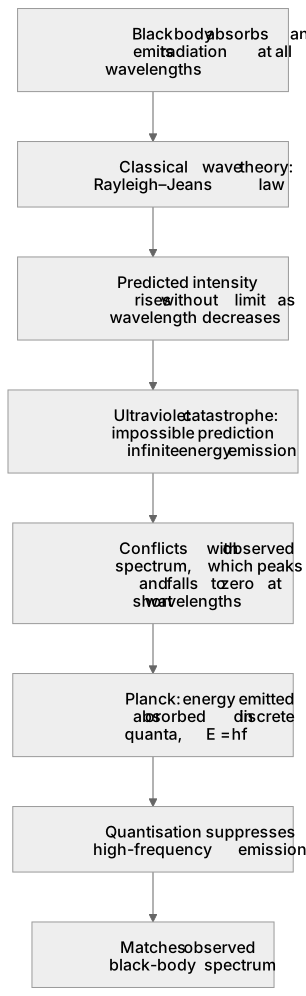
Put it in order
Put these steps in the order they happen.
- 1. Conflicts with observed spectrum, which peaks and falls to zero at short wavelengths
- 2. Matches observed black-body spectrum
- 3. Planck: energy emitted or absorbed in discrete quanta, E = hf
- 4. Black body absorbs and emits radiation at all wavelengths
- 5. Classical wave theory: Rayleigh–Jeans law
- 6. Quantisation suppresses high-frequency emission
- 7. Predicted intensity rises without limit as wavelength decreases
- 8. Ultraviolet catastrophe: impossible prediction of infinite energy emission
Key words
Say what each word means before you turn the card.
Black-body radiation
Try answering aloud or in your head before turning the card.
Ultraviolet catastrophe
Try answering aloud or in your head before turning the card.
Quantisation of energy
Try answering aloud or in your head before turning the card.
Planck's quantum hypothesis
Try answering aloud or in your head before turning the card.
See every definition
- Black-body radiation
- Radiation absorbed and emitted across all wavelengths by a black body, with a spectrum depending on temperature.
- Ultraviolet catastrophe
- The classical prediction that intensity rises without limit as wavelength decreases, implying infinite energy emission in the ultraviolet region.
- Quantisation of energy
- Energy is emitted or absorbed in discrete quanta, with energy E = hf, which suppresses high-frequency emission and matches the observed black-body spectrum.
- Planck's quantum hypothesis
- Energy is emitted or absorbed in discrete quanta of energy E = hf, limiting high-frequency emission because fewer oscillators can acquire large energy quanta, removing the divergence.
Label the diagram
Some boxes have lost their names. Pick the right name for each number.
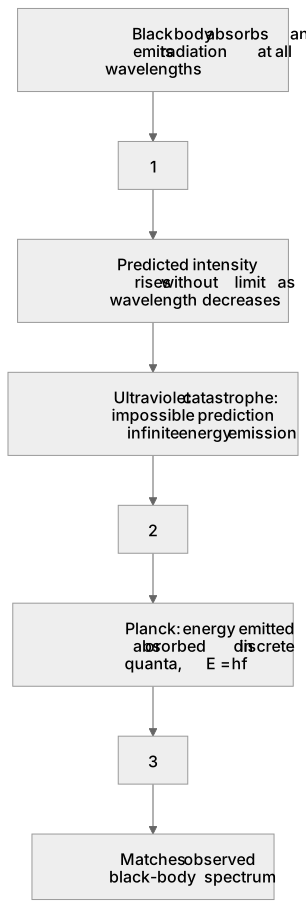
1Box 1
2Box 2
3Box 3
There is more to this lesson
The full lesson goes on to check your understanding and help you earn the marks. Create a free account to carry on, with your progress saved.
A week of Premium from your first lesson · Then the free plan continues · No card, no charge
Test your understanding of The discovery of photoelectricity (A-level only): The ultraviolet catastrophe and black-body radiation.
Active recall beats re-reading. Take an instant quiz now to test what you’ve learned and lock it into long-term memory.
A week of Premium from your first lesson · Then the free plan continues · No card, no charge