AQA · A-Level · Physics
Course version: 7408 · Version from Sept 2016
Stellar evolution: path of a star similar to our Sun on the HR diagram…
Full specification wording
The Hertzsprung-Russell (HR) diagram (A-level only): Stellar evolution: path of a star similar to our Sun on the HR diagram from formation to white dwarf.
A star similar to our Sun follows a distinct evolutionary path on the Hertzsprung-Russell diagram.
Checked against the AQA 7408 specification (opens in a new tab) on .
- Point 4 of 4
- 4 key terms
Study notes
From the checked teaching notes for this specification point.
The idea
A star similar to our Sun follows a distinct evolutionary path on the Hertzsprung-Russell diagram. It begins as a protostar, contracting and heating up, moving left and slightly down onto the main sequence at an absolute magnitude of roughly +5 and a temperature of 5700 K. Here it spends most of its life fusing hydrogen. Once core hydrogen is depleted, the core contracts while outer layers expand and cool, causing the star's path to move up and to the right into the red giant branch (higher luminosity, lower temperature). After helium fusion ceases, outer layers are ejected as a planetary nebula. The exposed, hot core remains as a white dwarf, causing the track to drop sharply down and to the left (low luminosity, high temperature).
What earns the marks
- Describe the initial path from a cooler, highly luminous protostar moving left and down onto the main sequence at approximately 5700 K and absolute magnitude +5.
- Explain the movement to the red giant branch: up (increased luminosity) and to the right (decreased surface temperature).
- Identify the transition phase where outer layers are expelled as a planetary nebula, leaving the core.
- Describe the final movement to the white dwarf region: down (decreased luminosity) and to the left (increased surface temperature).
Common mistakes and how to put them right
Drawing the path from the main sequence directly to the white dwarf region.
Put it right: Route the path through the red giant region (top right) before moving to the white dwarf region (bottom left).
Showing the star moving along the main sequence band as it ages.
Put it right: Stars do not move along the main sequence; they remain in a fixed position until they evolve off it into red giants.
Stating the white dwarf has a 'lower' absolute magnitude than the main sequence star.
Put it right: White dwarfs are fainter, so they have a higher absolute magnitude (e.g., +10 to +15 compared to +5), which corresponds to a lower luminosity.
Exam tips
- Use directional arrows on your drawn path to clearly indicate the chronological sequence of evolution.
- Ensure the red giant phase is plotted in the top right quadrant, clearly separated from the supergiant region above it.
- When describing the changes, explicitly link the movement on the diagram to changes in surface temperature and absolute magnitude.
Try the lesson
The start of the The Hertzsprung-Russell (HR) diagram (A-level only): Stellar evolution: path of a star similar to our Sun on the HR diagram from formation to white dwarf. lesson, made from checked teaching notes for this specification point.
Have a go first
Which sequence gives the correct order of stages in the evolution of a star similar to the Sun?
Listen
A star similar to our Sun follows a distinct evolutionary path on the Hertzsprung-Russell diagram. It begins as a protostar, contracting and heating up, moving left and slightly down onto the main sequence at an absolute magnitude of roughly +5 and a temperature of 5700 K. Here it spends most of its life fusing hydrogen. Once core hydrogen is depleted, the core contracts while outer layers expand and cool, causing the star's path to move up and to the right into the red giant branch (higher luminosity, lower temperature). After helium fusion ceases, outer layers are ejected as a planetary nebula. The exposed, hot core remains as a white dwarf, causing the track to drop sharply down and to the left (low luminosity, high temperature). A strong answer earns marks for these points. Describe the initial path from a cooler, highly luminous protostar moving left and down onto the main sequence at approximately 5700 K and absolute magnitude +5. Explain the movement to the red giant branch: up (increased luminosity) and to the right (decreased surface temperature). Identify the transition phase where outer layers are expelled as a planetary nebula, leaving the core. Describe the final movement to the white dwarf region: down (decreased luminosity) and to the left (increased surface temperature). A common slip: Drawing the path from the main sequence directly to the white dwarf region. Instead, Route the path through the red giant region (top right) before moving to the white dwarf region (bottom left). Exam tip: Use directional arrows on your drawn path to clearly indicate the chronological sequence of evolution.
See it
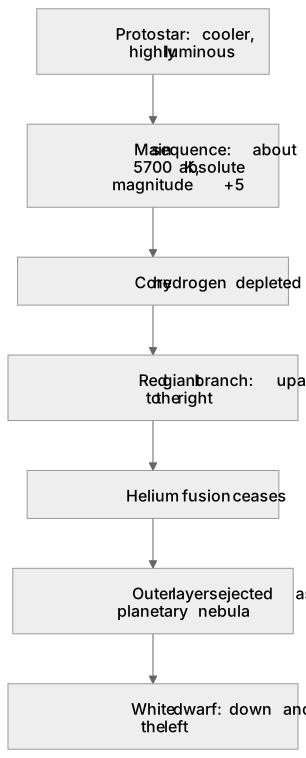
Put it in order
Put these steps in the order they happen.
- 1. White dwarf: down and to the left
- 2. Outer layers ejected as planetary nebula
- 3. Core hydrogen depleted
- 4. Helium fusion ceases
- 5. Protostar: cooler, highly luminous
- 6. Main sequence: about 5700 K, absolute magnitude +5
- 7. Red giant branch: up and to the right
Key words
Say what each word means before you turn the card.
Stellar evolution
Try answering aloud or in your head before turning the card.
Main sequence
Try answering aloud or in your head before turning the card.
Red giant branch
Try answering aloud or in your head before turning the card.
White dwarf
Try answering aloud or in your head before turning the card.
See every definition
- Stellar evolution
- The path of a star similar to our Sun on the HR diagram from formation to white dwarf.
- Main sequence
- The region where a star spends most of its life fusing hydrogen, at roughly 5700 K and absolute magnitude +5.
- Red giant branch
- The region reached when the core contracts while outer layers expand and cool, giving higher luminosity and lower temperature.
- White dwarf
- The exposed, hot core remaining after outer layers are ejected as a planetary nebula, with low luminosity and high temperature.
Label the diagram
Some boxes have lost their names. Pick the right name for each number.
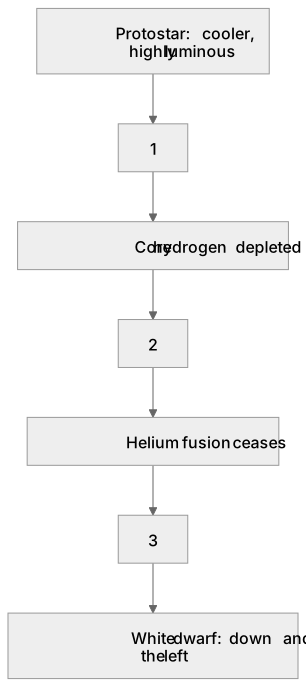
1Box 1
2Box 2
3Box 3
There is more to this lesson
The full lesson goes on to check your understanding and help you earn the marks. Create a free account to carry on, with your progress saved.
A week of Premium from your first lesson · Then the free plan continues · No card, no charge
Test your understanding of The Hertzsprung-Russell (HR) diagram (A-level only): Stellar evolution: path of a star similar to our Sun on the HR diagram from formation to white dwarf.
Active recall beats re-reading. Take an instant quiz now to test what you’ve learned and lock it into long-term memory.
A week of Premium from your first lesson · Then the free plan continues · No card, no charge