AQA · A-Level · Physics
Course version: 7408 · Version from Sept 2016
Principle of the Michelson-Morley interferometer.
Full specification wording
The Michelson-Morley experiment (A-level only): Principle of the Michelson-Morley interferometer.
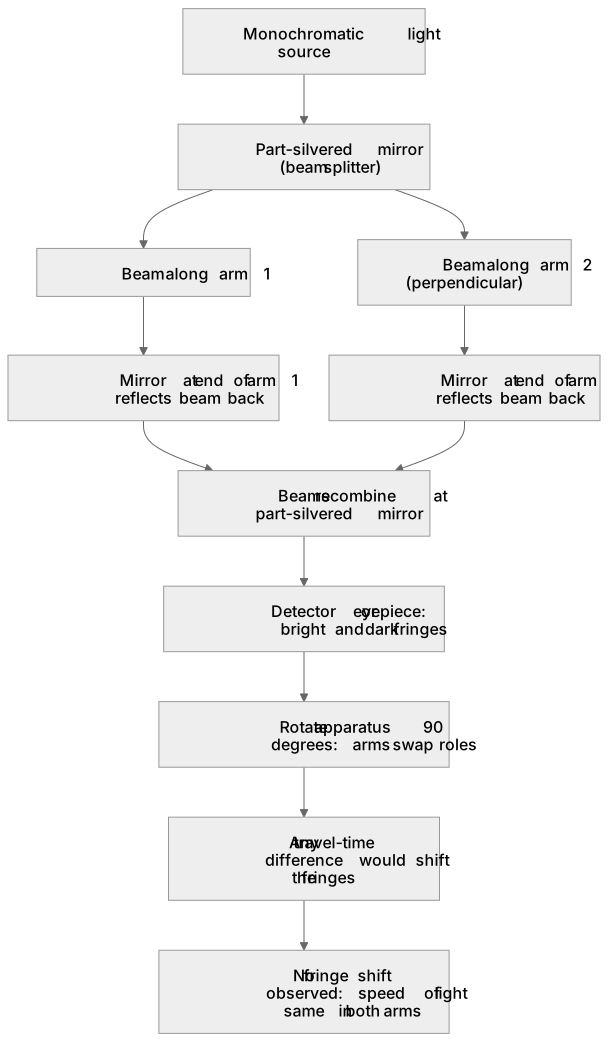
The Michelson–Morley interferometer splits a beam of monochromatic light with a part-silvered mirror into two perpendicular paths.
Checked against the AQA 7408 specification (opens in a new tab) on .
- Point 1 of 4
- 4 key terms
Study notes
From the checked teaching notes for this specification point.
The idea
The Michelson–Morley interferometer splits a beam of monochromatic light with a part-silvered mirror into two perpendicular paths. Each beam travels to a mirror, reflects, and returns to the same part-silvered mirror, where the beams recombine and fall on a detector or eyepiece. Because the two paths differ slightly in length, the recombining waves have a phase difference, producing bright and dark interference fringes. Rotating the apparatus through 90° swaps the roles of the two arms, so any difference in light travel time along the arms would shift the fringe pattern. Michelson and Morley looked for this shift to detect motion through the aether. No shift was observed, which showed that the speed of light is the same in both arms and independent of the Earth's motion.
What earns the marks
- A part-silvered mirror (beam splitter) divides one light beam into two coherent beams travelling along mutually perpendicular arms.
- Each beam reflects from a mirror at the end of its arm and returns to the part-silvered mirror, where the beams recombine.
- Recombination produces an interference pattern of bright and dark fringes because the two paths have different optical path lengths.
- The path difference determines the phase difference between the recombining waves and therefore the fringe positions.
- Rotating the interferometer by 90° exchanges the two arm lengths relative to any motion through the aether, so a change in travel time would shift the fringes.
- Michelson and Morley observed no measurable fringe shift, which is evidence that the speed of light is invariant and that the aether hypothesis is not supported.
Common mistakes and how to put them right
Thinking the two beams are incoherent.
Put it right: The beams originate from the same source and are coherent, which is why stable fringes form.
Believing the mirrors absorb the light.
Put it right: The end mirrors reflect the beams back, so each beam traverses its arm twice.
Assuming the apparatus measures the speed of light directly.
Put it right: It compares travel times along two arms by observing fringe shifts, not by timing a pulse.
Exam tips
- Sketch the layout with source, part-silvered mirror, two arms, end mirrors and detector, and label the two light paths.
- Explain the role of the 90° rotation explicitly, because this is what converts a possible aether effect into an observable fringe shift.
- Link the absence of a fringe shift to the invariance of the speed of light rather than simply saying the experiment failed.
Try the lesson
The start of the The Michelson-Morley experiment (A-level only): Principle of the Michelson-Morley interferometer. lesson, made from checked teaching notes for this specification point.
Have a go first
In the Michelson-Morley interferometer, a beam of light is split into two beams that travel along paths at right angles to each other. What is done to these two beams so that an interference pattern can be observed?
Listen
The Michelson–Morley interferometer splits a beam of monochromatic light with a part-silvered mirror into two perpendicular paths. Each beam travels to a mirror, reflects, and returns to the same part-silvered mirror, where the beams recombine and fall on a detector or eyepiece. Because the two paths differ slightly in length, the recombining waves have a phase difference, producing bright and dark interference fringes. Rotating the apparatus through 90° swaps the roles of the two arms, so any difference in light travel time along the arms would shift the fringe pattern. Michelson and Morley looked for this shift to detect motion through the aether. No shift was observed, which showed that the speed of light is the same in both arms and independent of the Earth's motion. A strong answer earns marks for these points. A part-silvered mirror (beam splitter) divides one light beam into two coherent beams travelling along mutually perpendicular arms. Each beam reflects from a mirror at the end of its arm and returns to the part-silvered mirror, where the beams recombine. Recombination produces an interference pattern of bright and dark fringes because the two paths have different optical path lengths. The path difference determines the phase difference between the recombining waves and therefore the fringe positions. Exam tip: Sketch the layout with source, part-silvered mirror, two arms, end mirrors and detector, and label the two light paths.
See it
Key words
Say what each word means before you turn the card.
Interference fringes
Try answering aloud or in your head before turning the card.
Phase difference
Try answering aloud or in your head before turning the card.
Part-silvered mirror
Try answering aloud or in your head before turning the card.
Invariance of the speed of light
Try answering aloud or in your head before turning the card.
See every definition
- Interference fringes
- Bright and dark fringes produced when the two recombining beams have a phase difference because the two paths differ slightly in length.
- Phase difference
- Determined by the path difference between the recombining waves and therefore fixes the fringe positions.
- Part-silvered mirror
- Splits a beam of monochromatic light into two perpendicular paths and later recombines the returning beams so they fall on a detector or eyepiece.
- Invariance of the speed of light
- Shown by the absence of any fringe shift, meaning the speed of light is the same in both arms and independent of the Earth's motion.
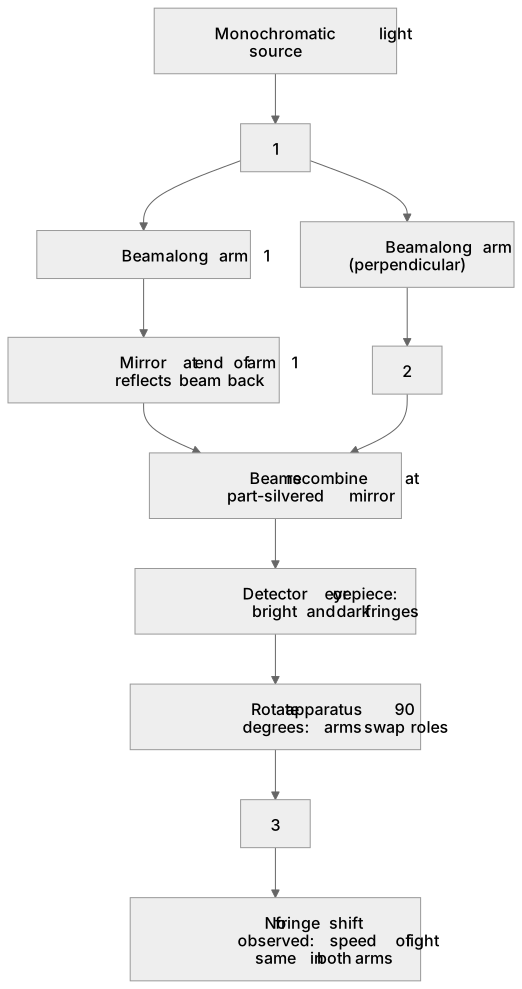
Label the diagram
Some boxes have lost their names. Pick the right name for each number.
1Box 1
2Box 2
3Box 3
There is more to this lesson
The full lesson goes on to check your understanding and help you earn the marks. Create a free account to carry on, with your progress saved.
A week of Premium from your first lesson · Then the free plan continues · No card, no charge
Test your understanding of The Michelson-Morley experiment (A-level only): Principle of the Michelson-Morley interferometer.
Active recall beats re-reading. Take an instant quiz now to test what you’ve learned and lock it into long-term memory.
A week of Premium from your first lesson · Then the free plan continues · No card, no charge