AQA · A-Level · Physics
Course version: 7408 · Version from Sept 2016
The invariance of the speed of light.
Full specification wording
The Michelson-Morley experiment (A-level only): The invariance of the speed of light.
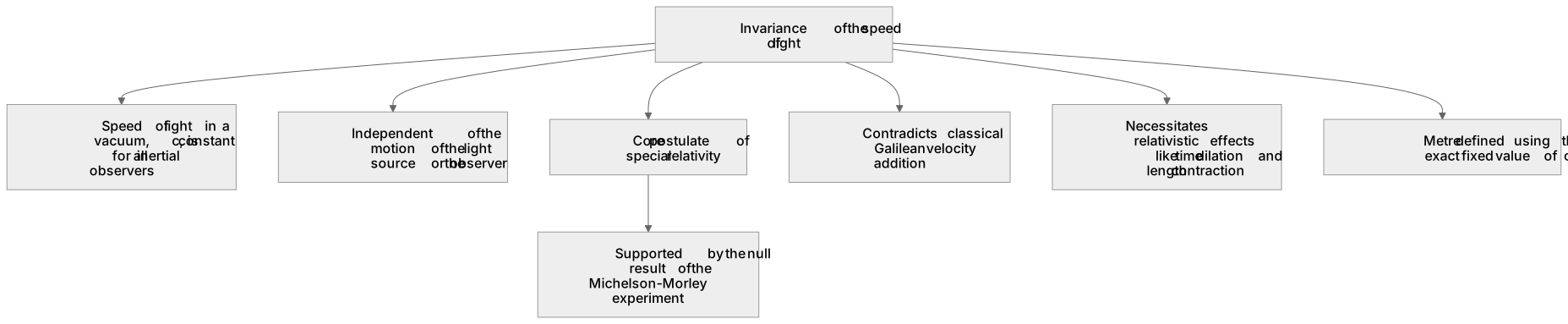
The invariance of the speed of light states that the speed of light in a vacuum, $c$, is constant for all inertial observers, regardless of the motion of the light source or the observer.
Checked against the AQA 7408 specification (opens in a new tab) on .
- Point 4 of 4
- 3 key terms
Study notes
From the checked teaching notes for this specification point.
The idea
The invariance of the speed of light states that the speed of light in a vacuum, $c$, is constant for all inertial observers, regardless of the motion of the light source or the observer. This fundamental postulate of special relativity is supported by the null result of the Michelson-Morley experiment. For example, if a spacecraft travelling at $0.5c$ shines a laser forward, a stationary observer measures the laser beam's speed as $c$, not $1.5c$. This contradicts classical Galilean velocity addition. This invariance necessitates relativistic effects like time dilation and length contraction. The metre is now defined using the exact fixed value of $c = 299\,792\,458\text{ m s}^{-1}$.
What earns the marks
- The speed of light in a vacuum, $c$, is constant for all inertial observers.
- The invariance of $c$ is a core postulate of special relativity, supported by the Michelson-Morley experiment's null result.
Common mistakes and how to put them right
Adding the speed of a moving source to $c$ (e.g., $c + v$).
Put it right: All inertial observers measure the vacuum speed of light as exactly $c$.
Applying the invariance principle to non-inertial frames.
Put it right: This specific postulate of special relativity applies strictly to inertial (non-accelerating) observers.
Confusing the invariance of $c$ with the constancy of frequency or wavelength.
Put it right: While the speed $c$ is invariant, the observed frequency and wavelength will shift due to the Doppler effect (though their product remains $c$).
Exam tips
- Always specify that the speed of light is constant 'in a vacuum' and 'for all inertial observers' to secure full marks in definition questions.
- Link the invariance of $c$ directly to the null result of the Michelson-Morley experiment when discussing experimental evidence for special relativity.
Try the lesson
The start of the The Michelson-Morley experiment (A-level only): The invariance of the speed of light. lesson, made from checked teaching notes for this specification point.
Have a go first
What does the invariance of the speed of light mean?
Listen
The invariance of the speed of light states that the speed of light in a vacuum, c, is constant for all inertial observers, regardless of the motion of the light source or the observer. This fundamental postulate of special relativity is supported by the null result of the Michelson-Morley experiment. For example, if a spacecraft travelling at 0.5c shines a laser forward, a stationary observer measures the laser beam's speed as c, not 1.5c. This contradicts classical Galilean velocity addition. This invariance necessitates relativistic effects like time dilation and length contraction. The metre is now defined using the exact fixed value of c = 299\,792\,458\text{ m s}^{-1}. A strong answer earns marks for these points. The speed of light in a vacuum, c, is constant for all inertial observers. The invariance of c is a core postulate of special relativity, supported by the Michelson-Morley experiment's null result. A common slip: Adding the speed of a moving source to c (e.g., c + v). Instead, all inertial observers measure the vacuum speed of light as exactly c. Exam tip: Always specify that the speed of light is constant 'in a vacuum' and 'for all inertial observers' to secure full marks in definition questions.
See it
Key words
Say what each word means before you turn the card.
Invariance of the speed of light
Try answering aloud or in your head before turning the card.
Michelson-Morley experiment
Try answering aloud or in your head before turning the card.
Classical Galilean velocity addition
Try answering aloud or in your head before turning the card.
See every definition
- Invariance of the speed of light
- The speed of light in a vacuum, c, is constant for all inertial observers, regardless of the motion of the light source or the observer.
- Michelson-Morley experiment
- An experiment whose null result supports the invariance of the speed of light, a fundamental postulate of special relativity.
- Classical Galilean velocity addition
- The classical view in which velocities simply add together as vectors, contradicted by the invariance of the speed of light.
Label the diagram
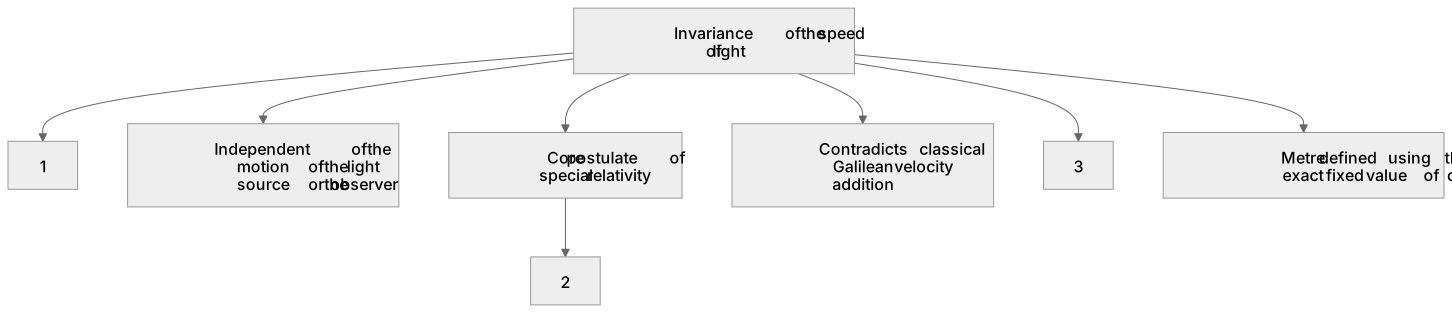
Some boxes have lost their names. Pick the right name for each number.
1Box 1
2Box 2
3Box 3
There is more to this lesson
The full lesson goes on to check your understanding and help you earn the marks. Create a free account to carry on, with your progress saved.
A week of Premium from your first lesson · Then the free plan continues · No card, no charge
Test your understanding of The Michelson-Morley experiment (A-level only): The invariance of the speed of light.
Active recall beats re-reading. Take an instant quiz now to test what you’ve learned and lock it into long-term memory.
A week of Premium from your first lesson · Then the free plan continues · No card, no charge