AQA · A-Level · Physics
Course version: 7408 · Version from Sept 2016
Appreciation that during a change of state the potential energies of the…
Full specification wording
Thermal energy transfer (A-level only): Appreciation that during a change of state the potential energies of the particle ensemble are changing but not the kinetic energies.
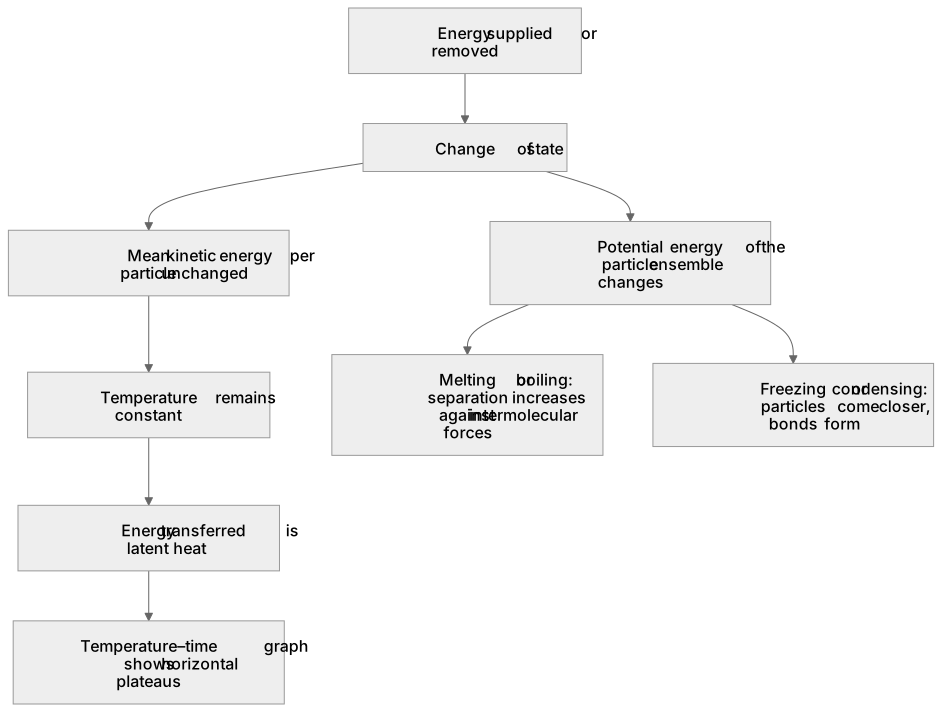
During a change of state, energy is supplied or removed while the temperature stays constant.
Checked against the AQA 7408 specification (opens in a new tab) on .
- Point 3 of 7
- 3 key terms
Study notes
From the checked teaching notes for this specification point.
The idea
During a change of state, energy is supplied or removed while the temperature stays constant. The energy changes the potential energy of the particle ensemble, not its kinetic energy. For example, melting a typical solid requires energy to break regular lattice bonds, so particles become freer and their mean separation increases; the mean kinetic energy per particle, and therefore temperature, remains unchanged. (Note: melting ice anomalously decreases average particle separation). Similarly, boiling water supplies energy to separate molecules against intermolecular forces. Because temperature is a measure of mean random kinetic energy, a constant temperature confirms kinetic energy is unchanged. The energy involved is the latent heat.
What earns the marks
- Temperature remains constant during a change of state because the mean random kinetic energy of the particles does not change.
- Energy supplied or removed during melting, boiling, condensing or freezing changes the potential energy of the particle ensemble.
- In melting (for most substances) and boiling, energy increases the separation of particles against intermolecular forces, raising their potential energy.
- In freezing and condensing, potential energy decreases as particles come closer together and intermolecular bonds form.
- The energy transferred at constant temperature is the latent heat, and it does not appear as a temperature rise.
- A temperature–time graph for a pure substance shows horizontal plateaus at the melting and boiling points.
Common mistakes and how to put them right
Thinking that supplied energy always raises temperature.
Put it right by stating that at a change of state the energy changes potential energy while kinetic energy stays constant.
Believing that particles stop moving during a change of state.
Put it right by explaining that particles still have the same mean kinetic energy and temperature, but are less constrained.
Confusing latent heat with specific heat capacity.
Put it right by noting that latent heat applies at constant temperature during a change of state, whereas specific heat capacity applies when temperature changes.
Exam tips
- Link the constant temperature directly to constant mean kinetic energy of the particles, using the definition of temperature.
- Use a labelled temperature–time graph to show plateaus at melting and boiling points, and annotate what is happening to potential energy on each plateau.
Try the lesson
The start of the Thermal energy transfer (A-level only): Appreciation that during a change of state the potential energies of the particle ensemble are changing but not the kinetic energies. lesson, made from checked teaching notes for this specification point.
Have a go first
A pure solid is melting at its normal melting point while energy is supplied steadily. Which quantity of the particles stays constant during this change of state?
Listen
During a change of state, energy is supplied or removed while the temperature stays constant. The energy changes the potential energy of the particle ensemble, not its kinetic energy. For example, melting a typical solid requires energy to break regular lattice bonds, so particles become freer and their mean separation increases; the mean kinetic energy per particle, and therefore temperature, remains unchanged. Note: melting ice anomalously decreases average particle separation). Similarly, boiling water supplies energy to separate molecules against intermolecular forces. Because temperature is a measure of mean random kinetic energy, a constant temperature confirms kinetic energy is unchanged. The energy involved is the latent heat. A strong answer earns marks for these points. Temperature remains constant during a change of state because the mean random kinetic energy of the particles does not change. Energy supplied or removed during melting, boiling, condensing or freezing changes the potential energy of the particle ensemble. In melting (for most substances) and boiling, energy increases the separation of particles against intermolecular forces, raising their potential energy. In freezing and condensing, potential energy decreases as particles come closer together and intermolecular bonds form. A common slip: Thinking that supplied energy always raises temperature. Instead, stating that at a change of state the energy changes potential energy while kinetic energy stays constant. Exam tip: Link the constant temperature directly to constant mean kinetic energy of the particles, using the definition of temperature.
See it
Key words
Say what each word means before you turn the card.
Latent heat
Try answering aloud or in your head before turning the card.
Temperature
Try answering aloud or in your head before turning the card.
Change of state
Try answering aloud or in your head before turning the card.
See every definition
- Latent heat
- The energy transferred at constant temperature during a change of state, which does not appear as a temperature rise.
- Temperature
- A measure of mean random kinetic energy, so a constant temperature confirms kinetic energy is unchanged.
- Change of state
- A process in which energy is supplied or removed while the temperature stays constant, changing the potential energy of the particle ensemble.
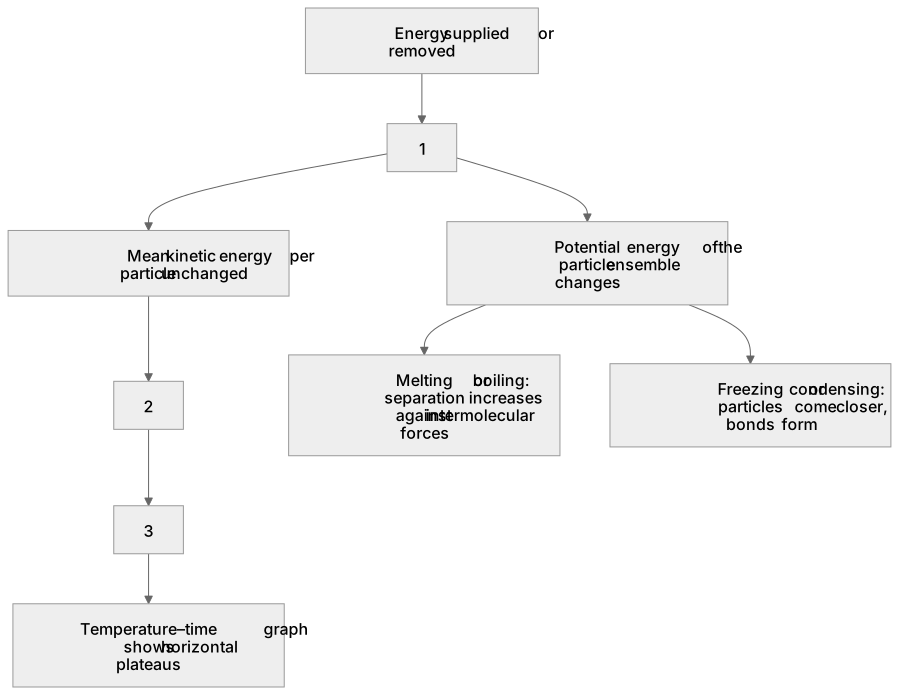
Label the diagram
Some boxes have lost their names. Pick the right name for each number.
1Box 1
2Box 2
3Box 3
There is more to this lesson
The full lesson goes on to check your understanding and help you earn the marks. Create a free account to carry on, with your progress saved.
A week of Premium from your first lesson · Then the free plan continues · No card, no charge
Test your understanding of Thermal energy transfer (A-level only): Appreciation that during a change of state the potential energies of the particle ensemble are changing but not the kinetic energies.
Active recall beats re-reading. Take an instant quiz now to test what you’ve learned and lock it into long-term memory.
A week of Premium from your first lesson · Then the free plan continues · No card, no charge