AQA · A-Level · Physics
Course version: 7408 · Version from Sept 2016
Internal energy is the sum of the randomly distributed kinetic energies…
Full specification wording
Thermal energy transfer (A-level only): Internal energy is the sum of the randomly distributed kinetic energies and potential energies of the particles in a body.
Internal energy is a property of a body arising from its particles.
Checked against the AQA 7408 specification (opens in a new tab) on .
- Point 1 of 7
- 4 key terms
Study notes
From the checked teaching notes for this specification point.
The idea
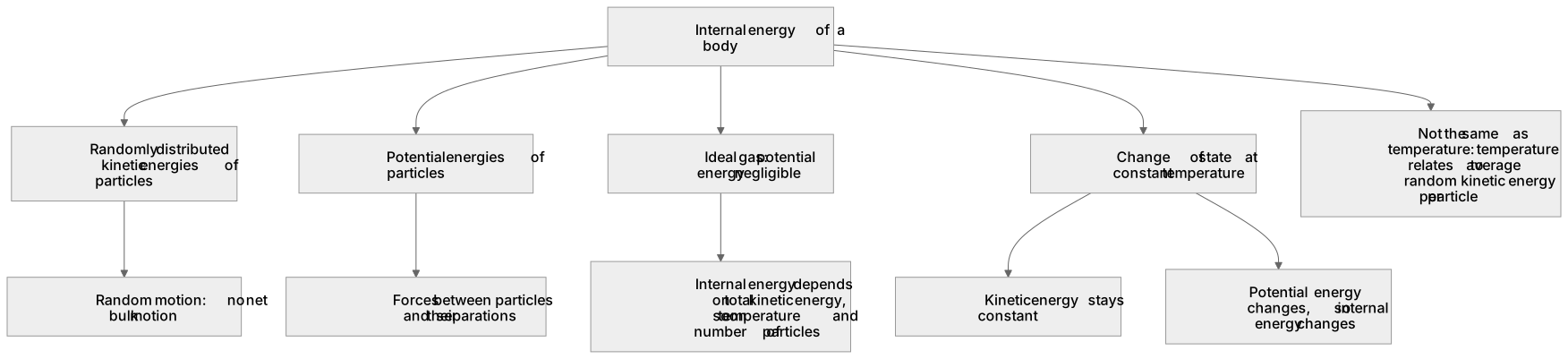
Internal energy is a property of a body arising from its particles. It is the total of two contributions: the kinetic energies associated with random motion of particles, and the potential energies associated with forces between particles. Random means there is no net bulk motion; individual particles have a distribution of speeds. For an ideal gas, potential energy is negligible, so internal energy depends only on total kinetic energy and therefore on temperature and number of particles. For a real substance, potential energy changes during changes of state at constant temperature, so internal energy changes even when kinetic energy does not.
For example: Melting ice at 0 °C increases internal energy because energy is used to break intermolecular bonds, increasing potential energy while temperature stays constant.
What earns the marks
- Internal energy is the total of the kinetic and potential energies of all particles in a body, not an average per particle.
- Kinetic energy contribution arises from random motion of particles; random means no net movement of the body as a whole.
- Potential energy contribution arises from forces between particles and their separations.
- For an ideal gas, intermolecular potential energy is negligible, so internal energy is the total random kinetic energy of its particles.
- During a change of state at constant temperature, kinetic energy stays constant but potential energy changes, so internal energy changes.
- Internal energy is not the same as temperature: temperature relates to average random kinetic energy per particle, while internal energy is a total over all particles.
Common mistakes and how to put them right
Treating internal energy as only kinetic energy.
Put it right by including potential energy for real substances, while noting it is negligible for an ideal gas.
Confusing internal energy with temperature.
Put it right by stating that temperature is related to average random kinetic energy per particle, whereas internal energy is the total for all particles.
Assuming internal energy always rises when temperature rises.
Put it right by recognising that during a change of state at constant temperature, internal energy can change because potential energy changes.
Using the term 'heat' for internal energy.
Put it right by using 'internal energy' for the energy stored in a body and 'heating' for a transfer process.
Exam tips
- Define internal energy in one sentence that includes both kinetic and potential contributions and the word 'random'.
- When explaining a change of state, state explicitly that kinetic energy remains constant while potential energy increases.
- Use the ideal gas case to show understanding: if potential energy is negligible, internal energy depends on total kinetic energy, so it depends on temperature and number of particles.
- Avoid saying 'heat energy inside a body'; refer to internal energy stored and energy transferred by heating.
Try the lesson
The start of the Thermal energy transfer (A-level only): Internal energy is the sum of the randomly distributed kinetic energies and potential energies of the particles in a body. lesson, made from checked teaching notes for this specification point.
Have a go first
Which statement defines the internal energy of a body?
Listen
Internal energy is a property of a body arising from its particles. It is the total of two contributions: the kinetic energies associated with random motion of particles, and the potential energies associated with forces between particles. Random means there is no net bulk motion; individual particles have a distribution of speeds. For an ideal gas, potential energy is negligible, so internal energy depends only on total kinetic energy and therefore on temperature and number of particles. For a real substance, potential energy changes during changes of state at constant temperature, so internal energy changes even when kinetic energy does not. For example, melting ice at 0 °C increases internal energy because energy is used to break intermolecular bonds, increasing potential energy while temperature stays constant. A strong answer earns marks for these points. Internal energy is the total of the kinetic and potential energies of all particles in a body, not an average per particle. Kinetic energy contribution arises from random motion of particles; random means no net movement of the body as a whole. Potential energy contribution arises from forces between particles and their separations. For an ideal gas, intermolecular potential energy is negligible, so internal energy is the total random kinetic energy of its particles. A common slip: Treating internal energy as only kinetic energy. Instead, including potential energy for real substances, while noting it is negligible for an ideal gas. Exam tip: Define internal energy in one sentence that includes both kinetic and potential contributions and the word 'random'.
See it
Key words
Say what each word means before you turn the card.
Internal energy
Try answering aloud or in your head before turning the card.
Random motion
Try answering aloud or in your head before turning the card.
Ideal gas
Try answering aloud or in your head before turning the card.
Change of state
Try answering aloud or in your head before turning the card.
See every definition
- Internal energy
- The sum of the randomly distributed kinetic energies and potential energies of the particles in a body.
- Random motion
- Motion of particles with no net movement of the body as a whole, with individual particles having a distribution of speeds.
- Ideal gas
- A gas for which potential energy is negligible, so internal energy depends only on total kinetic energy and therefore on temperature and number of particles.
- Change of state
- A process at constant temperature in which potential energy changes, so internal energy changes even when kinetic energy does not.
Label the diagram
Some boxes have lost their names. Pick the right name for each number.
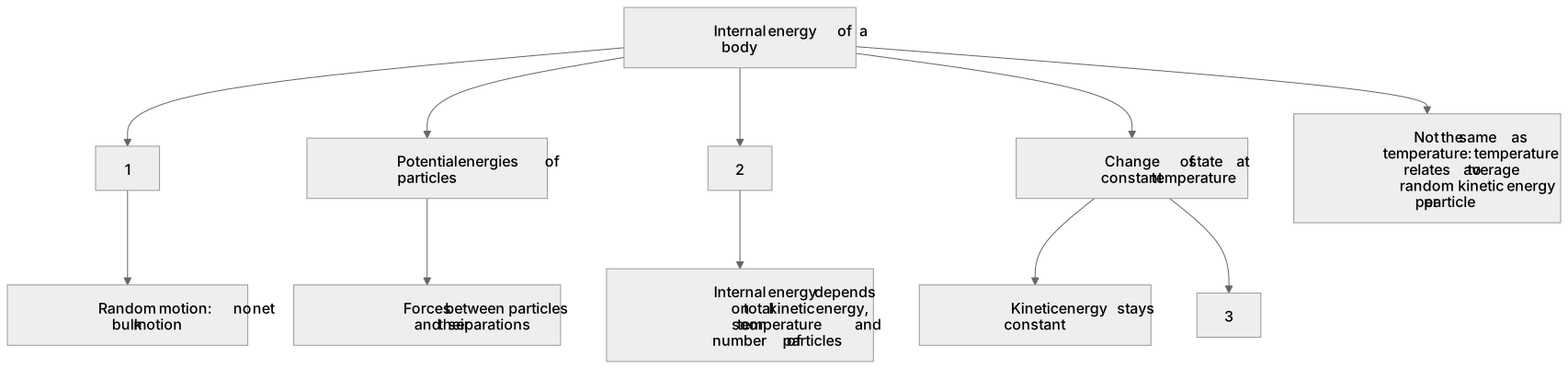
1Box 1
2Box 2
3Box 3
There is more to this lesson
The full lesson goes on to check your understanding and help you earn the marks. Create a free account to carry on, with your progress saved.
A week of Premium from your first lesson · Then the free plan continues · No card, no charge
Test your understanding of Thermal energy transfer (A-level only): Internal energy is the sum of the randomly distributed kinetic energies and potential energies of the particles in a body.
Active recall beats re-reading. Take an instant quiz now to test what you’ve learned and lock it into long-term memory.
A week of Premium from your first lesson · Then the free plan continues · No card, no charge