AQA · A-Level · Physics
Course version: 7408 · Version from Sept 2016
Proper time and time dilation as a consequence of special relativity.
Full specification wording
Time dilation (A-level only): Proper time and time dilation as a consequence of special relativity.
Proper time is the time interval measured by an observer who sees two events occur at the same place, so a single clock at rest relative to those events records it.
Checked against the AQA 7408 specification (opens in a new tab) on .
- 4 key terms
Study notes
From the checked teaching notes for this specification point.
The idea
Proper time is the time interval measured by an observer who sees two events occur at the same place, so a single clock at rest relative to those events records it. Any observer moving relative to that clock measures a longer interval, the dilated time, because the moving clock runs slow relative to them. The link is t = γt₀, where t₀ is proper time and the Lorentz factor is γ = 1 / √(1 − v²/c²). For example, a muon created in the upper atmosphere has a proper lifetime of about 2.2 μs; at 0.99c, γ ≈ 7.1, so an Earth observer measures roughly 16 μs, allowing many muons to reach sea level. Identify the frame in which the two events share a location, assign t₀ there, then apply γ to find the interval in the other frame.
What earns the marks
- Defines proper time as the interval between two events measured in the frame where those events occur at the same position, recorded by one clock at rest in that frame.
- States that the dilated time measured in any other inertial frame is always greater than the proper time, since the Lorentz factor γ is at least 1.
- Applies t = γt₀ with γ = 1 / √(1 − v²/c²), substituting speeds as a fraction of c and keeping c² consistent.
- Identifies the correct frame for t₀ in a muon, spacecraft or particle-decay context before calculating the observed lifetime or journey time.
- Explains the result physically: moving clocks run slow relative to the observer, and the effect becomes significant only when v is a appreciable fraction of c.
- Checks that the calculated dilated time exceeds the proper time and that γ is dimensionless, with units of time preserved.
Common mistakes and how to put them right
Treating the dilated time as the proper time.
Put it right: t₀ belongs to the frame where the events are co-located.
Using t = t₀/γ instead of t = γt₀.
Put it right: The other frame always measures the longer time.
Substituting v in m s⁻¹ without converting c to the same units, or omitting the square root.
Put it right: Form the dimensionless ratio v/c first and evaluate √(1 − v²/c²) carefully.
Exam tips
- Underline the two events in the question and state explicitly which frame measures proper time before substituting any numbers.
- Show the ratio v/c and the value of γ to at least two significant figures so method marks are visible even if the final arithmetic slips.
- Use the context to justify the answer, for example explaining why time dilation lets atmospheric muons reach the ground.
- Keep full precision through the calculation and round only the final time interval to an appropriate number of significant figures.
Try the lesson
The start of the Time dilation (A-level only): Proper time and time dilation as a consequence of special relativity. lesson, made from checked teaching notes for this specification point.
Have a go first
A muon is at rest in a laboratory, and a clock attached to the muon measures the interval between two events occurring at the muon's position. What name is given to the time interval measured by this clock?
Listen
Proper time is the time interval measured by an observer who sees two events occur at the same place, so a single clock at rest relative to those events records it. Any observer moving relative to that clock measures a longer interval, the dilated time, because the moving clock runs slow relative to them. The link is t = γt₀, where t₀ is proper time and the Lorentz factor is γ = 1 / √(1 − v²/c²). For example, a muon created in the upper atmosphere has a proper lifetime of about 2.2 μs; at 0.99c, γ ≈ 7.1, so an Earth observer measures roughly 16 μs, allowing many muons to reach sea level. Identify the frame in which the two events share a location, assign t₀ there, then apply γ to find the interval in the other frame. A strong answer earns marks for these points. Defines proper time as the interval between two events measured in the frame where those events occur at the same position, recorded by one clock at rest in that frame. States that the dilated time measured in any other inertial frame is always greater than the proper time, since the Lorentz factor γ is at least 1. Applies t = γt₀ with γ = 1 / √(1 − v²/c²), substituting speeds as a fraction of c and keeping c² consistent. Identifies the correct frame for t₀ in a muon, spacecraft or particle-decay context before calculating the observed lifetime or journey time. A common slip: Treating the dilated time as the proper time: the error is assigning t₀ to the moving observer's measurement. Instead, t₀ belongs to the frame where the events are co-located. Exam tip: Underline the two events in the question and state explicitly which frame measures proper time before substituting any numbers.
See it
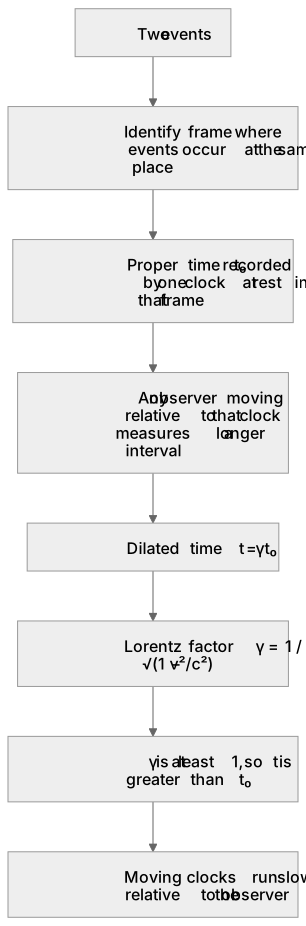
Put it in order
Put these steps in the order they happen.
- 1. Dilated time t = γt₀
- 2. Moving clocks run slow relative to the observer
- 3. Lorentz factor γ = 1 / √(1 − v²/c²)
- 4. Two events
- 5. Identify frame where events occur at the same place
- 6. γ is at least 1, so t is greater than t₀
- 7. Proper time t₀ recorded by one clock at rest in that frame
- 8. Any observer moving relative to that clock measures a longer interval
Key words
Say what each word means before you turn the card.
Proper time
Try answering aloud or in your head before turning the card.
Dilated time
Try answering aloud or in your head before turning the card.
Lorentz factor
Try answering aloud or in your head before turning the card.
Time dilation
Try answering aloud or in your head before turning the card.
See every definition
- Proper time
- The time interval measured by an observer who sees two events occur at the same place, recorded by a single clock at rest relative to those events.
- Dilated time
- The longer interval measured by any observer moving relative to the clock, because the moving clock runs slow relative to them.
- Lorentz factor
- Given by γ = 1 / √(1 − v²/c²), it links the proper time to the dilated time through t = γt₀.
- Time dilation
- A consequence of special relativity in which a moving clock runs slow relative to the observer, becoming significant only when v is an appreciable fraction of c.
Label the diagram
Some boxes have lost their names. Pick the right name for each number.
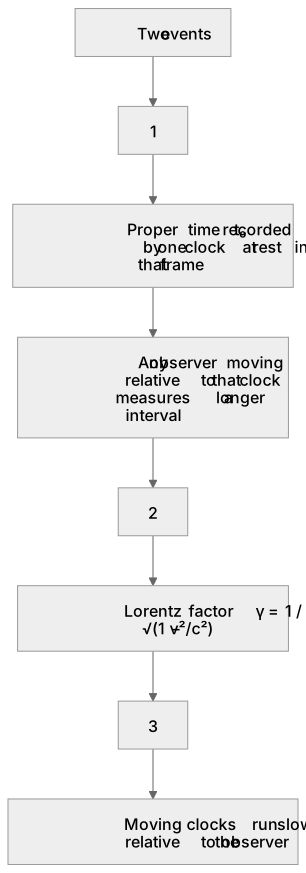
1Box 1
2Box 2
3Box 3
There is more to this lesson
The full lesson goes on to check your understanding and help you earn the marks. Create a free account to carry on, with your progress saved.
A week of Premium from your first lesson · Then the free plan continues · No card, no charge
Test your understanding of Time dilation (A-level only): Proper time and time dilation as a consequence of special relativity.
Active recall beats re-reading. Take an instant quiz now to test what you’ve learned and lock it into long-term memory.
A week of Premium from your first lesson · Then the free plan continues · No card, no charge