AQA · A-Level · Physics
Course version: 7408 · Version from Sept 2016
Torque and angular acceleration (A-level only): T = Fr T = Iα
Torque (moment of a force) measures the turning effect of a force about an axis: T = Fr, where F is the force and r is the perpendicular distance from the axis to the line of action.
Checked against the AQA 7408 specification (opens in a new tab) on .
- 4 key terms
Study notes
From the checked teaching notes for this specification point.
The idea
Torque (moment of a force) measures the turning effect of a force about an axis: T = Fr, where F is the force and r is the perpendicular distance from the axis to the line of action. For a rotating rigid body, the resultant torque produces angular acceleration according to T = Iα, where I is the moment of inertia and α is angular acceleration in rad s⁻². These equations are the rotational analogues of F = ma and the moment equation. To solve problems, identify the axis, find the perpendicular distance, calculate resultant torque, then use T = Iα to find α, or combine with rotational kinematics.
What earns the marks
- Torque is defined by T = Fr, where r is the perpendicular distance from the axis to the line of action of the force, not necessarily the length of the object.
- The rotational form of Newton's second law is T = Iα, where I is the moment of inertia about the chosen axis and α is angular acceleration in rad s⁻².
- For several forces, calculate the resultant torque by taking clockwise and anticlockwise contributions with opposite signs before applying T = Iα.
- Moment of inertia depends on mass and its distribution about the axis, so the same torque produces different angular accelerations for different bodies or axes.
- Angular acceleration links to linear acceleration at a point by a = rα, allowing rotational and linear dynamics to be combined.
- The equations apply to a rigid body rotating about a fixed axis, with torque and moment of inertia taken about that same axis.
Common mistakes and how to put them right
Using the full length of a rod as r when the force is not perpendicular to it.
Put it right: Use the perpendicular distance from the axis to the line of action, or resolve the force.
Adding torques arithmetically without direction.
Put it right: Assign opposite signs to clockwise and anticlockwise torques and find the resultant.
Mixing up I and α with linear m and a: the correction is to use T = Iα for rotation and keep the axis consistent throughout the calculation.
Exam tips
- Draw a diagram showing the axis, each force and its perpendicular distance before substituting into T = Fr.
- State the direction convention for torques, then calculate the resultant torque before using T = Iα.
- Check units: torque in N m, I in kg m² and α in rad s⁻², and convert degrees to radians where needed.
Try the lesson
The start of the Torque and angular acceleration (A-level only): T = Fr T = Iα lesson, made from checked teaching notes for this specification point.
Have a go first
A force of 12 N acts at a perpendicular distance of 0.50 m from the axis of a rotating wheel. What is the torque about the axis?
Listen
Torque (moment of a force) measures the turning effect of a force about an axis: T = Fr, where F is the force and r is the perpendicular distance from the axis to the line of action. For a rotating rigid body, the resultant torque produces angular acceleration according to T = Iα, where I is the moment of inertia and α is angular acceleration in rad s⁻². These equations are the rotational analogues of F = ma and the moment equation. To solve problems, identify the axis, find the perpendicular distance, calculate resultant torque, then use T = Iα to find α, or combine with rotational kinematics. A strong answer earns marks for these points. Torque is defined by T = Fr, where r is the perpendicular distance from the axis to the line of action of the force, not necessarily the length of the object. The rotational form of Newton's second law is T = Iα, where I is the moment of inertia about the chosen axis and α is angular acceleration in rad s⁻². For several forces, calculate the resultant torque by taking clockwise and anticlockwise contributions with opposite signs before applying T = Iα. Moment of inertia depends on mass and its distribution about the axis, so the same torque produces different angular accelerations for different bodies or axes. A common slip: Using the full length of a rod as r when the force is not perpendicular to it. Instead, use the perpendicular distance from the axis to the line of action, or resolve the force. Exam tip: Draw a diagram showing the axis, each force and its perpendicular distance before substituting into T = Fr.
See it
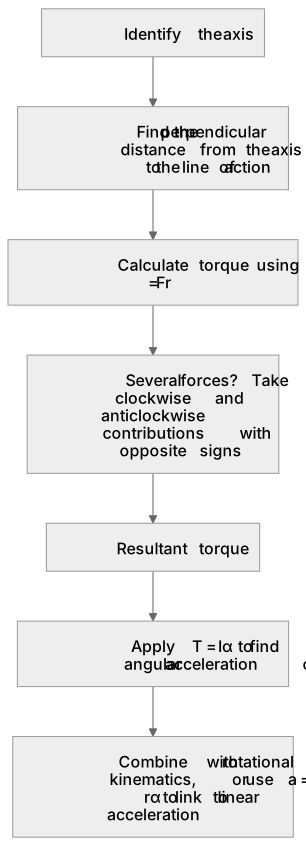
Put it in order
Put these steps in the order they happen.
- 1. Combine with rotational kinematics, or use a = rα to link to linear acceleration
- 2. Apply T = Iα to find angular acceleration α
- 3. Calculate torque using T = Fr
- 4. Resultant torque
- 5. Identify the axis
- 6. Find the perpendicular distance from the axis to the line of action
- 7. Several forces? Take clockwise and anticlockwise contributions with opposite signs
Key words
Say what each word means before you turn the card.
Torque
Try answering aloud or in your head before turning the card.
Rotational form of Newton's second law
Try answering aloud or in your head before turning the card.
Moment of inertia
Try answering aloud or in your head before turning the card.
Angular acceleration
Try answering aloud or in your head before turning the card.
See every definition
- Torque
- Measures the turning effect of a force about an axis, given by T = Fr, where r is the perpendicular distance from the axis to the line of action.
- Rotational form of Newton's second law
- The resultant torque produces angular acceleration according to T = Iα, the rotational analogue of F = ma.
- Moment of inertia
- Depends on mass and its distribution about the axis, so the same torque produces different angular accelerations for different bodies or axes.
- Angular acceleration
- Links to linear acceleration at a point by a = rα, allowing rotational and linear dynamics to be combined.
Label the diagram
Some boxes have lost their names. Pick the right name for each number.
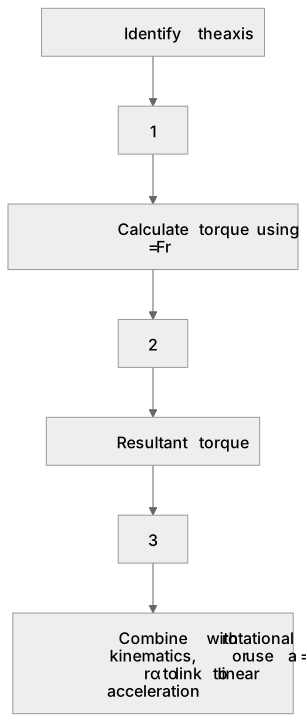
1Box 1
2Box 2
3Box 3
There is more to this lesson
The full lesson goes on to check your understanding and help you earn the marks. Create a free account to carry on, with your progress saved.
A week of Premium from your first lesson · Then the free plan continues · No card, no charge
Test your understanding of Torque and angular acceleration (A-level only): T = Fr T = Iα
Active recall beats re-reading. Take an instant quiz now to test what you’ve learned and lock it into long-term memory.
A week of Premium from your first lesson · Then the free plan continues · No card, no charge