AQA · A-Level · Physics
Course version: 7408 · Version from Sept 2016
Ground wave, refraction and reflection of sky waves, diffraction of…
Full specification wording
Transmission media (A-level only): Ground wave, refraction and reflection of sky waves, diffraction of long-wavelength radiation around the Earth’s surface.
Radio communication depends on how waves interact with the Earth and atmosphere.
Checked against the AQA 7408 specification (opens in a new tab) on .
- Point 2 of 5
- 3 key terms
Study notes
From the checked teaching notes for this specification point.
The idea
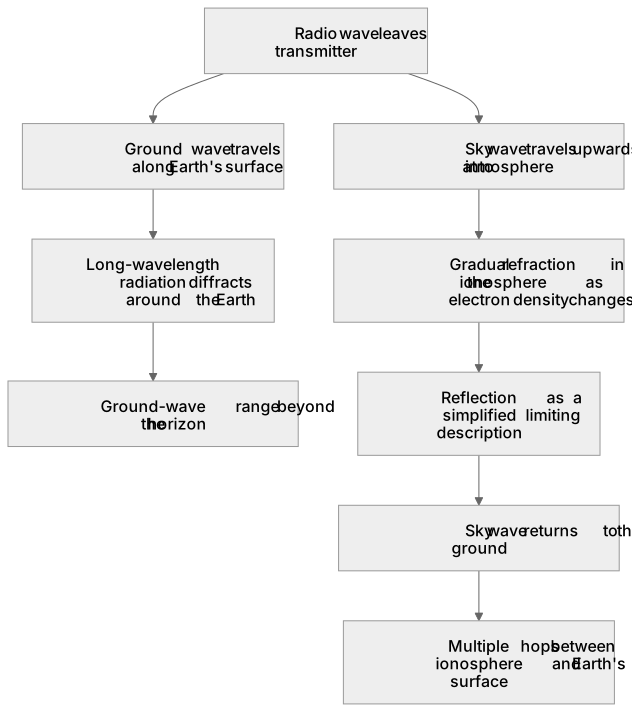
Radio communication depends on how waves interact with the Earth and atmosphere. Ground waves travel along the surface, following its curvature by diffraction; this works best for long wavelengths, which diffract more around obstacles and the Earth. Sky waves travel upwards, refract gradually through the ionosphere as electron density changes, and can return to Earth; reflection is a useful limiting description. The ionosphere's varying ionisation means sky-wave reception changes with frequency, time of day and solar activity. Shorter wavelengths diffract less, so ground-wave range falls. A practical example is long-wave AM broadcasting reaching beyond the horizon by ground wave, while short-wave signals reach distant receivers via sky waves.
What earns the marks
- Ground waves propagate along or near the Earth's surface and can follow its curvature because long-wavelength radiation diffracts significantly around the Earth.
- Diffraction is greater when wavelength is comparable to, or larger than, the size of the obstacle or aperture; the Earth itself acts as the obstacle for ground waves.
- Sky waves travel into the atmosphere and are gradually refracted by the ionosphere, where free electrons make the refractive index vary with height and frequency.
- Reflection at an ionospheric layer is a simplified model of the continuous refraction that can return a sky wave to the ground.
- The ionosphere's ionisation varies with time of day, season and solar activity, so sky-wave propagation is variable and frequency-dependent.
- Shorter wavelengths diffract less around the Earth, so ground-wave communication is more effective at long wavelengths.
- Multiple hops between the ionosphere and the Earth's surface can allow sky waves to travel very long distances.
Common mistakes and how to put them right
Treating ground waves as travelling in a straight line through the Earth.
Put it right by explaining that they follow the surface and spread around the curvature by diffraction.
Describing sky waves as reflecting perfectly from a sharp mirror-like layer.
Put it right by explaining gradual refraction in a medium whose refractive index changes with height, with reflection as a limiting description.
Assuming the ionosphere is constant.
Put it right by linking its changing ionisation to time of day, solar activity and frequency, which changes which frequencies return to Earth.
Exam tips
- When explaining ground-wave range, explicitly link wavelength to the amount of diffraction around the Earth rather than saying only that long waves travel further.
- For sky waves, describe the change in refractive index with height in the ionosphere and state that the wave bends progressively until it may return to Earth.
- Use a labelled diagram showing the Earth's surface, the ionosphere and possible paths; annotate where diffraction, refraction and reflection occur.
Try the lesson
The start of the Transmission media (A-level only): Ground wave, refraction and reflection of sky waves, diffraction of long-wavelength radiation around the Earth’s surface. lesson, made from checked teaching notes for this specification point.
Have a go first
Which transmission mechanism allows long-wavelength radio signals to travel beyond the horizon by bending around the curved surface of the Earth?
Listen
Radio communication depends on how waves interact with the Earth and atmosphere. Ground waves travel along the surface, following its curvature by diffraction; this works best for long wavelengths, which diffract more around obstacles and the Earth. Sky waves travel upwards, refract gradually through the ionosphere as electron density changes, and can return to Earth; reflection is a useful limiting description. The ionosphere's varying ionisation means sky-wave reception changes with frequency, time of day and solar activity. Shorter wavelengths diffract less, so ground-wave range falls. A practical example is long-wave AM broadcasting reaching beyond the horizon by ground wave, while short-wave signals reach distant receivers via sky waves. A strong answer earns marks for these points. Ground waves propagate along or near the Earth's surface and can follow its curvature because long-wavelength radiation diffracts significantly around the Earth. Diffraction is greater when wavelength is comparable to, or larger than, the size of the obstacle or aperture; the Earth itself acts as the obstacle for ground waves. Sky waves travel into the atmosphere and are gradually refracted by the ionosphere, where free electrons make the refractive index vary with height and frequency. Reflection at an ionospheric layer is a simplified model of the continuous refraction that can return a sky wave to the ground. A common slip: Treating ground waves as travelling in a straight line through the Earth. Instead, explaining that they follow the surface and spread around the curvature by diffraction. Exam tip: When explaining ground-wave range, explicitly link wavelength to the amount of diffraction around the Earth rather than saying only that long waves travel further.
See it
Key words
Say what each word means before you turn the card.
Diffraction
Try answering aloud or in your head before turning the card.
Refraction
Try answering aloud or in your head before turning the card.
Ionosphere and signal variability
Try answering aloud or in your head before turning the card.
See every definition
- Diffraction
- The spreading of long-wavelength radiation around the Earth's surface, which lets ground waves follow its curvature.
- Refraction
- The gradual bending of sky waves as electron density changes through the ionosphere, which can return them to Earth.
- Ionosphere and signal variability
- The ionosphere's varying ionisation means sky-wave reception changes with frequency, time of day and solar activity.
Label the diagram
Some boxes have lost their names. Pick the right name for each number.
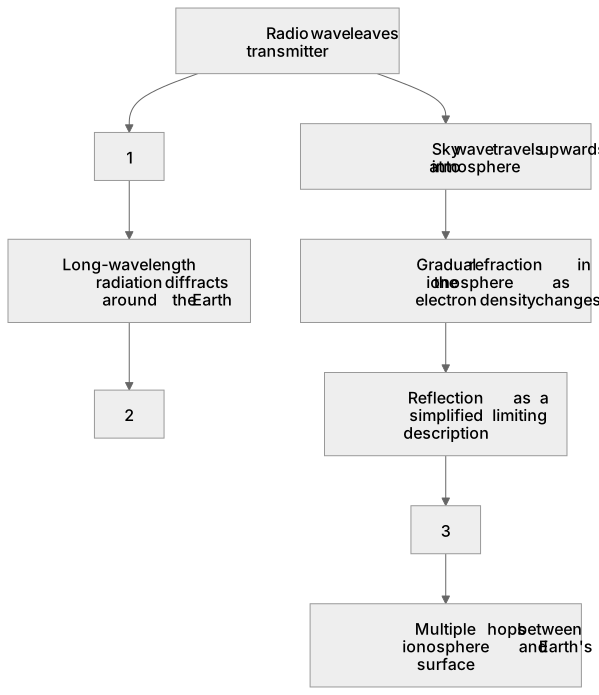
1Box 1
2Box 2
3Box 3
There is more to this lesson
The full lesson goes on to check your understanding and help you earn the marks. Create a free account to carry on, with your progress saved.
A week of Premium from your first lesson · Then the free plan continues · No card, no charge
Test your understanding of Transmission media (A-level only): Ground wave, refraction and reflection of sky waves, diffraction of long-wavelength radiation around the Earth’s surface.
Active recall beats re-reading. Take an instant quiz now to test what you’ve learned and lock it into long-term memory.
A week of Premium from your first lesson · Then the free plan continues · No card, no charge