AQA · A-Level · Physics
Course version: 7408 · Version from Sept 2016
Students should recognise that up- and down-links require different…
Full specification wording
Transmission media (A-level only): Students should recognise that up- and down-links require different frequencies so that the receivers are not de-sensed.
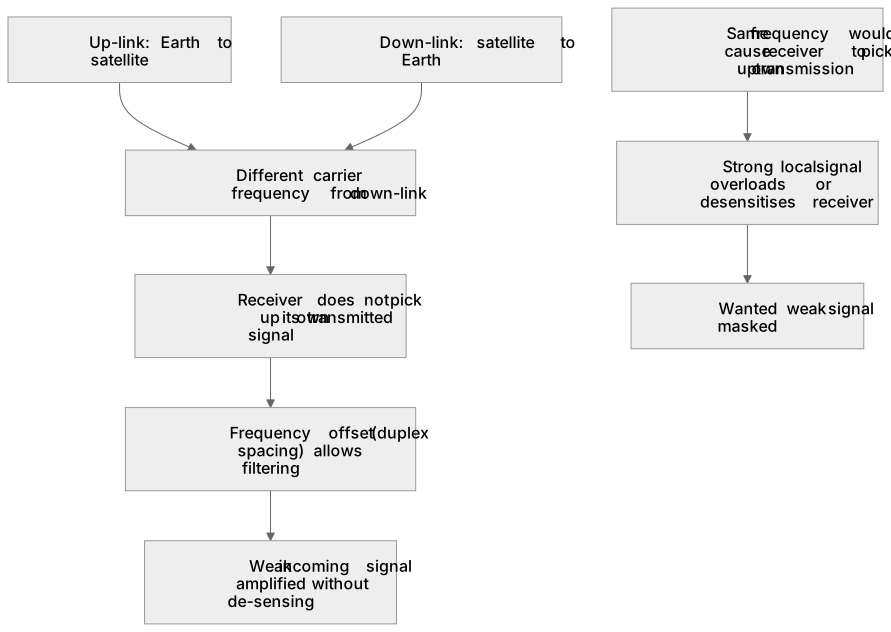
In satellite and many duplex radio systems, the up-link (Earth to satellite) and down-link (satellite to Earth) use different carrier frequencies.
Checked against the AQA 7408 specification (opens in a new tab) on .
- Point 4 of 5
- 4 key terms
Study notes
From the checked teaching notes for this specification point.
The idea
In satellite and many duplex radio systems, the up-link (Earth to satellite) and down-link (satellite to Earth) use different carrier frequencies. If both used the same frequency, a receiver would pick up its own transmitted signal as well as the weak incoming signal. The strong local transmission would overload or desensitise the receiver front end, masking the wanted signal. This is why a frequency offset, or duplex spacing, is used. For example, a satellite might receive at 14.25 GHz and transmit at 11.45 GHz, giving a 2.8 GHz separation. The receiver can then filter out its own transmission band and amplify the weak incoming signal without being de-sensed. You should be able to explain the problem and how different frequencies solve it.
What earns the marks
- States that up-link and down-link use different carrier frequencies.
- Explains that using the same frequency would cause the receiver to pick up its own transmitted signal.
- Describes de-sensing as the strong local signal overloading or desensitising the receiver, reducing its ability to detect the weak incoming signal.
- Explains that a frequency offset (duplex spacing) allows filtering so the receiver is not de-sensed.
- Applies the idea to a satellite or duplex radio system with a numerical example of frequency separation.
Common mistakes and how to put them right
Thinking that different frequencies are needed only to avoid interference between different users.
Put it right: The key issue is the receiver being de-sensed by its own transmission.
Confusing up-link and down-link.
Put it right: Up-link is Earth to satellite, down-link is satellite to Earth.
Assuming the frequency difference must be large.
Put it right: Any sufficient offset that allows filtering and avoids de-sensing is adequate, though practical systems use specific bands.
Exam tips
- Define de-sensing clearly in your answer, linking it to receiver overload.
- Use a labelled diagram or numerical example to show the frequency separation.
- Explain the consequence of not using different frequencies, not just state that they are different.
Try the lesson
The start of the Transmission media (A-level only): Students should recognise that up- and down-links require different frequencies so that the receivers are not de-sensed. lesson, made from checked teaching notes for this specification point.
Have a go first
In a satellite communication system, why must the up-link and down-link operate on different frequencies?
Listen
In satellite and many duplex radio systems, the up-link (Earth to satellite) and down-link (satellite to Earth) use different carrier frequencies. If both used the same frequency, a receiver would pick up its own transmitted signal as well as the weak incoming signal. The strong local transmission would overload or desensitise the receiver front end, masking the wanted signal. This is why a frequency offset, or duplex spacing, is used. For example, a satellite might receive at 14.25 GHz and transmit at 11.45 GHz, giving a 2.8 GHz separation. The receiver can then filter out its own transmission band and amplify the weak incoming signal without being de-sensed. You should be able to explain the problem and how different frequencies solve it. A strong answer earns marks for these points. States that up-link and down-link use different carrier frequencies. Explains that using the same frequency would cause the receiver to pick up its own transmitted signal. Describes de-sensing as the strong local signal overloading or desensitising the receiver, reducing its ability to detect the weak incoming signal. Explains that a frequency offset (duplex spacing) allows filtering so the receiver is not de-sensed. A common slip: Thinking that different frequencies are needed only to avoid interference between different users. Instead, the key issue is the receiver being de-sensed by its own transmission. Exam tip: Define de-sensing clearly in your answer, linking it to receiver overload.
See it
Key words
Say what each word means before you turn the card.
Up-link
Try answering aloud or in your head before turning the card.
Down-link
Try answering aloud or in your head before turning the card.
De-sensing
Try answering aloud or in your head before turning the card.
Frequency offset
Try answering aloud or in your head before turning the card.
See every definition
- Up-link
- The link from Earth to satellite, which uses a different carrier frequency from the down-link.
- Down-link
- The link from satellite to Earth, which uses a different carrier frequency from the up-link.
- De-sensing
- The strong local signal overloading or desensitising the receiver, reducing its ability to detect the weak incoming signal.
- Frequency offset
- A duplex spacing that allows filtering so the receiver is not de-sensed.
Label the diagram
Some boxes have lost their names. Pick the right name for each number.
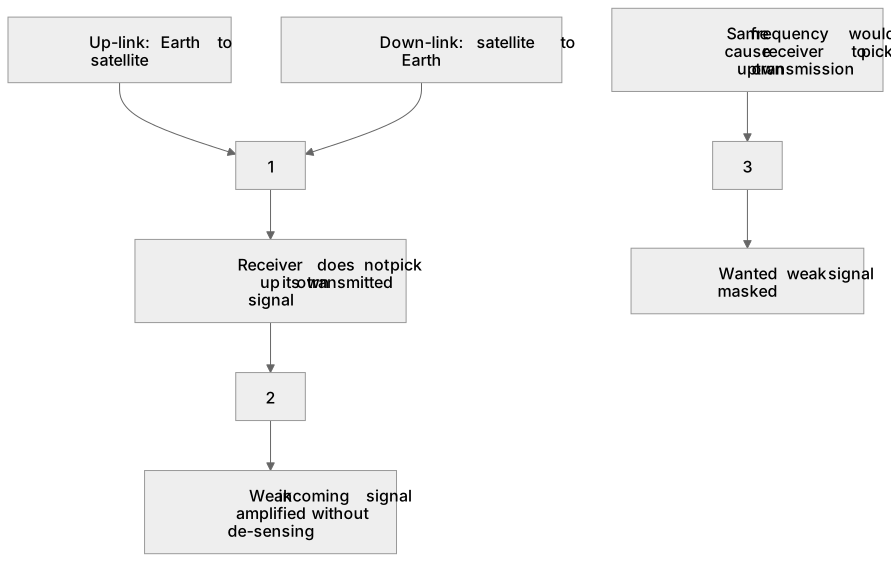
1Box 1
2Box 2
3Box 3
There is more to this lesson
The full lesson goes on to check your understanding and help you earn the marks. Create a free account to carry on, with your progress saved.
A week of Premium from your first lesson · Then the free plan continues · No card, no charge
Test your understanding of Transmission media (A-level only): Students should recognise that up- and down-links require different frequencies so that the receivers are not de-sensed.
Active recall beats re-reading. Take an instant quiz now to test what you’ve learned and lock it into long-term memory.
A week of Premium from your first lesson · Then the free plan continues · No card, no charge