AQA · A-Level · Physics
Course version: 7408 · Version from Sept 2016
Internal treatment using beta emitting implants.
Full specification wording
Use of radioactive implants (A-level only): Internal treatment using beta emitting implants.
Beta-emitting implants are sealed sources placed inside or next to a tumour so that ionising radiation damages malignant cells while sparing much healthy tissue.
Checked against the AQA 7408 specification (opens in a new tab) on .
- 2 key terms
Study notes
From the checked teaching notes for this specification point.
The idea
Beta-emitting implants are sealed sources placed inside or next to a tumour so that ionising radiation damages malignant cells while sparing much healthy tissue. A beta emitter is chosen because beta particles have a short range in tissue, so dose falls steeply with distance; this confines the therapeutic effect to the target volume and limits exposure of organs beyond it. The implant may be a wire, seed or plaque, and it can be temporary or permanent. A concrete example is a phosphorus-32 or yttrium-90 source used in targeted internal radiotherapy, where the short beta range means the surrounding tissue receives a high local dose.
What earns the marks
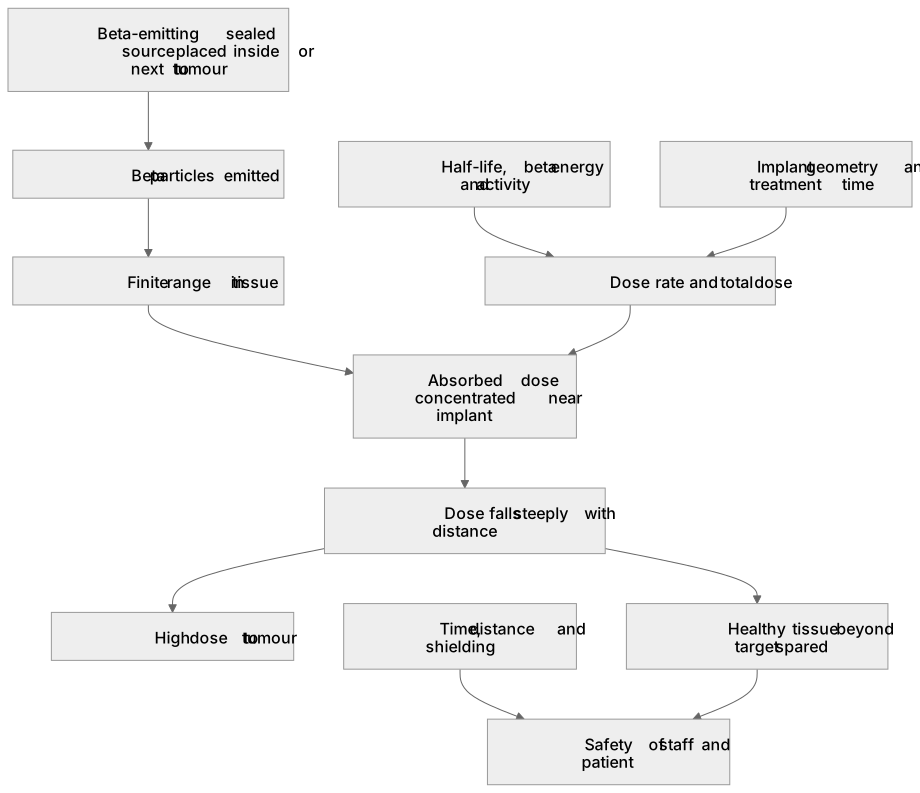
- Beta particles are moderately penetrating but have a finite range in tissue, so the absorbed dose is concentrated near the implant and falls rapidly with distance.
- The implant is a sealed source, so the radioactive material is contained and does not enter the patient's general circulation.
- Choice of radionuclide depends on half-life, beta energy and the required treatment duration; a suitable half-life allows a useful dose rate without unnecessary long-term irradiation.
- The clinical aim is to deliver a high dose to the tumour while keeping dose to healthy tissue and staff as low as reasonably practicable.
- Dose depends on source activity, distance from the source and exposure time, so implant placement and treatment time are planned carefully.
- Staff and patient safety involve time, distance and shielding, plus monitoring and controlled handling of the source.
Common mistakes and how to put them right
Treating beta particles as having unlimited range.
Put it right by stating that beta particles have a finite range in tissue and that dose falls steeply beyond it.
Confusing beta-emitting implants with external beam radiotherapy.
Put it right by explaining that the source is placed inside or adjacent to the tumour.
Assuming the implant irradiates the whole body uniformly.
Put it right by describing the steep dose gradient around the source and the need to protect healthy tissue.
Exam tips
- Name the emission type and explain how its range in tissue produces a localised dose.
- Link half-life and activity to the practical treatment schedule rather than quoting them in isolation.
- Use the principles of time, distance and shielding when discussing safety for staff and the patient.
Try the lesson
The start of the Use of radioactive implants (A-level only): Internal treatment using beta emitting implants. lesson, made from checked teaching notes for this specification point.
Have a go first
Why are beta emitting implants placed directly inside a tumour rather than outside the patient's body?
Listen
Beta-emitting implants are sealed sources placed inside or next to a tumour so that ionising radiation damages malignant cells while sparing much healthy tissue. A beta emitter is chosen because beta particles have a short range in tissue, so dose falls steeply with distance; this confines the therapeutic effect to the target volume and limits exposure of organs beyond it. The implant may be a wire, seed or plaque, and it can be temporary or permanent. A concrete example is a phosphorus-32 or yttrium-90 source used in targeted internal radiotherapy, where the short beta range means the surrounding tissue receives a high local dose. A strong answer earns marks for these points. Beta particles are moderately penetrating but have a finite range in tissue, so the absorbed dose is concentrated near the implant and falls rapidly with distance. The implant is a sealed source, so the radioactive material is contained and does not enter the patient's general circulation. Choice of radionuclide depends on half-life, beta energy and the required treatment duration; a suitable half-life allows a useful dose rate without unnecessary long-term irradiation. The clinical aim is to deliver a high dose to the tumour while keeping dose to healthy tissue and staff as low as reasonably practicable. A common slip: Treating beta particles as having unlimited range. Instead, stating that beta particles have a finite range in tissue and that dose falls steeply beyond it. Exam tip: Name the emission type and explain how its range in tissue produces a localised dose.
See it
Key words
Say what each word means before you turn the card.
Sealed source
Try answering aloud or in your head before turning the card.
Time, distance and shielding
Try answering aloud or in your head before turning the card.
See every definition
- Sealed source
- Radioactive material that is contained so that it does not enter the patient's general circulation.
- Time, distance and shielding
- Principles used for staff and patient safety, plus monitoring and controlled handling of the source.
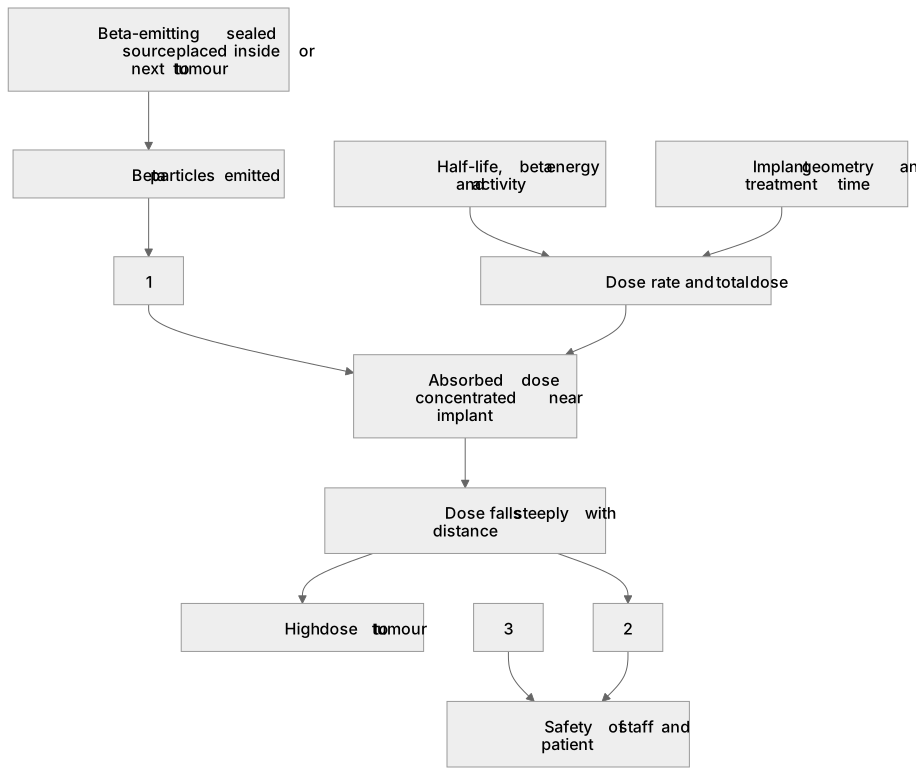
Label the diagram
Some boxes have lost their names. Pick the right name for each number.
1Box 1
2Box 2
3Box 3
There is more to this lesson
The full lesson goes on to check your understanding and help you earn the marks. Create a free account to carry on, with your progress saved.
A week of Premium from your first lesson · Then the free plan continues · No card, no charge
Test your understanding of Use of radioactive implants (A-level only): Internal treatment using beta emitting implants.
Active recall beats re-reading. Take an instant quiz now to test what you’ve learned and lock it into long-term memory.
A week of Premium from your first lesson · Then the free plan continues · No card, no charge