AQA · A-Level · Physics
Course version: 7408 · Version from Sept 2016
Use of SI units and their prefixes: SI units derived.
Deriving an SI unit means building it from the seven base units: kg, m, s, A, K, mol and cd.
Checked against the AQA 7408 specification (opens in a new tab) on .
- Point 3 of 5
- 2 key terms
Study notes
From the checked teaching notes for this specification point.
The idea
Deriving an SI unit means building it from the seven base units: kg, m, s, A, K, mol and cd. You do this by taking the defining equation for the quantity and substituting base units for each symbol. For example, speed is distance ÷ time, so its unit is m ÷ s = m s⁻¹. Force comes from F = ma, giving kg × m s⁻² = kg m s⁻², which is the newton. Energy from W = Fs gives kg m² s⁻², the joule. Charge from Q = It gives A s, the coulomb. Always cancel and collect powers, and check the result matches the named unit. This skill underpins dimensional consistency, unit conversion and checking whether an equation is physically possible.
What earns the marks
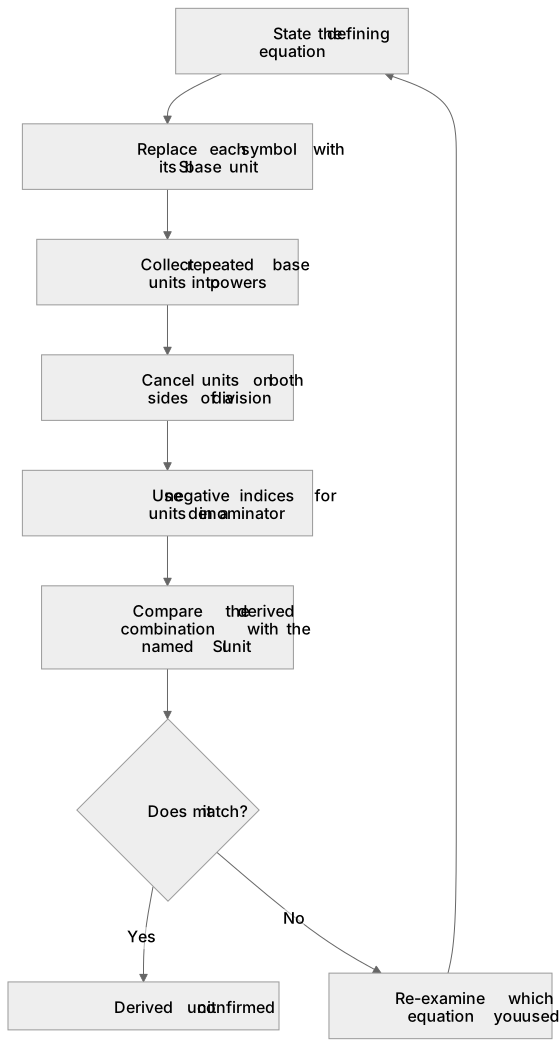
- State the defining equation for the quantity before substituting units.
- Replace each symbol with its SI base unit, not with a named derived unit.
- Collect repeated base units into powers, for example m × m = m².
- Cancel units that appear on both sides of a division.
- Compare the derived combination with the named SI unit to confirm it is correct.
- Use negative indices for units in a denominator, for example m s⁻¹ rather than m/s.
Common mistakes and how to put them right
Substituting a named derived unit such as N into a defining equation instead of its base-unit equivalent.
Put it right by expanding N to kg m s⁻² first.
Forgetting to square a unit when a quantity is squared, for example writing kg m s⁻² for kinetic energy.
Put it right by squaring every factor, giving kg m² s⁻².
Treating the mole or kelvin as if it were dimensionless.
Put it right by including mol or K wherever the defining equation contains amount of substance or temperature.
Exam tips
- Write the defining equation first, then substitute units line by line so the examiner can follow your reasoning.
- Keep negative indices rather than fractions, as this makes cancellation clearer and matches the expected notation.
- Check the final combination against the named unit; if it does not match, re-examine which equation you used.
Try the lesson
The start of the Use of SI units and their prefixes: SI units derived. lesson, made from checked teaching notes for this specification point.
Have a go first
The newton is a derived SI unit. Which combination of SI base units is equivalent to one newton?
Listen
Deriving an SI unit means building it from the seven base units: kg, m, s, A, K, mol and cd. You do this by taking the defining equation for the quantity and substituting base units for each symbol. For example, speed is distance ÷ time, so its unit is m ÷ s = m s⁻¹. Force comes from F = ma, giving kg × m s⁻² = kg m s⁻², which is the newton. Energy from W = Fs gives kg m² s⁻², the joule. Charge from Q = It gives A s, the coulomb. Always cancel and collect powers, and check the result matches the named unit. This skill underpins dimensional consistency, unit conversion and checking whether an equation is physically possible. A strong answer earns marks for these points. State the defining equation for the quantity before substituting units. Replace each symbol with its SI base unit, not with a named derived unit. Collect repeated base units into powers, for example m × m = m². Cancel units that appear on both sides of a division. A common slip: Substituting a named derived unit such as N into a defining equation instead of its base-unit equivalent. Instead, expanding N to kg m s⁻² first. Exam tip: Write the defining equation first, then substitute units line by line so the examiner can follow your reasoning.
See it
Watch it explained
What is the one idea the video explains? Say it in a sentence.
Read the described scene instead
SI units can be built from seven base units: kilogram, metre, second, ampere, kelvin, mole and candela. A derived unit is not a new basic quantity; it is a combination of these base units. To derive one, start from the defining equation for the quantity. That equation tells you which base units to substitute, collect and cancel. This skill supports unit conversion, dimensional consistency and checking whether an equation is physically possible. Use a consistent method. First, write the defining equation, for example speed equals distance divided by time. Second, replace each symbol with its SI base unit, not with a named derived unit. Third, collect repeated base units into powers, so metre times metre becomes metre squared. Fourth, cancel units that appear on both sides of a division. Finally, use negative indices for units in a denominator and compare your combination with the named SI unit. Let's apply the method to speed. Speed is distance divided by time, so its unit is metre divided by second, written m s⁻¹. Now consider force. Before I substitute, pause and ask which defining equation links force to mass and acceleration. The equation is F = ma. Substituting gives kilogram times metre per second squared, or kg m s⁻². This combination is the newton. Collect the powers and check the named unit. Energy follows from work, W = Fs. Using force in base units gives kg m s⁻² times metre, which simplifies to kg m² s⁻², the joule. Charge follows from Q = It, giving ampere times second, or A s, the coulomb. Notice that every factor is included and every repeated unit becomes a power. If a unit appears in a denominator, keep it as a negative index. These derived combinations are what you compare with named SI units. Three mistakes are common. First, substituting a named derived unit such as N into a defining equation. Expand N to kg m s⁻² first. Second, forgetting to square a unit when a quantity is squared. For kinetic energy, square every factor, giving kg m² s⁻². Third, treating the mole or kelvin as dimensionless. Include mol or K wherever the defining equation contains amount of substance or temperature. To derive an SI unit, write the defining equation, substitute base units, collect powers and cancel where possible. Keep negative indices for denominators, then compare the result with the named SI unit. This checks dimensional consistency and helps you judge whether an equation is physically possible. Before moving on, pause and choose one equation from your course, then derive its unit line by line.
Key words
Say what each word means before you turn the card.
Base units
Try answering aloud or in your head before turning the card.
Defining equation
Try answering aloud or in your head before turning the card.
See every definition
- Base units
- The seven units kg, m, s, A, K, mol and cd from which an SI unit is built.
- Defining equation
- The equation for a quantity that is taken and has base units substituted for each symbol.
Label the diagram
Some boxes have lost their names. Pick the right name for each number.
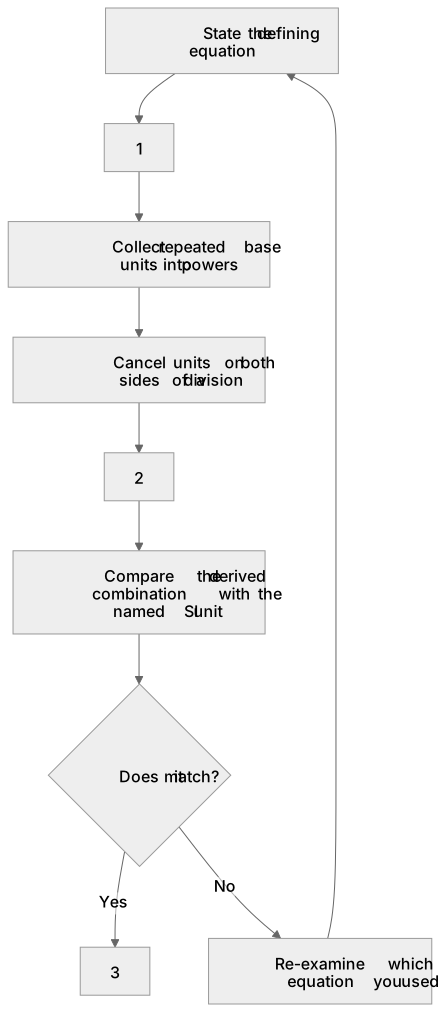
1Box 1
2Box 2
3Box 3
There is more to this lesson
The full lesson goes on to check your understanding and help you earn the marks. Create a free account to carry on, with your progress saved.
A week of Premium from your first lesson · Then the free plan continues · No card, no charge
Test your understanding of Use of SI units and their prefixes: SI units derived.
Active recall beats re-reading. Take an instant quiz now to test what you’ve learned and lock it into long-term memory.
A week of Premium from your first lesson · Then the free plan continues · No card, no charge