AQA · A-Level · Physics
Course version: 7408 · Version from Sept 2016
Appreciation that such changes need to be evaluated through peer review…
Full specification wording
Wave-particle duality: Appreciation that such changes need to be evaluated through peer review and validated by the scientific community.
New claims about matter, such as de Broglie's matter waves or Einstein's photons, are not accepted automatically.
Checked against the AQA 7408 specification (opens in a new tab) on .
- Point 4 of 4
- 4 key terms
Study notes
From the checked teaching notes for this specification point.
The idea
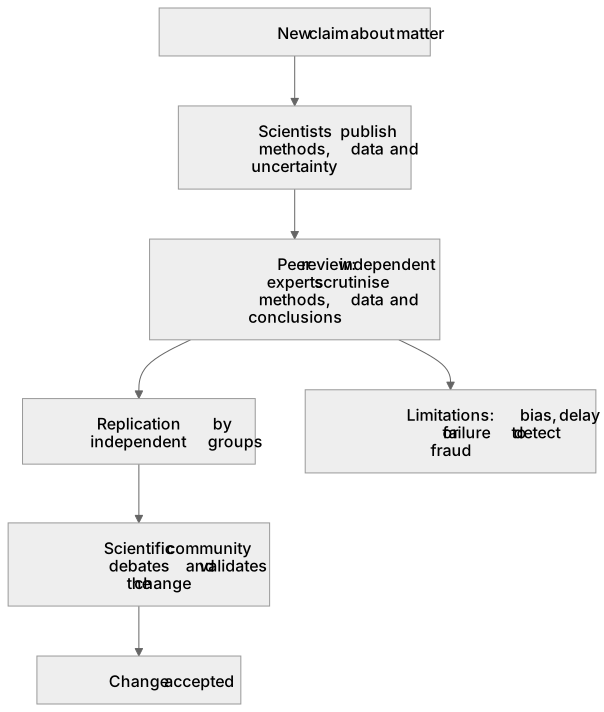
New claims about matter, such as de Broglie's matter waves or Einstein's photons, are not accepted automatically. Scientists publish methods, data and uncertainty so others can scrutinise them. Peer review checks whether conclusions follow from evidence, whether methods are sound and whether analysis is valid. Independent replication by different groups strengthens confidence. The scientific community then debates and validates a change, as happened when electron diffraction confirmed matter waves. Acceptance is therefore social as well as empirical: evidence must be shared, tested and judged. Assessment asks you to explain the purpose of peer review, its limitations and why validation requires the community.
What earns the marks
- State that peer review involves independent experts scrutinising methods, data and conclusions before publication.
- Explain that replication by independent groups increases confidence in a claim.
- Describe how the scientific community debates and validates a change, for example electron diffraction supporting matter waves.
- Recognise that peer review can be imperfect, for example bias, delay or failure to detect fraud.
- Explain that validation is a collective process, not the decision of one scientist.
Common mistakes and how to put them right
Confusing peer review with replication.
Put it right: State that peer review checks a submitted paper, while replication repeats the investigation independently.
Assuming peer review proves a claim true.
Put it right: Explain that it judges whether evidence and reasoning are sound, and claims remain open to revision.
Thinking one famous scientist's authority validates a change.
Put it right: Describe scrutiny and independent evidence from the community.
Exam tips
- Name the specific claim being evaluated, such as matter waves, and say what evidence supported it.
- Distinguish clearly between peer review, replication and community validation.
- Use evaluative language such as strength, limitation and reliability.
Try the lesson
The start of the Wave-particle duality: Appreciation that such changes need to be evaluated through peer review and validated by the scientific community. lesson, made from checked teaching notes for this specification point.
Have a go first
What is the main purpose of peer review when a new scientific claim about the nature of matter is published?
Listen
New claims about matter, such as de Broglie's matter waves or Einstein's photons, are not accepted automatically. Scientists publish methods, data and uncertainty so others can scrutinise them. Peer review checks whether conclusions follow from evidence, whether methods are sound and whether analysis is valid. Independent replication by different groups strengthens confidence. The scientific community then debates and validates a change, as happened when electron diffraction confirmed matter waves. Acceptance is therefore social as well as empirical: evidence must be shared, tested and judged. Assessment asks you to explain the purpose of peer review, its limitations and why validation requires the community. A strong answer earns marks for these points. State that peer review involves independent experts scrutinising methods, data and conclusions before publication. Explain that replication by independent groups increases confidence in a claim. Describe how the scientific community debates and validates a change, for example electron diffraction supporting matter waves. Recognise that peer review can be imperfect, for example bias, delay or failure to detect fraud. A common slip: Confusing peer review with replication. Instead, state that peer review checks a submitted paper, while replication repeats the investigation independently. Exam tip: Name the specific claim being evaluated, such as matter waves, and say what evidence supported it.
See it
Key words
Say what each word means before you turn the card.
Peer review
Try answering aloud or in your head before turning the card.
Replication and reliability
Try answering aloud or in your head before turning the card.
Scientific community
Try answering aloud or in your head before turning the card.
Validation of new knowledge
Try answering aloud or in your head before turning the card.
See every definition
- Peer review
- Independent experts scrutinise methods, data and conclusions before publication, checking whether conclusions follow from evidence and whether analysis is valid.
- Replication and reliability
- Independent groups repeat the investigation, which strengthens confidence in a claim.
- Scientific community
- The collective body that debates and validates a change, so acceptance is social as well as empirical.
- Validation of new knowledge
- A collective process in which evidence must be shared, tested and judged, not the decision of one scientist.
Label the diagram
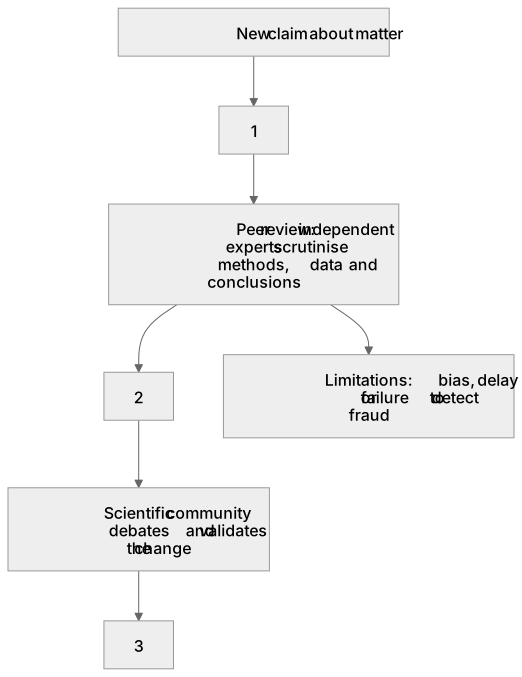
Some boxes have lost their names. Pick the right name for each number.
1Box 1
2Box 2
3Box 3
There is more to this lesson
The full lesson goes on to check your understanding and help you earn the marks. Create a free account to carry on, with your progress saved.
A week of Premium from your first lesson · Then the free plan continues · No card, no charge
Test your understanding of Wave-particle duality: Appreciation that such changes need to be evaluated through peer review and validated by the scientific community.
Active recall beats re-reading. Take an instant quiz now to test what you’ve learned and lock it into long-term memory.
A week of Premium from your first lesson · Then the free plan continues · No card, no charge