AQA · A-Level · Physics
Course version: 7408 · Version from Sept 2016
Students should know that electron diffraction suggests that particles…
Full specification wording
Wave-particle duality: Students should know that electron diffraction suggests that particles possess wave properties and the photoelectric effect suggests that electromagnetic waves have a particulate nature.
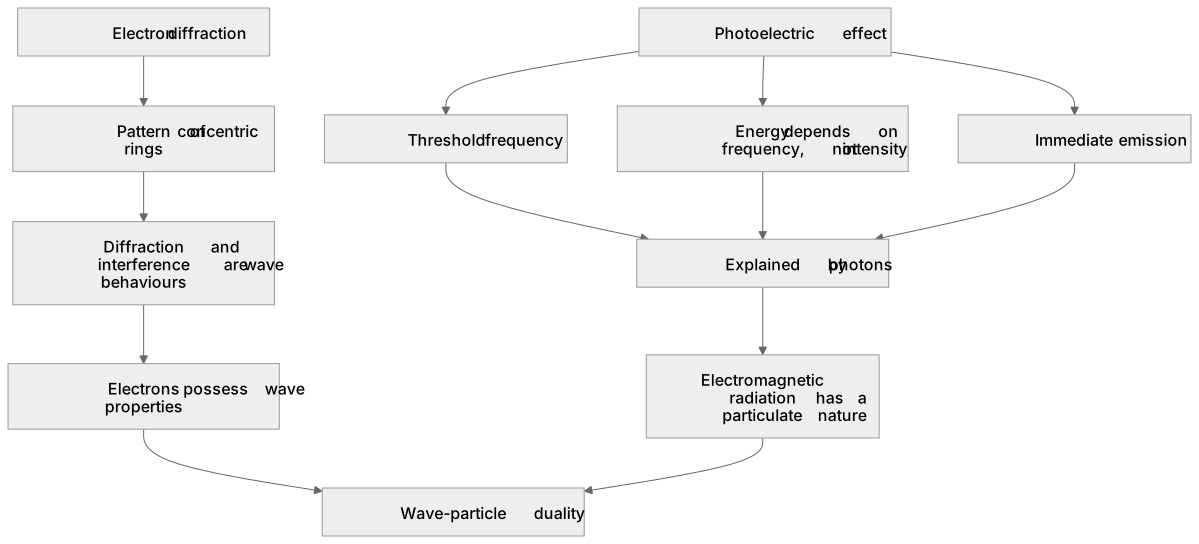
Electron diffraction is observed when a beam of electrons passes through a thin graphite film or similar material, producing a pattern of concentric rings on a screen.
Checked against the AQA 7408 specification (opens in a new tab) on .
- Point 1 of 4
- 4 key terms
Study notes
From the checked teaching notes for this specification point.
The idea
Electron diffraction is observed when a beam of electrons passes through a thin graphite film or similar material, producing a pattern of concentric rings on a screen. Diffraction and interference are wave behaviours, so this shows that electrons, normally treated as particles, also possess wave properties. The photoelectric effect occurs when electromagnetic radiation above a threshold frequency ejects electrons from a metal surface almost instantly. The existence of a threshold frequency, the independence of electron energy from intensity, and the immediate emission cannot be explained by a continuous wave model, but are explained if light arrives as photons. Together these experiments show that both matter and electromagnetic radiation have wave and particle aspects.
What earns the marks
- Electron diffraction produces a pattern of rings or fringes, which is evidence of wave behaviour such as diffraction and interference.
- The de Broglie relation λ = h/p links an electron's momentum to its wavelength, supporting the wave description of particles.
- In the photoelectric effect, electrons are emitted only above a threshold frequency, which supports a photon model of electromagnetic radiation.
- The maximum kinetic energy of emitted electrons depends on frequency, not intensity, which is consistent with one photon interacting with one electron.
- Emission is immediate even at low intensity, which is difficult to explain with a continuous wave model.
- The two experiments together support wave-particle duality rather than a single classical description.
Common mistakes and how to put them right
Claiming that electron diffraction proves electrons are only waves.
Put it right: It shows electrons have wave properties as well as particle properties.
Saying the photoelectric effect proves light is only a particle.
Put it right: It shows electromagnetic radiation has a particulate nature in addition to wave behaviour.
Stating that brighter light always gives faster photoelectrons.
Put it right: Intensity affects the number of electrons, while frequency affects their maximum kinetic energy.
Exam tips
- Name the observation, for example diffraction rings or threshold frequency, then state what it suggests about the nature of the particle or wave.
- Use λ = h/p when a question asks for the wavelength of an electron or the effect of changing its speed.
- Keep the two experiments distinct: electron diffraction concerns particles showing wave properties, while the photoelectric effect concerns waves showing particle properties.
Try the lesson
The start of the Wave-particle duality: Students should know that electron diffraction suggests that particles possess wave properties and the photoelectric effect suggests that electromagnetic waves have a particulate nature. lesson, made from checked teaching notes for this specification point.
Have a go first
A beam of electrons is passed through a thin graphite film and a pattern of concentric rings is observed on a screen. What does this observation suggest about electrons?
Listen
Electron diffraction is observed when a beam of electrons passes through a thin graphite film or similar material, producing a pattern of concentric rings on a screen. Diffraction and interference are wave behaviours, so this shows that electrons, normally treated as particles, also possess wave properties. The photoelectric effect occurs when electromagnetic radiation above a threshold frequency ejects electrons from a metal surface almost instantly. The existence of a threshold frequency, the independence of electron energy from intensity, and the immediate emission cannot be explained by a continuous wave model, but are explained if light arrives as photons. Together these experiments show that both matter and electromagnetic radiation have wave and particle aspects. A strong answer earns marks for these points. Electron diffraction produces a pattern of rings or fringes, which is evidence of wave behaviour such as diffraction and interference. The de Broglie relation λ = h/p links an electron's momentum to its wavelength, supporting the wave description of particles. In the photoelectric effect, electrons are emitted only above a threshold frequency, which supports a photon model of electromagnetic radiation. The maximum kinetic energy of emitted electrons depends on frequency, not intensity, which is consistent with one photon interacting with one electron. A common slip: Claiming that electron diffraction proves electrons are only waves. Instead, it shows electrons have wave properties as well as particle properties. Exam tip: Name the observation, for example diffraction rings or threshold frequency, then state what it suggests about the nature of the particle or wave.
See it
Key words
Say what each word means before you turn the card.
Wave-particle duality
Try answering aloud or in your head before turning the card.
de Broglie wavelength
Try answering aloud or in your head before turning the card.
Photoelectric effect
Try answering aloud or in your head before turning the card.
Threshold frequency
Try answering aloud or in your head before turning the card.
See every definition
- Wave-particle duality
- The idea that both matter and electromagnetic radiation have wave and particle aspects, supported by electron diffraction and the photoelectric effect together.
- de Broglie wavelength
- Given by the relation λ = h/p, which links an electron's momentum to its wavelength and supports the wave description of particles.
- Photoelectric effect
- Occurs when electromagnetic radiation above a threshold frequency ejects electrons from a metal surface almost instantly.
- Threshold frequency
- The frequency above which electrons are emitted in the photoelectric effect, supporting a photon model of electromagnetic radiation.
Label the diagram
Some boxes have lost their names. Pick the right name for each number.
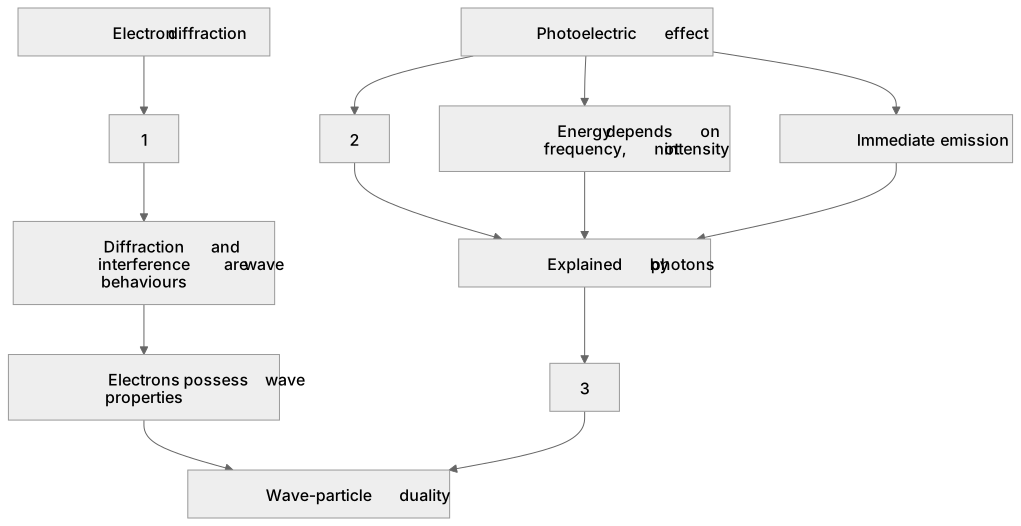
1Box 1
2Box 2
3Box 3
There is more to this lesson
The full lesson goes on to check your understanding and help you earn the marks. Create a free account to carry on, with your progress saved.
A week of Premium from your first lesson · Then the free plan continues · No card, no charge
Test your understanding of Wave-particle duality: Students should know that electron diffraction suggests that particles possess wave properties and the photoelectric effect suggests that electromagnetic waves have a particulate nature.
Active recall beats re-reading. Take an instant quiz now to test what you’ve learned and lock it into long-term memory.
A week of Premium from your first lesson · Then the free plan continues · No card, no charge