AQA · A-Level · Physics
Course version: 7408 · Version from Sept 2016
Significance of the area under a force–displacement graph.
Full specification wording
Work, energy and power: Significance of the area under a force–displacement graph.
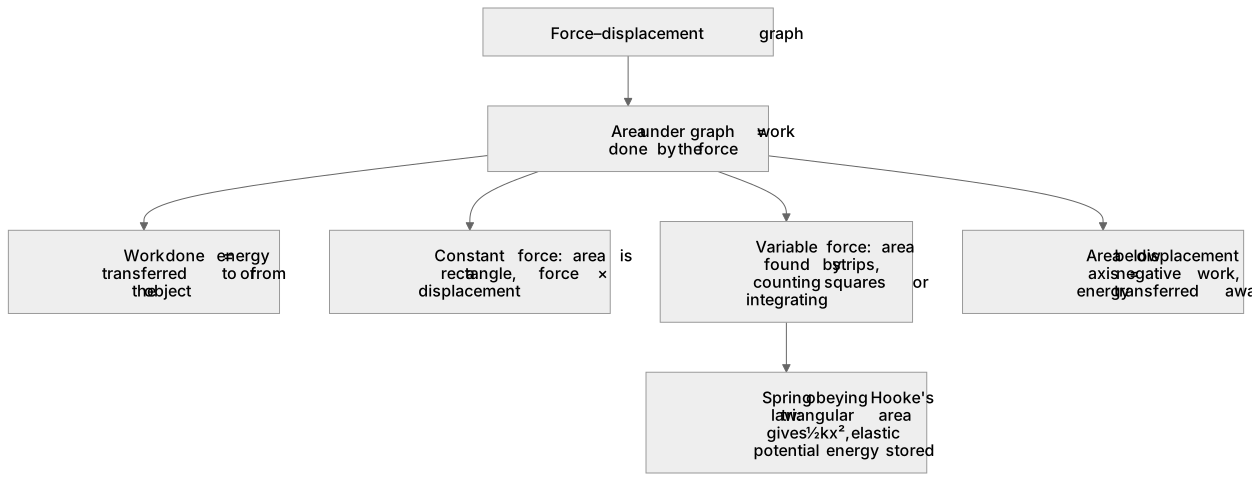
The area under a force–displacement graph represents the work done by the force.
Checked against the AQA 7408 specification (opens in a new tab) on .
- 2 key terms
Study notes
From the checked teaching notes for this specification point.
The idea
The area under a force–displacement graph represents the work done by the force. Work is the energy transferred when a force moves its point of application through a displacement in the direction of the force. For a constant force, work W = Fs cos θ, and the area of a rectangle on an F–s graph gives F × s. For a variable force, the area under the curve must be found by splitting the graph into strips, counting squares or integrating F with respect to s. For example, a spring obeying Hooke's law has F = kx, so the area under its straight-line graph is ½kx², the elastic potential energy stored. The area is a signed quantity: area below the displacement axis represents negative work, meaning energy is transferred away from the object. Always check the axes and units before calculating area.
What earns the marks
- States that the area under a force–displacement graph equals the work done by the force.
- Explains that work done equals energy transferred, so the area also represents the energy transferred to or from the object.
- For a constant force, calculates area as a rectangle: area = force × displacement.
- For a variable force, finds area by counting squares, using the trapezium rule or integrating the force–displacement relationship.
- Interprets area below the displacement axis as negative work done, indicating energy transferred away from the object.
- Applies the result to a spring obeying Hooke's law, where the triangular area gives elastic potential energy ½kx².
Common mistakes and how to put them right
Confusing the area under a force–displacement graph with the gradient.
Put it right by recalling that area = work done and gradient = force constant for a spring.
Using the maximum force instead of the average force for a variable force.
Put it right: For a linear variation the average force is half the maximum, but for a non-linear graph the area must be found by squares or integration.
Ignoring the sign of the area when the force acts opposite to the displacement.
Put it right: Area below the axis represents negative work done, not a magnitude to be made positive.
Forgetting to convert units such as cm to m or N to kN before calculating area, which gives an incorrect value for work done.
Exam tips
- Always label the axes and state the unit of area, for example N m or J, before or after calculating the area.
- When a graph is not a simple shape, count squares within the curve and multiply by the area represented by one square, showing your working clearly.
- If the force–displacement graph is a straight line through the origin, use the triangle area formula ½ × base × height rather than counting squares.
- Check whether the question asks for work done on the object or by the object, and use the sign of the area to support your answer.
Try the lesson
The start of the Work, energy and power: Significance of the area under a force–displacement graph. lesson, made from checked teaching notes for this specification point.
Have a go first
A constant force of 20 N acts on a box and moves it 3.0 m in the direction of the force. What does the area under the force–displacement graph represent, and what is its value?
Listen
The area under a force–displacement graph represents the work done by the force. Work is the energy transferred when a force moves its point of application through a displacement in the direction of the force. For a constant force, work W = Fs cos θ, and the area of a rectangle on an F–s graph gives F × s. For a variable force, the area under the curve must be found by splitting the graph into strips, counting squares or integrating F with respect to s. For example, a spring obeying Hooke's law has F = kx, so the area under its straight-line graph is ½kx², the elastic potential energy stored. The area is a signed quantity: area below the displacement axis represents negative work, meaning energy is transferred away from the object. Always check the axes and units before calculating area. A strong answer earns marks for these points. States that the area under a force–displacement graph equals the work done by the force. Explains that work done equals energy transferred, so the area also represents the energy transferred to or from the object. For a constant force, calculates area as a rectangle: area = force × displacement. For a variable force, finds area by counting squares, using the trapezium rule or integrating the force–displacement relationship. A common slip: Confusing the area under a force–displacement graph with the gradient; the gradient gives stiffness or force per unit displacement, not work done. Instead, recalling that area = work done and gradient = force constant for a spring. Exam tip: Always label the axes and state the unit of area, for example N m or J, before or after calculating the area.
See it
Key words
Say what each word means before you turn the card.
Work done
Try answering aloud or in your head before turning the card.
Elastic potential energy
Try answering aloud or in your head before turning the card.
See every definition
- Work done
- The energy transferred when a force moves its point of application through a displacement in the direction of the force.
- Elastic potential energy
- The energy stored in a spring obeying Hooke's law, given by the area under its straight-line graph as ½kx².
Label the diagram
Some boxes have lost their names. Pick the right name for each number.
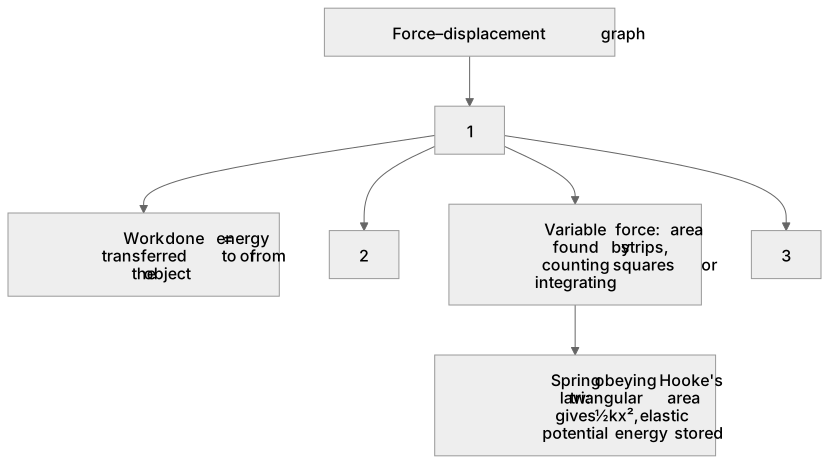
1Box 1
2Box 2
3Box 3
There is more to this lesson
The full lesson goes on to check your understanding and help you earn the marks. Create a free account to carry on, with your progress saved.
A week of Premium from your first lesson · Then the free plan continues · No card, no charge
Test your understanding of Work, energy and power: Significance of the area under a force–displacement graph.
Active recall beats re-reading. Take an instant quiz now to test what you’ve learned and lock it into long-term memory.
A week of Premium from your first lesson · Then the free plan continues · No card, no charge