AQA · A-Level · Physics
Course version: 7408 · Version from Sept 2016
Zener diode (A-level only): Use to provide a reference voltage.
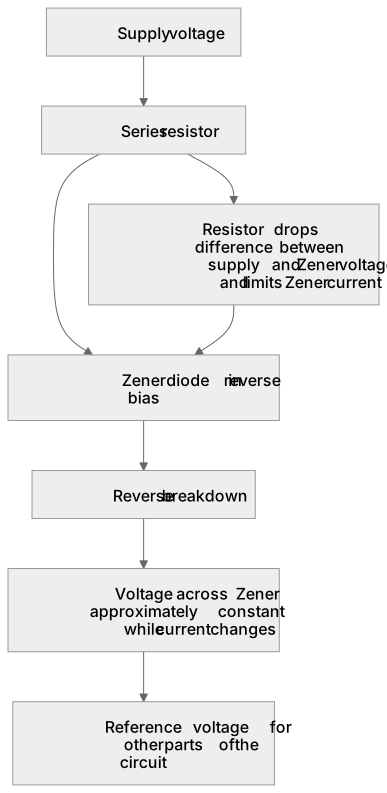
A Zener diode is normally reverse biased so that it operates in reverse breakdown, where the voltage across it stays almost constant even when the current through it changes.
Checked against the AQA 7408 specification (opens in a new tab) on .
- Point 4 of 4
- 4 key terms
Study notes
From the checked teaching notes for this specification point.
The idea
A Zener diode is normally reverse biased so that it operates in reverse breakdown, where the voltage across it stays almost constant even when the current through it changes. That steady voltage is the reference voltage: other parts of a circuit compare their signals against it or use it as a fixed level. In a simple regulator, a resistor in series with the Zener drops the difference between the input voltage and the Zener voltage, while the Zener holds the output at its breakdown value.
For example: A 5.1 V Zener fed from a 9 V supply gives an output near 5.1 V as the load current varies, provided the Zener stays in breakdown and the series resistor limits current.
What earns the marks
- States that the Zener diode is connected in reverse bias so that it operates in reverse breakdown.
- Explains that in reverse breakdown the voltage across the Zener remains approximately constant while the current through it changes.
- Identifies this approximately constant voltage as the reference voltage used by other parts of the circuit.
- Describes a series resistor that takes the voltage difference between the supply and the Zener, limiting the Zener current.
- Applies the idea to a numerical or circuit example, such as a 5.1 V Zener holding an output near 5.1 V from a larger supply.
- Recognises that the reference stays useful only while the Zener remains in reverse breakdown and within its power rating.
Common mistakes and how to put them right
Treating the Zener as a forward-biased ordinary diode.
Put it right by stating that the reference action needs reverse bias and reverse breakdown.
Assuming the Zener voltage is exactly constant for every current.
Put it right by saying it is approximately constant, with small changes in voltage as current changes.
Forgetting the series resistor and connecting the Zener directly across the supply.
Put it right by including a resistor to limit current and drop the excess voltage.
Exam tips
- Sketch the circuit with the Zener reverse biased and label the reference voltage across it.
- Use the phrase approximately constant voltage and link it to changes in current or load.
- When a value is given, check that the Zener is still in reverse breakdown before quoting the reference voltage.
Try the lesson
The start of the Zener diode (A-level only): Use to provide a reference voltage. lesson, made from checked teaching notes for this specification point.
Have a go first
A Zener diode is connected in reverse bias so that it operates in its breakdown region. Which property makes it suitable for providing a reference voltage?
Listen
A Zener diode is normally reverse biased so that it operates in reverse breakdown, where the voltage across it stays almost constant even when the current through it changes. That steady voltage is the reference voltage: other parts of a circuit compare their signals against it or use it as a fixed level. In a simple regulator, a resistor in series with the Zener drops the difference between the input voltage and the Zener voltage, while the Zener holds the output at its breakdown value. For example, a 5.1 V Zener fed from a 9 V supply gives an output near 5.1 V as the load current varies, provided the Zener stays in breakdown and the series resistor limits current. A strong answer earns marks for these points. States that the Zener diode is connected in reverse bias so that it operates in reverse breakdown. Explains that in reverse breakdown the voltage across the Zener remains approximately constant while the current through it changes. Identifies this approximately constant voltage as the reference voltage used by other parts of the circuit. Describes a series resistor that takes the voltage difference between the supply and the Zener, limiting the Zener current. A common slip: Treating the Zener as a forward-biased ordinary diode. Instead, stating that the reference action needs reverse bias and reverse breakdown. Exam tip: Sketch the circuit with the Zener reverse biased and label the reference voltage across it.
See it
Key words
Say what each word means before you turn the card.
Reverse breakdown
Try answering aloud or in your head before turning the card.
Voltage reference
Try answering aloud or in your head before turning the card.
Current limiting
Try answering aloud or in your head before turning the card.
Circuit application
Try answering aloud or in your head before turning the card.
See every definition
- Reverse breakdown
- The state in which a Zener diode is normally operated, where the voltage across it stays almost constant even when the current through it changes.
- Voltage reference
- The steady voltage across a Zener diode in reverse breakdown, against which other parts of a circuit compare their signals or use as a fixed level.
- Current limiting
- The role of a series resistor, which drops the difference between the input voltage and the Zener voltage and limits the Zener current.
- Circuit application
- A simple regulator in which a series resistor drops the difference between the input voltage and the Zener voltage while the Zener holds the output at its breakdown value.
Label the diagram
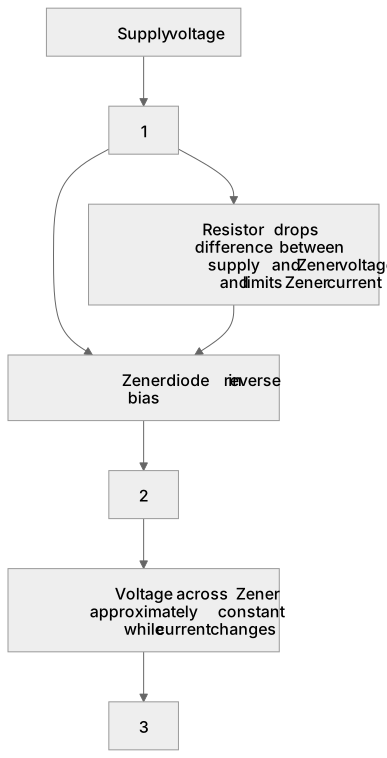
Some boxes have lost their names. Pick the right name for each number.
1Box 1
2Box 2
3Box 3
There is more to this lesson
The full lesson goes on to check your understanding and help you earn the marks. Create a free account to carry on, with your progress saved.
A week of Premium from your first lesson · Then the free plan continues · No card, no charge
Test your understanding of Zener diode (A-level only): Use to provide a reference voltage.
Active recall beats re-reading. Take an instant quiz now to test what you’ve learned and lock it into long-term memory.
A week of Premium from your first lesson · Then the free plan continues · No card, no charge