Electricity
Master the structure and safety features of domestic mains electricity. Learn exactly how the live, neutral, and earth wires function together to protect you from 230V AC shocks, and discover the specific phrasing examiners demand for full marks.
Study Notes
Overview
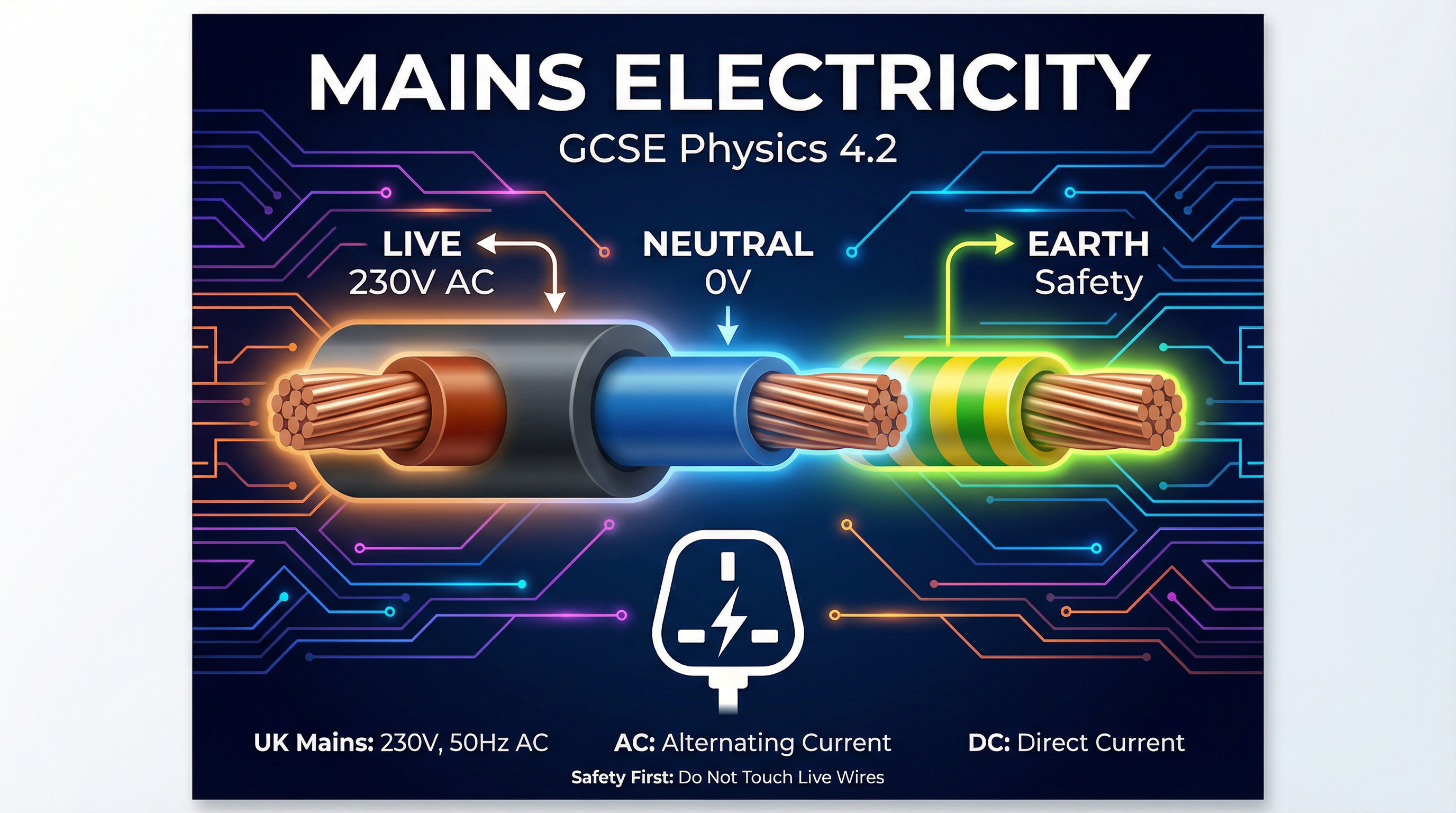
Welcome to one of the most practically important topics in your GCSE Physics course: Mains Electricity. This topic covers the structure and safety features of the UK domestic mains supply, detailing the function of the three-core cable system, including the live, neutral, and earth wires.
Understanding mains electricity is crucial because it connects theoretical physics to the real world. Every time you plug in an appliance, you are relying on the principles covered in this section to operate safely. Examiners frequently test this topic because it combines factual recall (like colour codes and voltages) with applied understanding (like explaining why a live wire is dangerous even when switched off).
This topic links closely with your earlier studies on electrical circuits and power. Typical exam questions range from simple 1-mark factual recall to 4-6 mark explanations requiring you to describe the sequence of events during an electrical fault.
Listen to the comprehensive audio guide below for a deep dive into the concepts and exam strategies:
Key Concepts
Concept 1: The UK Mains Supply
The UK mains electricity supply is an alternating current (AC) supply. Unlike a battery which provides direct current (DC) flowing in one direction, an alternating current repeatedly reverses its direction of flow.
For the UK mains supply, you must memorise two specific values:
- Potential Difference: The effective potential difference is 230 V.
- Frequency: The frequency is 50 Hz (meaning the current changes direction 50 times every second).
Concept 2: The Three-Core Cable
Most electrical appliances are connected to the mains using a three-core cable. This cable contains three separate copper wires, each coated in coloured plastic insulation for easy identification.
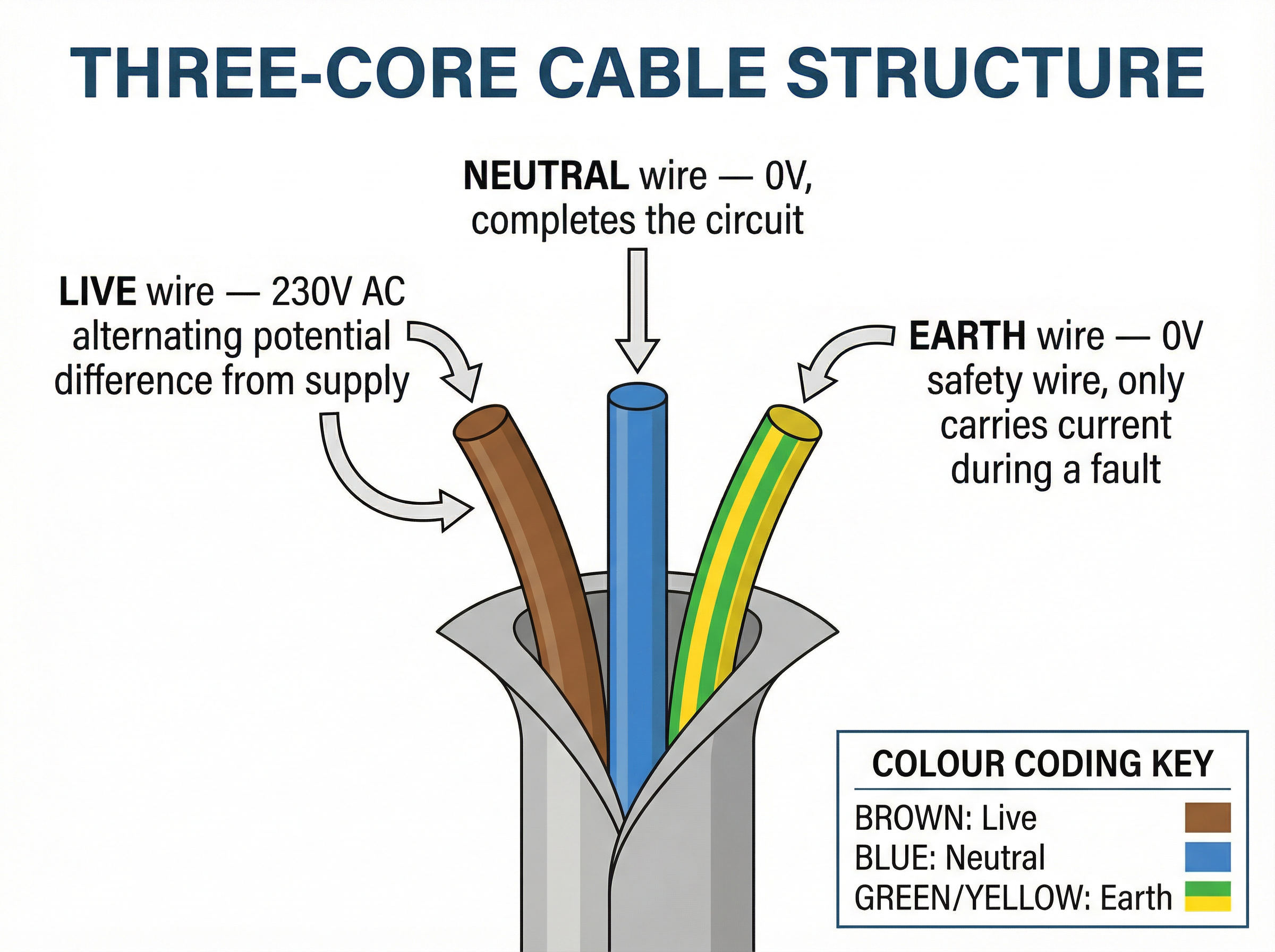
- The Live Wire (Brown): The live wire carries the alternating potential difference from the supply. The potential difference between the live wire and earth is approximately 230 V. This is the dangerous wire that delivers energy to the appliance.
- The Neutral Wire (Blue): The neutral wire completes the circuit. Current flows in through the live wire and out through the neutral wire. The neutral wire is at, or close to, 0 V.
- The Earth Wire (Green and Yellow stripes): The earth wire is a safety wire designed to stop the appliance casing from becoming live. It is at 0 V and only carries a current if there is a fault.
Concept 3: The Danger of the Live Wire
The live wire is extremely dangerous. It is maintained at a potential difference of 230 V relative to the earth. Because your body is connected to the earth (by standing on the ground), touching the live wire creates a large potential difference across your body. This drives a large current through you, resulting in a potentially fatal electric shock.
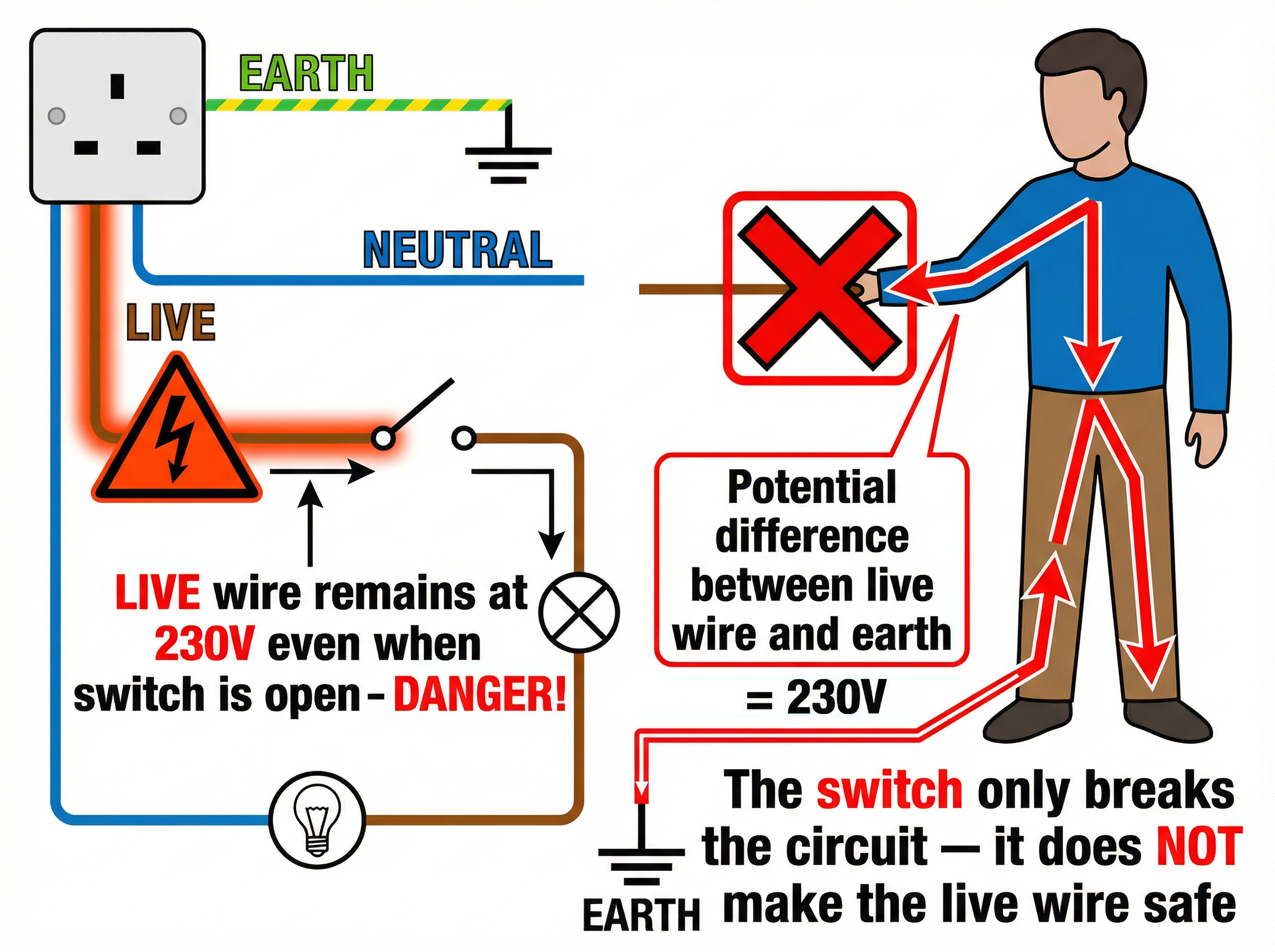
Crucial Exam Point: The live wire remains dangerous even when a switch in the circuit is open. A switch only breaks the circuit; it does not disconnect the live wire from the mains supply. The live wire up to the switch is still at 230 V. If you touch it, the potential difference between the wire and earth will still drive a current through your body.
Concept 4: The Danger of Connecting Live to Earth
If the live wire is accidentally connected directly to the earth (for example, if the insulation is damaged and the wire touches the metal casing of an appliance), a short circuit is created. Because the resistance of the earth wire is very low, a very large current will flow from the live wire to earth. This can cause a fire or a massive electric shock if a person is part of the path to earth.
This is why the earth wire works in tandem with a fuse or circuit breaker. The massive current flowing through the earth wire will melt the fuse or trip the breaker, instantly disconnecting the live supply and making the appliance safe.
Mathematical/Scientific Relationships
While this specific subtopic (4.2) is primarily conceptual, it is intimately linked with the electrical power equations you must know:
- P = V \times I (Power = Potential Difference \times Current)
- P = I^2 \times R (Power = Current^2 \times Resistance)
- E = P \times t (Energy = Power \times time)
- E = Q \times V (Energy = Charge flow \times Potential Difference)
Examiner Note: You will often be asked to calculate the current flowing through an appliance to determine the correct fuse rating to use. The fuse rating should be slightly higher than the normal operating current.
Practical Applications
- Wiring a Plug: Knowing the colour codes is essential for wiring a standard UK 3-pin plug correctly.
- Double Insulation: Appliances with plastic casings do not need an earth wire because the casing cannot become live. These use a two-core cable (live and neutral only) and are said to be 'double insulated'.
Visual Resources
2 diagrams and illustrations
Interactive Diagrams
2 interactive diagrams to visualise key concepts
Conceptual Flow Outline
Flowchart showing the sequence of events when an electrical fault occurs in an earthed appliance.
Conceptual Flow Outline
Normal operating circuit showing the path of current and the standby state of the earth wire.
Worked Examples
3 detailed examples with solutions and examiner commentary
Practice Questions
Test your understanding — click to reveal model answers
State the frequency and potential difference of the UK mains electricity supply. (2 marks)
Hint: Think of the two numbers you must memorise for the national grid.
Describe the difference between alternating current (AC) and direct current (DC). (2 marks)
Hint: Think about the direction the charge flows in each type.
A student touches the live wire of a damaged cable. The switch to the appliance is open. Explain why the student receives an electric shock. (3 marks)
Hint: What is the voltage of the live wire? What is the voltage of the student? What does this difference cause?
An electrician is installing a new shower. The washing machine has a metal case. Explain why it is essential that the washing machine is connected to the earth wire. (4 marks)
Hint: Walk through the steps of what happens if a fault occurs and the live wire touches the case.
Some appliances, like hairdryers, have plastic casings and do not require an earth wire. Explain why. (2 marks)
Hint: What property does plastic have that metal doesn't?