AQA · GCSE · Physics
Course version: 8463 · Version from Sept 2016
(HT only) Students should be able to explain qualitatively, with examples,…
Full specification wording
Velocity: (HT only) Students should be able to explain qualitatively, with examples, that motion in a circle involves constant speed but changing velocity.
An object going round a circle at a steady rate keeps the same speed but is always turning, so its direction, and therefore its velocity, changes at every instant.
Checked against the AQA 8463 specification (opens in a new tab) on .
- Point 3 of 3
Study notes
From the checked teaching notes for this specification point.
The idea
An object going round a circle at a steady rate keeps the same speed but is always turning, so its direction, and therefore its velocity, changes at every instant. A changing velocity is an acceleration, and an acceleration needs a resultant force, which here points towards the centre of the circle. Because that force acts at right angles to the motion it does no work, so the speed does not change and only the direction does. For a satellite such as the Hubble Space Telescope the force is the Earth's gravitational pull, which makes it accelerate towards the Earth and keeps it in orbit instead of flying off in a straight line. For a car on a roundabout it is friction between the tyres and the road, and for a conker on a string it is tension.
What earns the marks
- The speed staying constant while the direction of motion changes.
- A changing direction meaning a changing velocity.
- A resultant force directed towards the centre of the circle.
- Naming that force in a given example, such as gravity acting on a satellite.
Common mistakes and how to put them right
Saying the velocity is constant because the speed is constant.
Claiming there is no resultant force because the speed does not change.
Describing the force as acting along the direction of travel.
Stating that gravity changes the speed of an orbiting satellite.
Exam tips
- Write the chain: direction changes, so velocity changes, so it accelerates, so a resultant force acts towards the centre.
- Name the actual force in the example - gravity, tension or friction - rather than writing centripetal force alone.
Try the lesson
The start of the Velocity: (HT only) Students should be able to explain qualitatively, with examples, that motion in a circle involves constant speed but changing velocity. lesson, made from checked teaching notes for this specification point.
Have a go first
A satellite moves around the Earth in a circular orbit at a steady rate. Why does the satellite have a changing velocity even though its speed is constant?
Listen
An object going round a circle at a steady rate keeps the same speed but is always turning, so its direction, and therefore its velocity, changes at every instant. A changing velocity is an acceleration, and an acceleration needs a resultant force, which here points towards the centre of the circle. Because that force acts at right angles to the motion it does no work, so the speed does not change and only the direction does. For a satellite such as the Hubble Space Telescope the force is the Earth's gravitational pull, which makes it accelerate towards the Earth and keeps it in orbit instead of flying off in a straight line. For a car on a roundabout it is friction between the tyres and the road, and for a conker on a string it is tension. A strong answer earns marks for these points. the speed staying constant while the direction of motion changes. a changing direction meaning a changing velocity. a resultant force directed towards the centre of the circle. naming that force in a given example, such as gravity acting on a satellite. Exam tip: Write the chain: direction changes, so velocity changes, so it accelerates, so a resultant force acts towards the centre.
See it
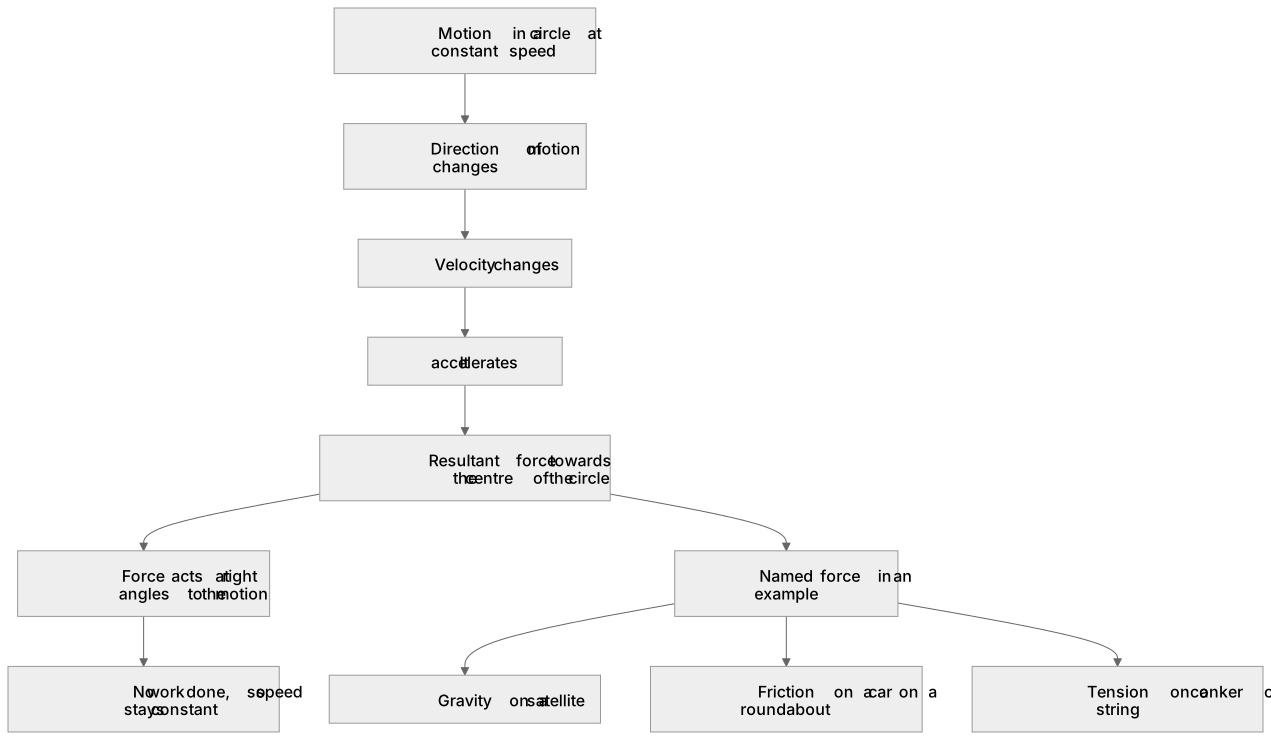
Label the diagram
Some boxes have lost their names. Pick the right name for each number.
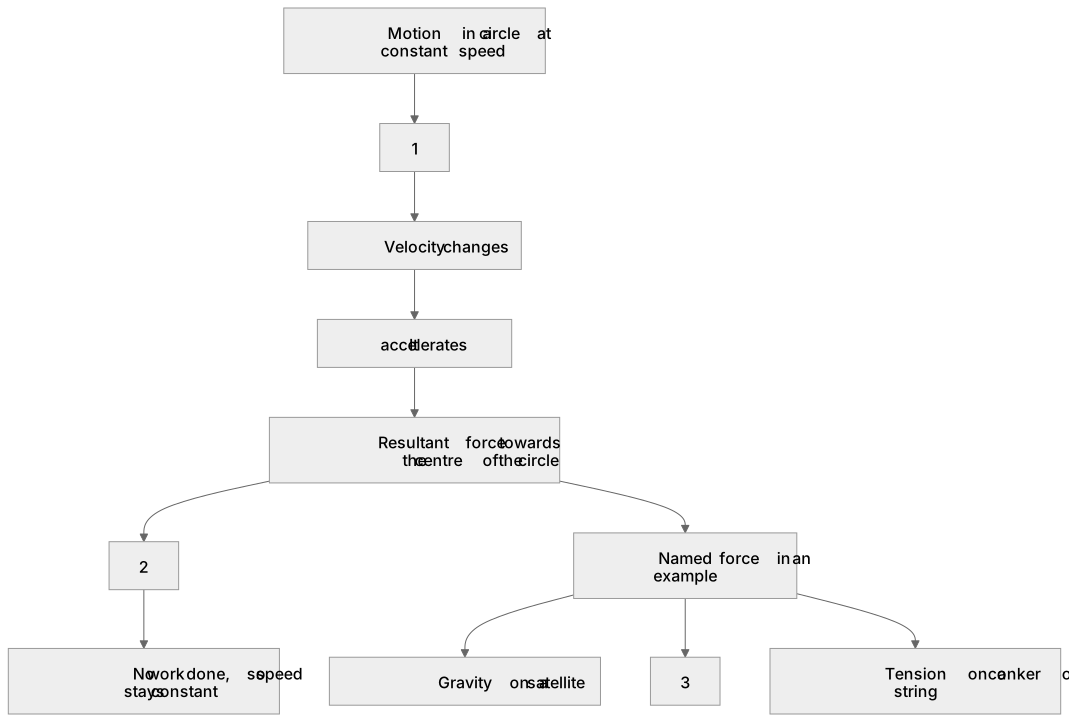
1Box 1
2Box 2
3Box 3
There is more to this lesson
The full lesson goes on to check your understanding and help you earn the marks. Create a free account to carry on, with your progress saved.
A week of Premium from your first lesson · Then the free plan continues · No card, no charge
Test your understanding of Velocity: (HT only) Students should be able to explain qualitatively, with examples, that motion in a circle involves constant speed but changing velocity.
Active recall beats re-reading. Take an instant quiz now to test what you’ve learned and lock it into long-term memory.
A week of Premium from your first lesson · Then the free plan continues · No card, no charge