AQA · GCSE · Physics
Waves
Waves are the universe's way of moving energy without moving matter. Mastering this topic is crucial for your GCSE Physics exam, as it forms the foundation for understanding everything from how we see and hear to how mobile phones and earthquakes work.
- 4 min read
- 3 worked examples
- 5 practice questions
- 6 key terms
Study Notes
Overview
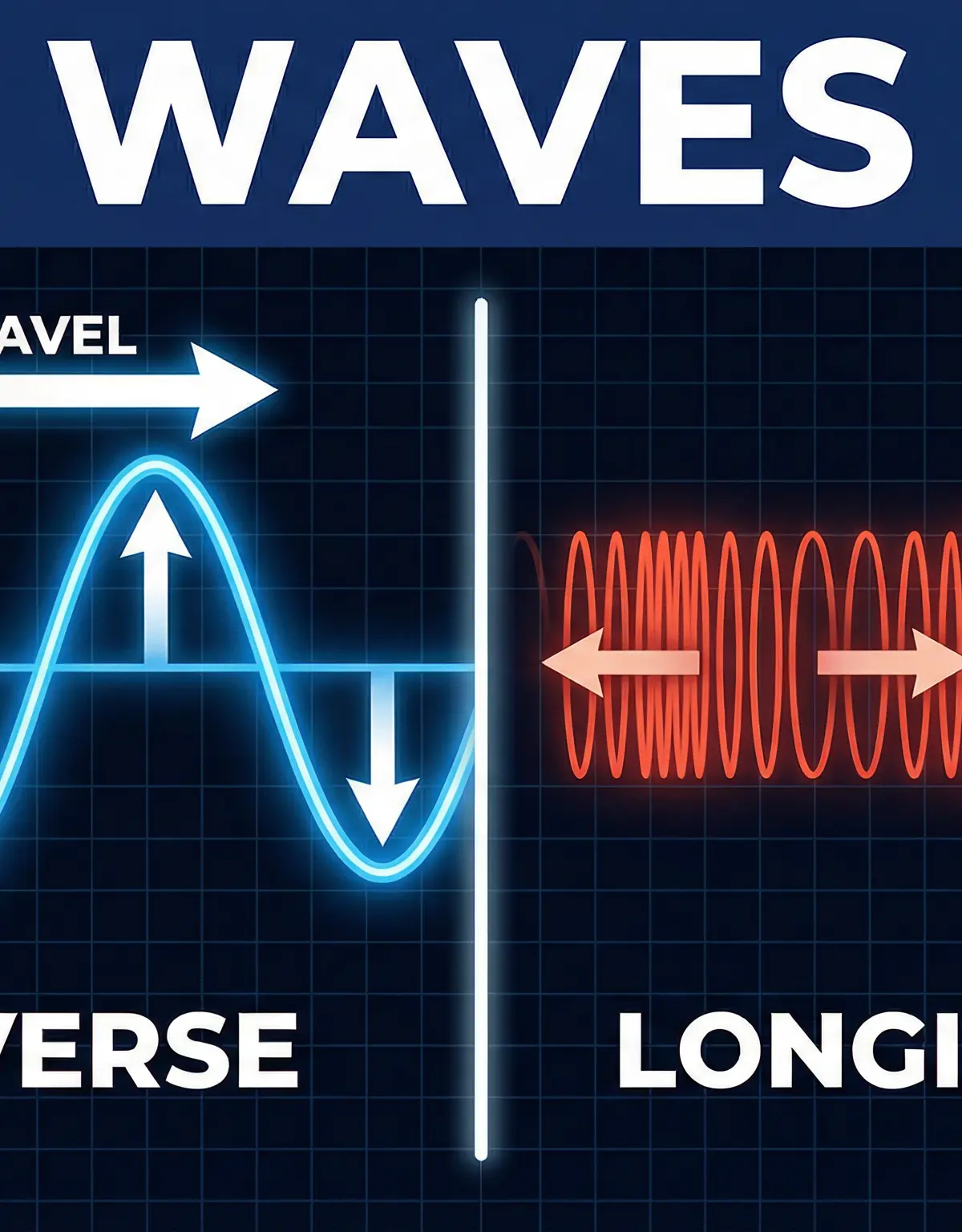
Welcome to Topic 4.6: Waves. Whether you're listening to music, surfing the internet on WiFi, or looking at a rainbow, you are interacting with waves. In GCSE Physics, understanding waves is absolutely fundamental because they are the primary mechanism by which energy is transferred across space without the net movement of matter.
This topic is heavily examined and frequently links to other areas of the specification, such as the electromagnetic spectrum, energy transfers, and even atomic structure. Examiners will expect you to not only know the definitions but to apply them to novel situations. You'll need to interpret diagrams, perform calculations using the wave equation, and clearly explain the differences between types of waves using precise scientific vocabulary.
Listen to the topic podcast here:
Key Concepts
Concept 1: The Nature of Waves
A wave is an oscillation (or vibration) that transfers energy from one place to another without transferring matter. This is a critical marking point in exams. When a wave travels through a medium (like water or air), the particles of the medium oscillate around a fixed point. They do not travel with the wave.
Example: Consider a duck sitting on a pond. When a water wave passes, the duck bobs up and down, but it does not move across the pond with the wave. The energy moves horizontally, but the water (the matter) only moves vertically.
Concept 2: Transverse Waves
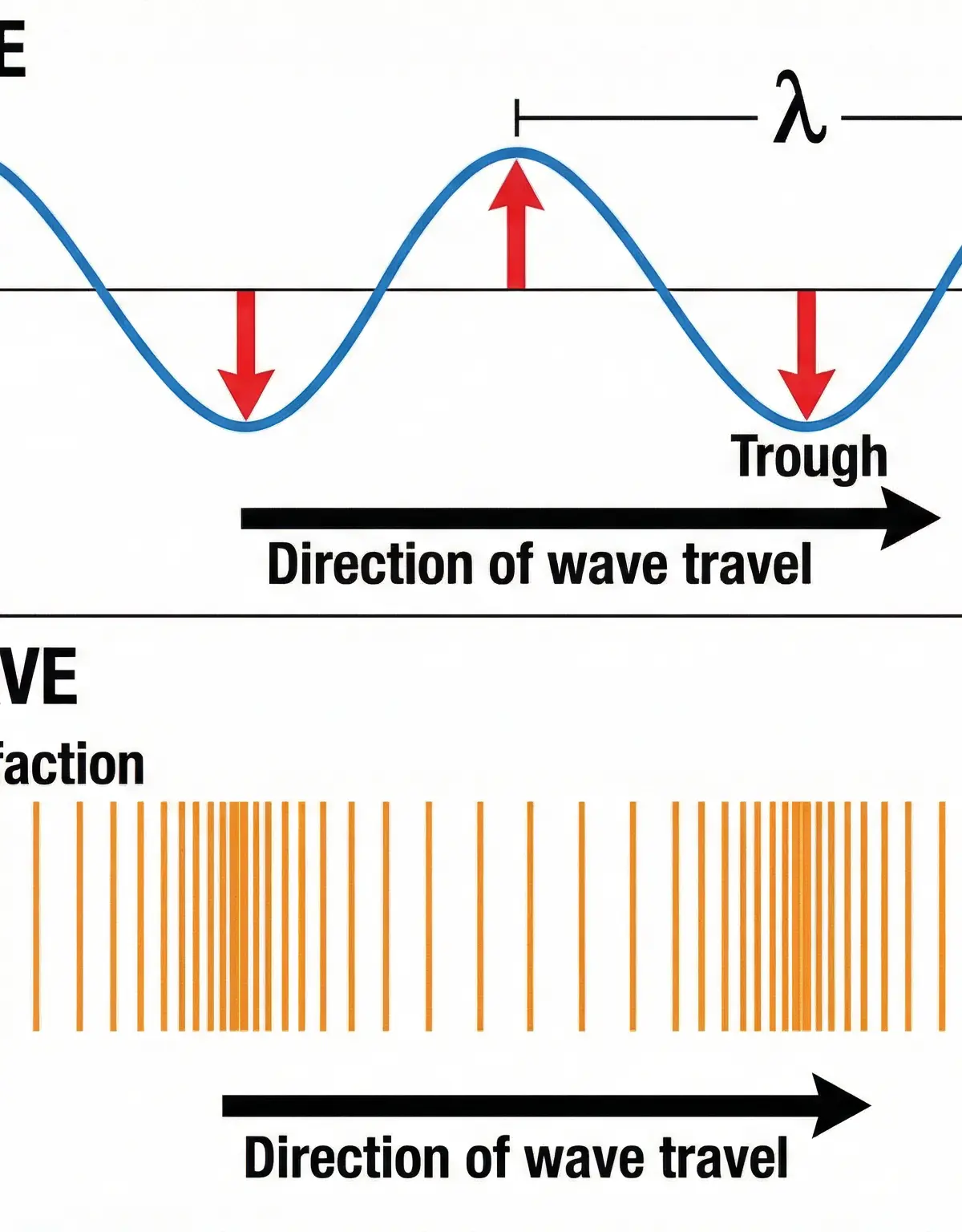
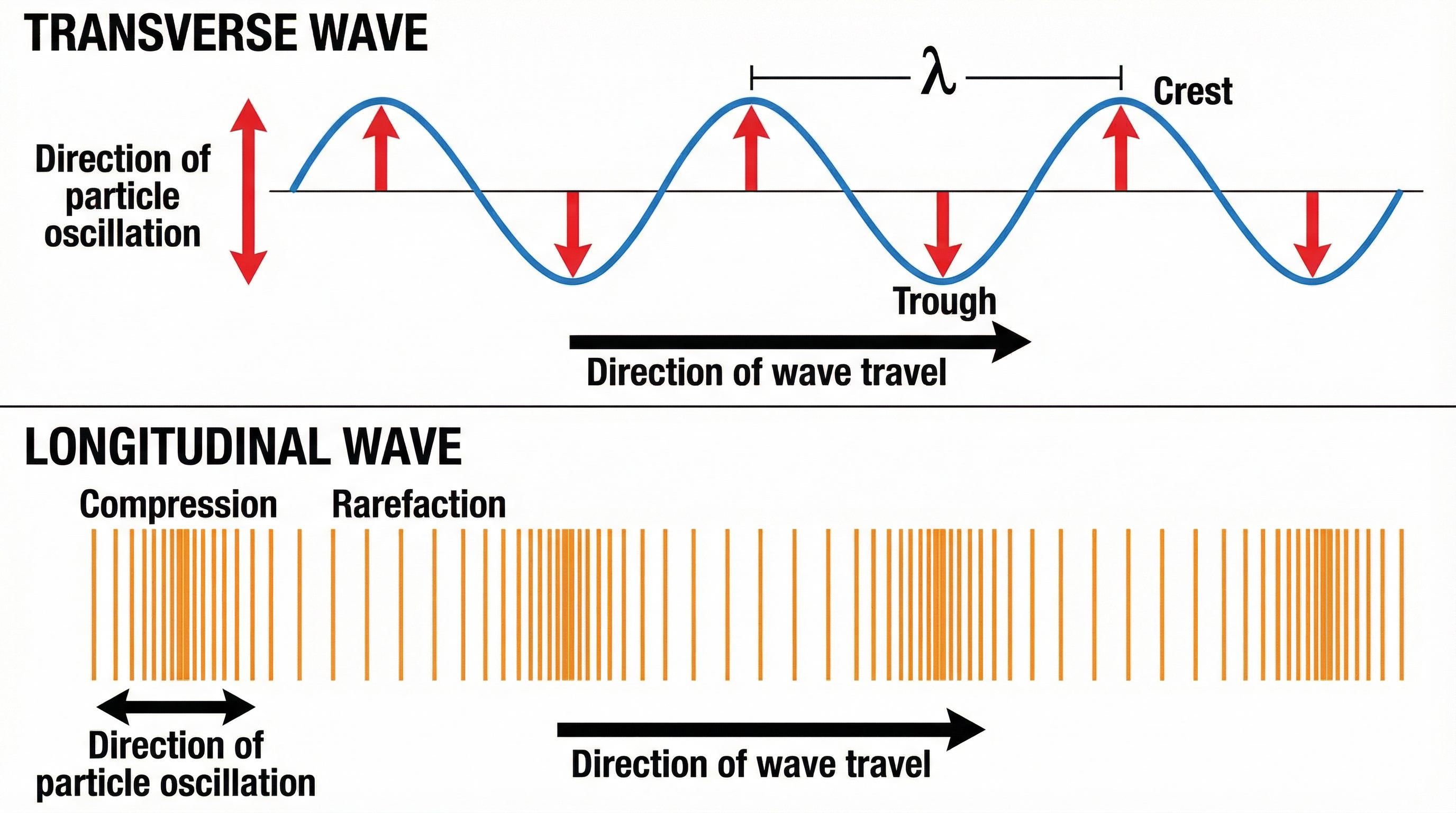
In a transverse wave, the oscillations are perpendicular (at right angles) to the direction of energy transfer (the direction the wave is travelling).
Examples of transverse waves include:
- All electromagnetic waves (e.g., light, microwaves, X-rays)
- Ripples on the surface of water
- S-waves (secondary seismic waves)
Concept 3: Longitudinal Waves
In a longitudinal wave, the oscillations are parallel to the direction of energy transfer. These waves consist of alternating regions of high pressure (compressions) where particles are pushed together, and low pressure (rarefactions) where particles are spread apart.
Examples of longitudinal waves include:
- Sound waves
- Ultrasound waves
- P-waves (primary seismic waves)
Concept 4: Wave Properties
To describe waves accurately, we use specific measurable properties:
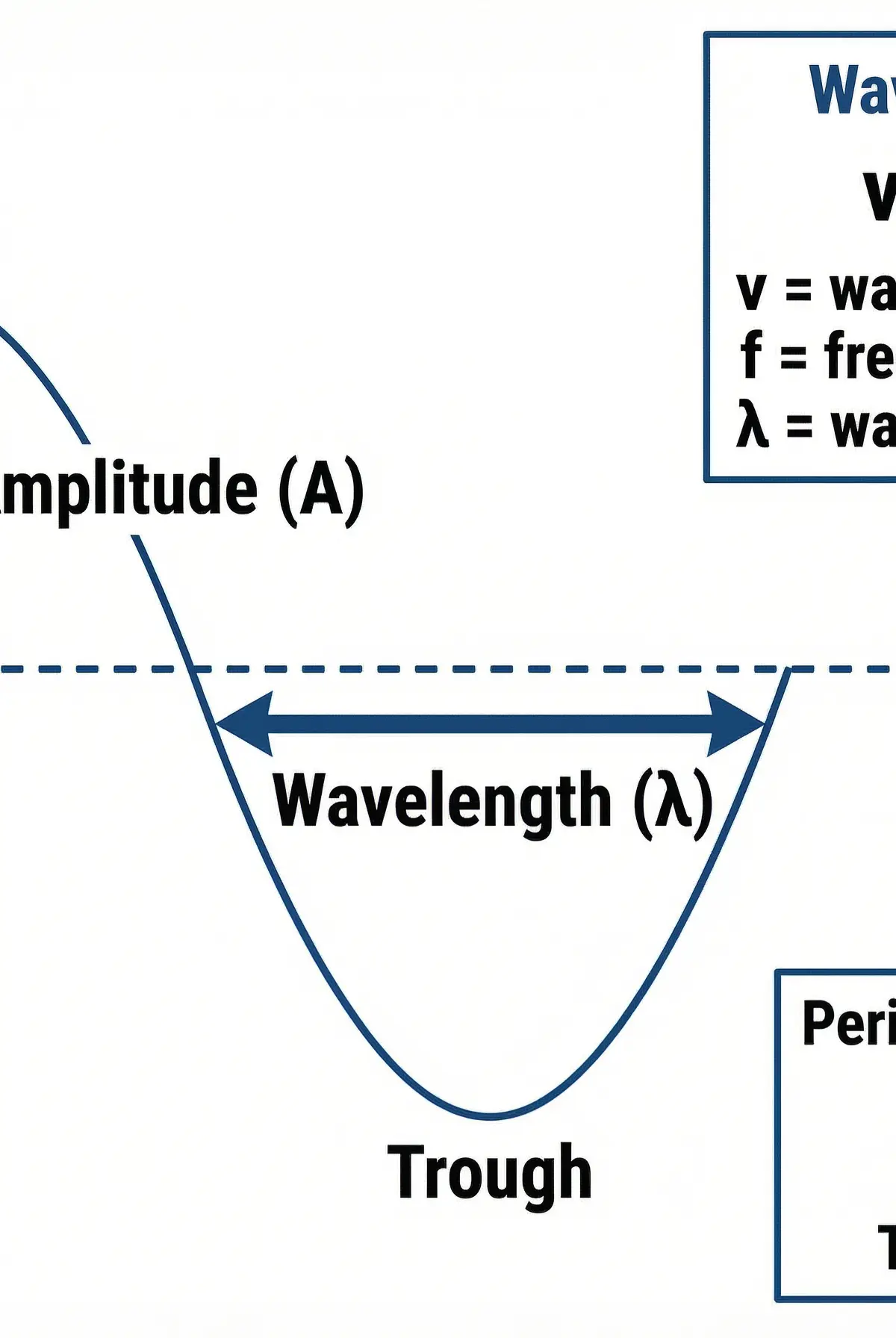
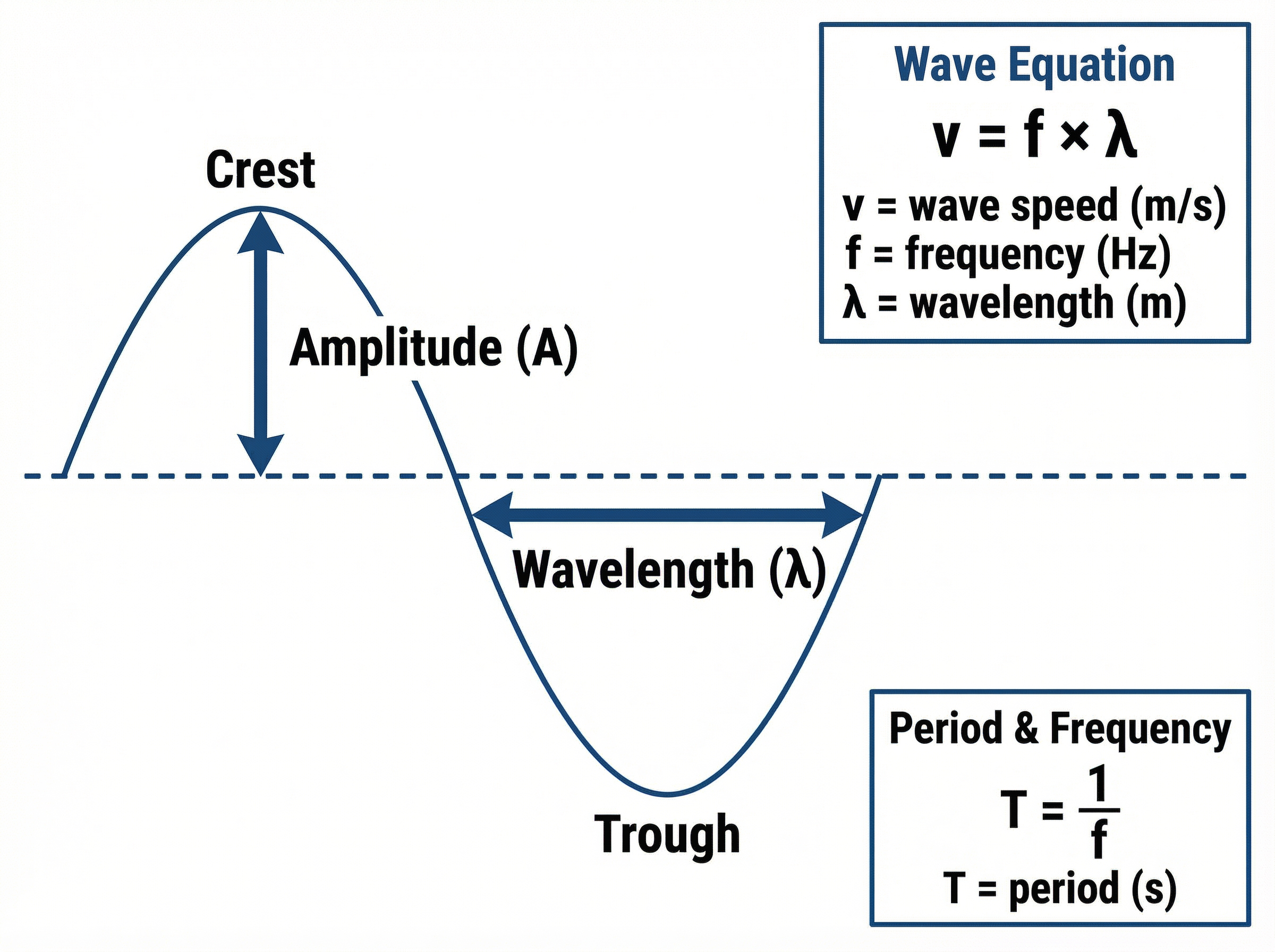
- Amplitude: The maximum displacement of a point on a wave away from its undisturbed (equilibrium) position.
- Wavelength (λ): The distance from a point on one wave to the equivalent point on the adjacent wave (e.g., crest to crest or compression to compression).
- Frequency (f): The number of complete waves passing a certain point each second. Measured in Hertz (Hz).
- Period (T): The time taken for one complete wave to pass a point. Measured in seconds (s).
Mathematical/Scientific Relationships
There are two crucial equations you must memorise and use for this topic:
1. The Wave Equation
v = f × λ
v= wave speed in metres per second (m/s)f= frequency in Hertz (Hz)λ= wavelength in metres (m)
Note: You must memorise this equation. It is the most frequently tested calculation in this topic.
2. Period and Frequency
T = 1 / f
T= period in seconds (s)f= frequency in Hertz (Hz)
Note: You must memorise this equation.
Practical Applications
Required Practical: Measuring Wave SpeedExaminers frequently ask about the practical methods for measuring the speed of sound in air or the speed of ripples on water surfaces.
- Ripple Tank: Used to measure the wavelength, frequency, and speed of water waves. A strobe light is often used to 'freeze' the waves to make measuring the wavelength easier.
- Speed of Sound: Often measured by two people standing a known distance apart (e.g., 100m). One person clashes wooden blocks; the other starts a stopwatch when they see the clash and stops it when they hear the sound.
Speed = Distance / Time.
Visual Resources
2 diagrams and illustrations
Interactive Diagrams
2 interactive diagrams to visualise key concepts
Conceptual Flow Outline
Classification of wave types and their properties.
Conceptual Flow Outline
The fundamental principle of wave energy transfer.
Worked Examples
3 worked examples — open one to explore the question and available guidance.
Practice Questions
Test your understanding — click to reveal model answers
A student watches a toy boat bobbing up and down on a pond as ripples pass it. The boat does not move towards the edge of the pond. Explain what this shows about the nature of water waves. (2 marks)
Hint: Think about the difference between what is moving and what is staying in place.
Sound waves in air travel at 330 m/s. A tuning fork produces a sound wave with a frequency of 256 Hz. Calculate the wavelength of the sound wave. Give your answer to 2 significant figures. (4 marks)
Hint: You need to rearrange the wave equation to make wavelength the subject.
Describe how you would use a ripple tank to measure the wavelength of water waves. (3 marks)
Hint: How can you make moving waves easier to measure? What equipment do you need?
State the difference between a compression and a rarefaction in a sound wave. (2 marks)
Hint: Think about the spacing of the air particles.
A wave has a frequency of 0.5 Hz. Calculate its time period. (2 marks)
Hint: Use the equation linking period and frequency.
Test your understanding of Waves
Active recall beats re-reading. Take an instant quiz now to test what you’ve learned and lock it into long-term memory.
7 days Premium · Then free forever · No card, no charge