AQA · GCSE · Physics
Course version: 8463 · Version from Sept 2016
Joule = 1 newton-metre Students should be able to describe the energy…
Full specification wording
Work done and energy transfer: 1 joule = 1 newton-metre Students should be able to describe the energy transfer involved when work is done.
One joule and one newton-metre are the same amount of energy, because multiplying newtons by metres is exactly what the work equation does.
Checked against the AQA 8463 specification (opens in a new tab) on .
- Point 4 of 6
- 4 key terms
Study notes
From the checked teaching notes for this specification point.
The idea
One joule and one newton-metre are the same amount of energy, because multiplying newtons by metres is exactly what the work equation does. Describing a transfer means naming both ends of it. Lifting a box: the chemical store in the muscles empties into the gravitational potential store of the box. Braking a car: the kinetic store of the car empties into the thermal store of the brakes and the surroundings. The pathway here is mechanical working (work done against friction), not heating. Stretching a spring: work done by the pulling force fills the elastic potential store. Examiners are strict here - friction on its own earns nothing, and neither does 'energy is lost'. The answer has to say work is done, name the stores, and where a temperature rises say that the internal energy has increased.
What earns the marks
- Stating that one joule is the work done when one newton moves through one metre.
- Naming the store the energy is transferred from.
- Naming the store the energy is transferred to, and the pathway, such as mechanical working against friction.
- Describing a temperature rise as an increase in the internal energy of the object.
Common mistakes and how to put them right
Answering friction alone, which mark schemes explicitly ignore.
Put it right: State that work is done against friction.
Writing that energy is lost instead of naming the store it was transferred to.
Treating the newton-metre as a different unit from the joule and converting with a factor.
Put it right: They are equivalent.
Naming heat as a store rather than internal energy.
Incorrectly identifying the pathway for friction as heating rather than mechanical working.
Exam tips
- Build the answer as one sentence with two stores in it: from this store to that store.
- If something gets warmer, say the internal energy increases; heat energy is not a store.
Try the lesson
The start of the Work done and energy transfer: 1 joule = 1 newton-metre Students should be able to describe the energy transfer involved when work is done. lesson, made from checked teaching notes for this specification point.
Have a go first
A student pushes a box with a constant force of 30 N along a rough horizontal floor at a steady speed for 4 m. Which energy transfer takes place?
Listen
One joule and one newton-metre are the same amount of energy, because multiplying newtons by metres is exactly what the work equation does. Describing a transfer means naming both ends of it. Lifting a box: the chemical store in the muscles empties into the gravitational potential store of the box. Braking a car: the kinetic store of the car empties into the thermal store of the brakes and the surroundings. The pathway here is mechanical working (work done against friction), not heating. Stretching a spring: work done by the pulling force fills the elastic potential store. Examiners are strict here - friction on its own earns nothing, and neither does 'energy is lost'. The answer has to say work is done, name the stores, and where a temperature rises say that the internal energy has increased. A strong answer earns marks for these points. stating that one joule is the work done when one newton moves through one metre. naming the store the energy is transferred from. naming the store the energy is transferred to, and the pathway, such as mechanical working against friction. describing a temperature rise as an increase in the internal energy of the object. A common slip: answering friction alone, which mark schemes explicitly ignore. Instead, state that work is done against friction. Exam tip: Build the answer as one sentence with two stores in it: from this store to that store.
See it

Key words
Say what each word means before you turn the card.
joule and newton-metre
Try answering aloud or in your head before turning the card.
energy transfer
Try answering aloud or in your head before turning the card.
named stores
Try answering aloud or in your head before turning the card.
internal energy
Try answering aloud or in your head before turning the card.
See every definition
- joule and newton-metre
- One joule and one newton-metre are the same amount of energy, because multiplying newtons by metres is exactly what the work equation does.
- energy transfer
- Describing a transfer means naming both ends of it, building the answer as one sentence with two stores in it.
- named stores
- The answer has to name the store the energy is transferred from and the store the energy is transferred to.
- internal energy
- Where a temperature rises, say that the internal energy has increased; heat energy is not a store.
Label the diagram
Some boxes have lost their names. Pick the right name for each number.
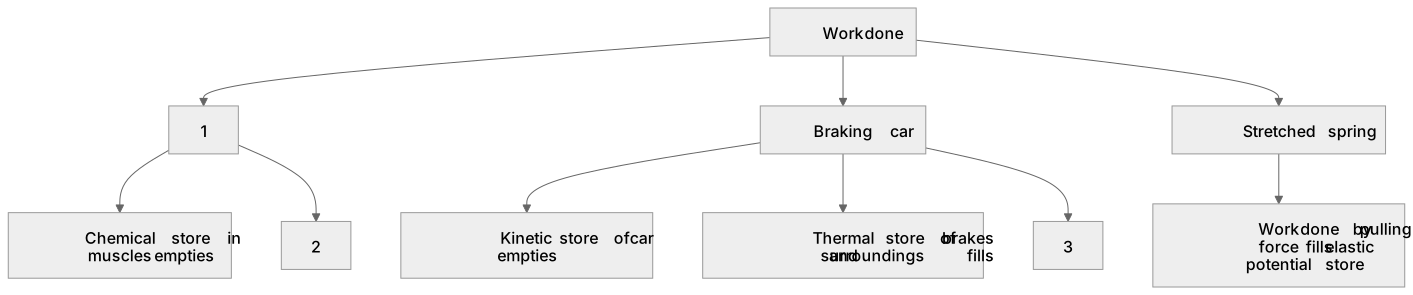
1Box 1
2Box 2
3Box 3
There is more to this lesson
The full lesson goes on to check your understanding and help you earn the marks. Create a free account to carry on, with your progress saved.
A week of Premium from your first lesson · Then the free plan continues · No card, no charge
Test your understanding of Work done and energy transfer: 1 joule = 1 newton-metre Students should be able to describe the energy transfer involved when work is done.
Active recall beats re-reading. Take an instant quiz now to test what you’ve learned and lock it into long-term memory.
A week of Premium from your first lesson · Then the free plan continues · No card, no charge