AQA · GCSE · Physics
Course version: 8463 · Version from Sept 2016
When a force causes an object to move through a distance work is done on…
Full specification wording
Work done and energy transfer: When a force causes an object to move through a distance work is done on the object.
Work is the name physics gives to energy transferred by a force.
Checked against the AQA 8463 specification (opens in a new tab) on .
- Point 1 of 6
Study notes
From the checked teaching notes for this specification point.
The idea
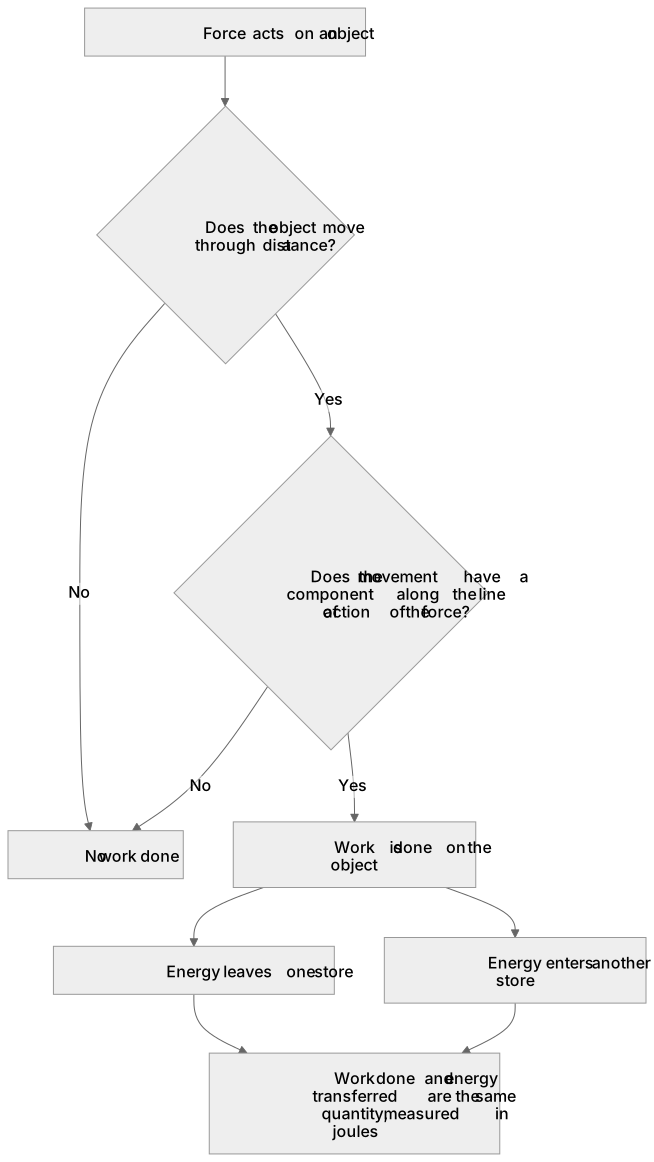
Work is the name physics gives to energy transferred by a force. A force on its own transfers nothing: a person holding a heavy box still, or pushing on a wall that will not move, does no work in the physics sense however tired they feel. The object has to move, and only the part of the movement along the line in which the force acts counts, so carrying a box horizontally at a steady height does no work against its weight. When work is done the energy comes out of one store and goes into another - chemical in a muscle or an engine into kinetic as a car speeds up, or into gravitational potential as a crate is lifted. Work done and energy transferred are the same quantity measured in joules, which is why the two phrases are interchangeable in mark schemes.
What earns the marks
- Stating that the force must move the object through a distance before any work is done.
- Using the distance moved along the line of action of the force, not the whole path.
- Naming the energy store the transfer comes from and the store it fills.
- Treating work done and energy transferred as the same quantity, measured in joules.
Common mistakes and how to put them right
Saying work is done while someone holds a heavy load still, when the load does not move.
Using the full path length where the force acts at right angles to part of the motion, such as the weight of a bag carried along a level floor.
Writing that the force makes energy rather than transferring it between stores.
Confusing work done with power by leaving a time in the answer.
Exam tips
- Check the object actually moves before writing that work is done; a stationary object means the answer is zero.
- Name the store that empties and the store that fills - examiners want the transfer named, not just the word energy.
Try the lesson
The start of the Work done and energy transfer: When a force causes an object to move through a distance work is done on the object. lesson, made from checked teaching notes for this specification point.
Have a go first
A force of 20 N pushes a box 3 m along a floor in the direction of the force. How much work is done on the box?
Listen
Work is the name physics gives to energy transferred by a force. A force on its own transfers nothing: a person holding a heavy box still, or pushing on a wall that will not move, does no work in the physics sense however tired they feel. The object has to move, and only the part of the movement along the line in which the force acts counts, so carrying a box horizontally at a steady height does no work against its weight. When work is done the energy comes out of one store and goes into another - chemical in a muscle or an engine into kinetic as a car speeds up, or into gravitational potential as a crate is lifted. Work done and energy transferred are the same quantity measured in joules, which is why the two phrases are interchangeable in mark schemes. A strong answer earns marks for these points. stating that the force must move the object through a distance before any work is done. using the distance moved along the line of action of the force, not the whole path. naming the energy store the transfer comes from and the store it fills. treating work done and energy transferred as the same quantity, measured in joules. Exam tip: Check the object actually moves before writing that work is done; a stationary object means the answer is zero.
See it
There is more to this lesson
The full lesson goes on to check your understanding and help you earn the marks. Create a free account to carry on, with your progress saved.
A week of Premium from your first lesson · Then the free plan continues · No card, no charge
Test your understanding of Work done and energy transfer: When a force causes an object to move through a distance work is done on the object.
Active recall beats re-reading. Take an instant quiz now to test what you’ve learned and lock it into long-term memory.
A week of Premium from your first lesson · Then the free plan continues · No card, no charge